


In industrial engineering, the selection of filtration media is a critical decision that impacts process efficiency, equipment longevity, and product purity. Among the various materials available, the stainless steel mesh filter net stands out as a versatile and robust solution for demanding environments. Unlike synthetic or paper-based media, stainless steel mesh offers a unique combination of mechanical strength, thermal stability, and chemical resistance. This article provides a technical overview of stainless steel mesh filtration, focusing on its construction, performance characteristics, and its application in the manufacturing of Wire Mesh Filter Cylinders & Tubes.
Understanding Stainless Steel Mesh Filter Net: Construction and Weave Types
The performance of a stainless steel mesh filter net is primarily determined by its weave pattern and the diameter of the wires used. Engineering teams must specify these parameters based on the particle size they intend to capture and the pressure conditions of the system.
Plain Weave
This is the most common and straightforward weave pattern. Each warp wire (running lengthwise) passes alternately over and under each weft wire (running crosswise). Plain weave mesh provides square openings and is typically used for coarse to medium filtration. It offers high flow rates and is easy to clean, making it suitable for applications where high permeability is prioritized over ultra-fine particle retention.
Twill Weave
In a twill weave, each warp wire passes over and under two weft wires. This allows for the use of heavier wires in a given mesh count, providing greater mechanical strength. Twill weave is often selected when the mesh needs to withstand higher pressure differentials or when a thicker filter medium is required for deep-bed filtration effects.
Dutch Weave (Plain and Twilled)
Dutch weaves utilize different diameters for warp and weft wires. Typically, the warp wires are heavier and spaced further apart, while the weft wires are finer and driven closely together. This results in a dense, wedge-shaped opening rather than a square one.
* Plain Dutch Weave: Offers high strength and is capable of filtering very fine particles while maintaining a relatively high flow rate.
* Twilled Dutch Weave: Combines the twill weave pattern with the Dutch weave wire configuration. This produces the finest filtration ratings available in wire mesh, often reaching down to the 5-10 micron range. It is the preferred choice for high-pressure hydraulic systems and critical fuel filtration.
Material Properties and Chemical Compatibility
The choice of alloy for a stainless steel mesh filter net is dictated by the chemical composition of the fluid and the operating temperature. While many grades exist, 304 and 316L are the industry standards.
Grade 304 Stainless Steel
Grade 304 is the general-purpose stainless steel for filtration. It offers excellent resistance to atmospheric corrosion and many organic and inorganic chemicals. It is widely used in food and beverage processing due to its sanitary properties and cost-effectiveness. However, it is susceptible to chloride-induced pitting, which limits its use in marine environments or highly acidic chemical processes.
Grade 316L Stainless Steel
Grade 316L contains molybdenum, which significantly enhances its resistance to pitting and crevice corrosion in chloride-rich environments. The "L" denotes low carbon content, which improves weldability and reduces the risk of sensitization—a common cause of corrosion near weld seams. This makes 316L the preferred material for pharmaceutical manufacturing, marine applications, and aggressive chemical processing.
High-Temperature Considerations
Stainless steel mesh maintains its structural integrity at temperatures far exceeding those of polymer filters. Depending on the alloy, these meshes can operate continuously at temperatures ranging from 400°C to 800°C. This thermal stability is essential for hot gas filtration and steam processing applications.
Engineering Wire Mesh into Filter Cylinders and Tubes
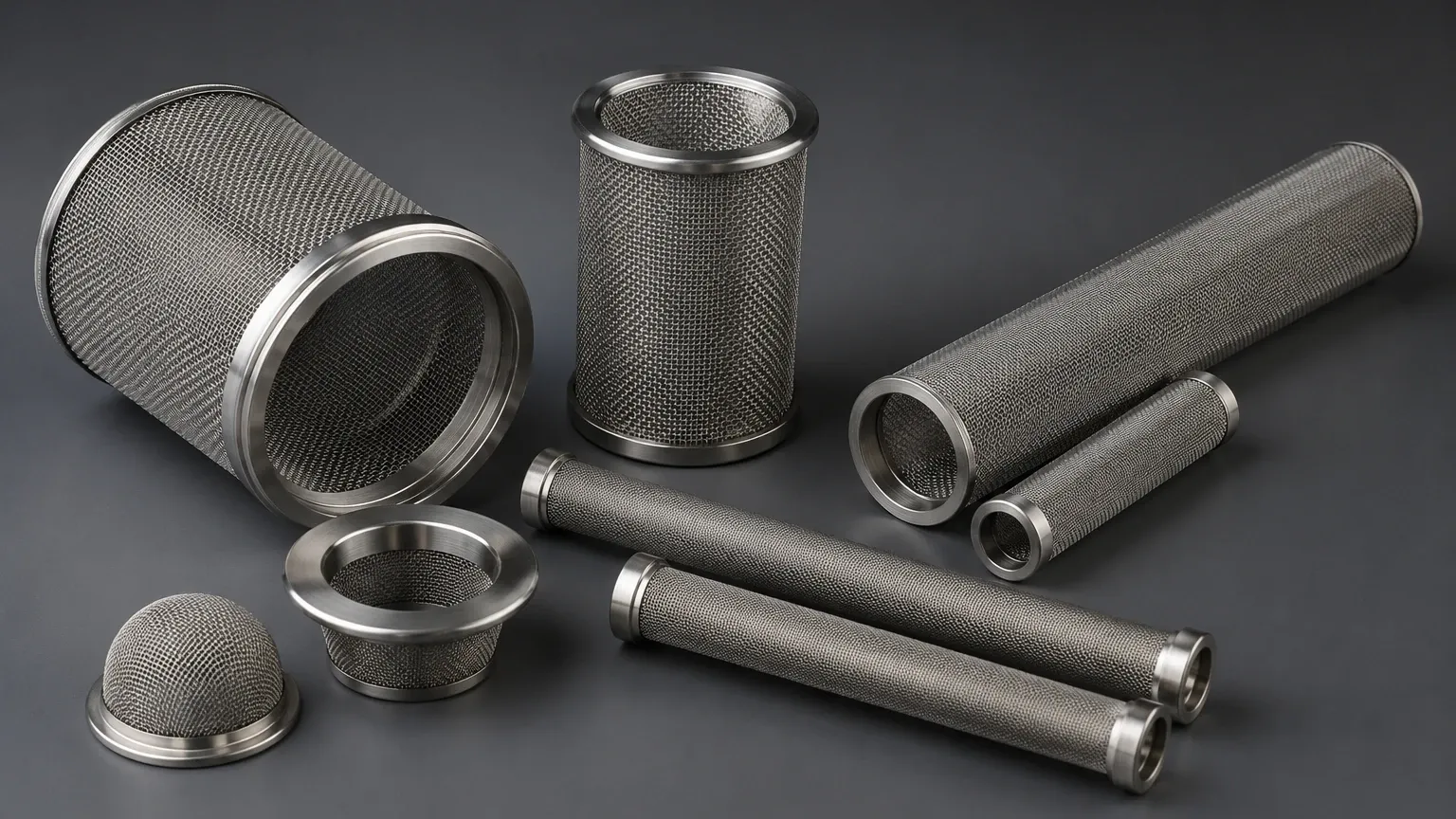
While the mesh itself is the primary filtration medium, it must be engineered into a structural component to be integrated into industrial machinery. This is where the transition from a flat stainless steel mesh filter net to Wire Mesh Filter Cylinders & Tubes occurs.
Structural Reinforcement
Fine mesh lacks the inherent rigidity to withstand high flow velocities or back-pressure. To solve this, engineers often use a multi-layer construction. A common configuration includes:
1. Filtration Layer: The specific micron-rated mesh.
2. Support Layer: A coarser mesh or perforated metal sheet that provides mechanical backing.
3. Protective Layer: An outer layer to protect the fine mesh from abrasion or handling damage.
Fabrication Techniques
The fabrication of filter cylinders involves precise cutting, rolling, and welding. Plasma welding and TIG (Tungsten Inert Gas) welding are standard because they provide clean, strong seams without introducing contaminants. For applications requiring extreme durability, vacuum brazing or sintering can be used to fuse multiple layers of mesh into a single, rigid porous plate before it is formed into a tube.
Pleating for Surface Area
To increase the Effective Filtration Area (EFA) within a fixed housing volume, the mesh can be pleated. Pleated cylinders offer significantly lower initial pressure drops and higher dirt-holding capacities compared to plain cylindrical designs. This design is particularly effective in hydraulic and lubrication systems where space is at a premium.
Performance Evaluation: Filtration Efficiency and Flow Dynamics
When selecting a stainless steel mesh filter net, engineers must evaluate performance based on three primary metrics: micron rating, pressure drop, and dirt-holding capacity.
Absolute vs. Nominal Micron Ratings
* Nominal Rating: An arbitrary value indicating the ability of the filter to retain the majority of particles of a specific size (usually 60% to 90%).
* Absolute Rating: The diameter of the largest hard spherical particle that will pass through the filter under specified test conditions. For wire mesh, the absolute rating is closely tied to the physical pore size of the weave.
Pressure Drop (Delta P)
The resistance to flow across the filter medium is known as the pressure drop. A high initial pressure drop reduces the available energy in the system and can lead to premature filter bypass. Stainless steel mesh is valued for its high porosity, which allows for high flow rates with minimal resistance. Factors influencing Delta P include the fluid viscosity, flow velocity, and the open area percentage of the mesh.
Dirt-Holding Capacity
This refers to the amount of contaminant the filter can retain before the pressure drop reaches a critical limit. While surface filters like wire mesh generally have lower dirt-holding capacity than depth filters, their ability to be cleaned and reused often offsets this limitation in closed-loop industrial systems.
Selection Criteria for Demanding Industrial Applications
Purchasing teams and engineers should confirm several technical details before finalizing a filter specification. The following checklist ensures that the selected stainless steel mesh filter net meets the application requirements:
1. Fluid Compatibility: Confirm that the alloy (304, 316L, or specialty alloys like Hastelloy) is resistant to the process fluid at operating temperatures.
2. Micron Requirement: Determine if the application requires absolute or nominal filtration. For protecting sensitive components like spray nozzles or high-pressure valves, absolute filtration is often necessary.
3. Operating Pressure and Differential Pressure: Ensure the structural design of the Wire Mesh Filter Cylinders & Tubes can withstand the maximum expected system pressure and the collapse pressure at the end of the filter's life cycle.
4. Flow Rate: Calculate the required surface area to maintain an acceptable clean pressure drop at maximum flow.
5. Connection Type: Specify the end fittings (e.g., NPT threads, flanges, or O-ring seals) to ensure a leak-proof installation in the filter housing.
Maintenance, Cleaning, and Life Cycle Management
One of the most significant advantages of using a stainless steel mesh filter net over disposable media is the ability to clean and reuse the component. This reduces the Total Cost of Ownership (TCO) and minimizes industrial waste.
Cleaning Methods
* Backwashing: Reversing the flow of the fluid to dislodge particles trapped on the surface of the mesh. This is often automated in continuous process systems.
* Ultrasonic Cleaning: Using high-frequency sound waves in a cleaning solvent to create cavitation bubbles. These bubbles reach deep into the mesh pores to remove fine particulates that backwashing might miss.
* Chemical Cleaning: Using acids, alkalis, or specialized detergents to dissolve organic or inorganic scaling. This must be done with careful consideration of the alloy's chemical resistance.
* Burn-off/Pyrolysis: For filters used in polymer or resin processing, heating the filter in a controlled atmosphere can carbonize organic contaminants, which are then removed by ultrasonic cleaning.
Determining Replacement Cycles
While stainless steel filters are durable, they are not infinite. Over time, repeated cleaning and mechanical stress can lead to work hardening of the wires or localized fatigue. Engineers should monitor the "clean pressure drop" after each cleaning cycle. If the clean pressure drop begins to rise steadily, it indicates that the mesh is becoming permanently blinded or damaged, signaling the need for replacement.
Conclusion
The stainless steel mesh filter net is a fundamental component in modern industrial filtration. Its ability to be engineered into various shapes, specifically Wire Mesh Filter Cylinders & Tubes, allows it to serve in applications ranging from simple strainers to high-precision pharmaceutical separators. By understanding the technical nuances of weave patterns, material grades, and structural reinforcement, engineering and procurement professionals can optimize their filtration processes for reliability, efficiency, and long-term cost savings.
