


Disc Filter Bank
In industrial filtration, scaling a process from a laboratory or pilot stage to full-scale production requires a significant increase in filtration surface area without compromising on precision or structural integrity. A disc filter bank represents a sophisticated engineering solution designed to meet these high-capacity demands. By configuring multiple Filter Discs & Packs in a parallel or series arrangement, engineers can achieve high flow rates, multi-stage particle separation, and system redundancy.
For technical professionals in chemical processing, water treatment, and hydraulic systems, understanding the nuances of a disc filter bank—from material selection to fluid dynamics—is essential for optimizing system performance and minimizing downtime. This article examines the technical specifications, engineering considerations, and operational advantages of utilizing a bank of filter discs in demanding industrial environments.
Understanding the Architecture of a Disc Filter Bank
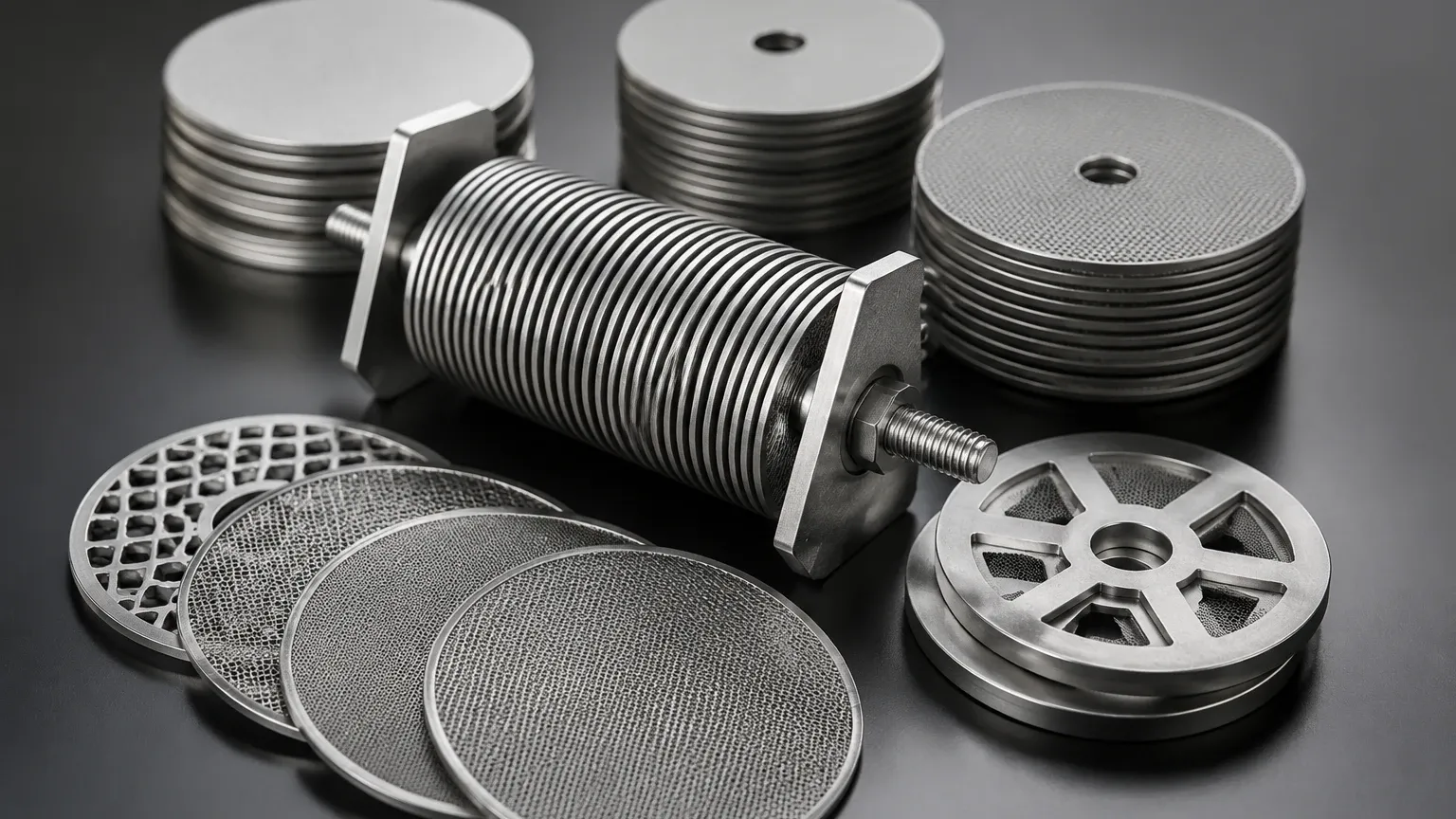
A disc filter bank is essentially a modular assembly where individual filtration units are grouped together within a single housing or across a manifold system. The core component of this assembly is the filter disc, which may consist of single or multi-layer wire mesh, often reinforced with perforated metal or sintered for added rigidity.
Parallel vs. Series Configurations
In most high-volume applications, a disc filter bank is arranged in a parallel configuration. This allows the total incoming flow to be distributed across multiple filter surfaces simultaneously. The primary advantage is a significant reduction in the face velocity of the fluid at each individual disc, which lowers the initial pressure drop and extends the time between cleaning cycles.
Conversely, a series configuration is employed when multi-stage filtration is required. In this setup, the fluid passes through a sequence of filter discs with progressively finer micron ratings. This "gradient filtration" approach is highly effective for fluids with a wide distribution of particle sizes, as it prevents the finest mesh layers from becoming prematurely blinded by larger debris.
Housing and Manifold Design
The efficiency of a disc filter bank is heavily dependent on the design of the manifold. Uneven flow distribution can lead to certain discs in the bank working harder than others, resulting in uneven wear and unpredictable pressure spikes. Precision engineering of the inlet and outlet headers ensures that the fluid velocity remains constant across all filtration points, maintaining the integrity of the process.
Material Engineering for High-Performance Filter Discs & Packs
The performance of a disc filter bank is only as reliable as the materials used in its construction. Since these systems often operate in corrosive or high-temperature environments, stainless steel is the industry standard.
Stainless Steel Grades
* Type 304: Suitable for general industrial applications where basic corrosion resistance is required.
* Type 316L: The preferred choice for chemical processing and pharmaceutical applications. The low carbon content and addition of molybdenum provide superior resistance to pitting and crevice corrosion, particularly in chloride-rich environments.
* Specialty Alloys: For extreme conditions, materials like Hastelloy or Inconel may be utilized to withstand highly acidic or high-heat processes.
Mesh Weave Types and Sintering
The filtration characteristics of the Filter Discs & Packs within the bank are determined by the weave of the wire mesh.
* Plain Weave: Offers a simple, straight-through flow path, ideal for high-flow, low-pressure applications.
* Dutch Weave: Provides a more tortuous path and higher mechanical strength, allowing for finer filtration ratings down to the sub-micron level.
* Sintered Mesh: To prevent wire migration and ensure pore size stability under high pressure, multiple layers of mesh are sintered together. This process uses heat and pressure to fuse the wires at their contact points without melting them, creating a robust, porous plate that can withstand repeated backwashing.
Key Performance Indicators in Industrial Filtration Banks
When evaluating a disc filter bank for a specific application, engineers must focus on several critical metrics that define the system's efficiency and total cost of ownership.
Effective Filtration Area (EFA)
The EFA is the total surface area of the mesh available for fluid passage. In a disc filter bank, the goal is to maximize the EFA within the smallest possible footprint. A higher EFA directly correlates to a lower flux (flow per unit area), which reduces the mechanical stress on the mesh and improves the retention of deformable particles.
Differential Pressure (ΔP)
Monitoring the pressure drop across the bank is the primary method for determining the state of the filter. A well-designed bank will have a low "clean" pressure drop. As contaminants accumulate, the ΔP increases. Engineering specifications must define the maximum allowable ΔP before the system triggers a backwash cycle or requires manual intervention to prevent structural failure of the discs.
Dirt Holding Capacity
This refers to the amount of contaminant the disc filter bank can retain before reaching the terminal pressure drop. Factors influencing this include the depth of the media (in multi-layer packs) and the pore geometry. For high-solids applications, selecting discs with a high dirt-holding capacity is vital to reducing the frequency of maintenance.
Selection Criteria for Engineering and Procurement Teams
Selecting the right components for a disc filter bank involves more than just matching a micron rating. Procurement teams and engineers should collaborate to confirm several technical details before finalizing a specification.
1. Fluid Compatibility: Beyond the base metal, consider the sealing materials (O-rings or gaskets) used to secure the discs within the bank. PTFE, Viton, or EPDM must be selected based on the chemical nature and temperature of the process fluid.
2. Micron Rating (Absolute vs. Nominal): Ensure the discs are rated appropriately for the task. An absolute rating implies that 99.9% of particles at that size will be retained, whereas a nominal rating is an average. For critical downstream equipment protection, absolute-rated Filter Discs & Packs are usually required.
3. Structural Support: In high-pressure systems, filter discs can bow or rupture if not properly supported. Confirm if the discs require internal support cores or external reinforcement rings to maintain their shape during pressure surges.
Maintenance Protocols and Service Life Optimization
A significant advantage of a stainless steel disc filter bank is its cleanability. Unlike disposable polymer cartridges, metal filter discs can be restored to near-original performance levels through various cleaning methods.
Backwashing and In-Situ Cleaning
Many automated disc filter banks utilize a backwash mechanism where a portion of the filtered fluid (or an external clean fluid) is forced through the discs in the reverse direction. This dislodges the filter cake and flushes it out through a drain valve. The success of backwashing depends on the strength of the mesh and the nature of the contaminants.
Ultrasonic and Chemical Cleaning
For stubborn contaminants like polymers, resins, or carbonized oils, the discs can be removed from the bank and subjected to ultrasonic cleaning or chemical baths. Ultrasonic waves create microscopic cavitation bubbles that implode on the surface of the mesh, reaching deep into the pores to remove particles that backwashing cannot.
Replacement Cycles
While stainless steel discs are durable, they are not infinite. Fatigue from pressure cycling and erosion from abrasive particles will eventually necessitate replacement. Establishing a baseline for "clean" pressure drop after each maintenance cycle helps in identifying when a disc has reached the end of its functional life.
Addressing Common Operational Risks
Even with high-quality components, operational challenges can arise in a disc filter bank system. Identifying these risks early allows for the implementation of preventative measures.
* Bypass Leakage: If the discs are not perfectly seated or if gaskets fail, unfiltered fluid can bypass the media. This is often detected by a sudden, unexplained drop in differential pressure or a decline in downstream fluid quality.
* Media Migration: In low-quality or non-sintered mesh, individual wires can break and enter the process stream. Using high-quality, sintered Filter Discs & Packs virtually eliminates this risk, which is critical in food, beverage, and pharmaceutical sectors.
* Caking and Channeling: If the flow rate is too low, solids may settle at the bottom of the housing rather than forming an even cake on the discs. Conversely, if the flow is too high, "channeling" can occur where the fluid forces its way through a small area of the mesh, leading to localized wear and reduced efficiency.
Conclusion
A disc filter bank is a powerful tool for industrial fluid management, offering a balance of high-volume throughput and precision filtration. By selecting the appropriate materials, such as 316L stainless steel, and carefully considering the configuration of the bank, engineers can ensure a reliable and cost-effective filtration process.
Whether the application involves protecting sensitive hydraulic components, refining chemical precursors, or ensuring the purity of water supplies, the integrity of the Filter Discs & Packs remains the foundation of the system. Through rigorous selection criteria and proactive maintenance, a disc filter bank provides a long-term solution for the most demanding industrial filtration challenges.
