


Disc Filter China
In the landscape of industrial filtration, the demand for precision, durability, and cost-effectiveness has led many global engineering firms and procurement departments to explore the manufacturing capabilities of the Chinese market. The term "disc filter china" represents a significant sector of the global supply chain, providing critical components for industries ranging from plastic extrusion and chemical processing to pharmaceutical manufacturing and food production. For technical professionals, selecting the right Filter Discs & Packs requires a deep understanding of material science, weave types, and the manufacturing nuances that differentiate a standard component from a high-performance filtration solution.
Stainless steel filter discs and multi-layer packs are engineered to remove contaminants from liquid or gaseous streams under varying pressures and temperatures. Unlike disposable synthetic filters, these metal components offer superior mechanical strength and the ability to be cleaned and reused, making them a sustainable choice for demanding industrial environments. This guide examines the technical considerations, material specifications, and evaluation criteria essential for sourcing high-quality filtration components from specialized manufacturers.
Technical Construction of Filter Discs & Packs
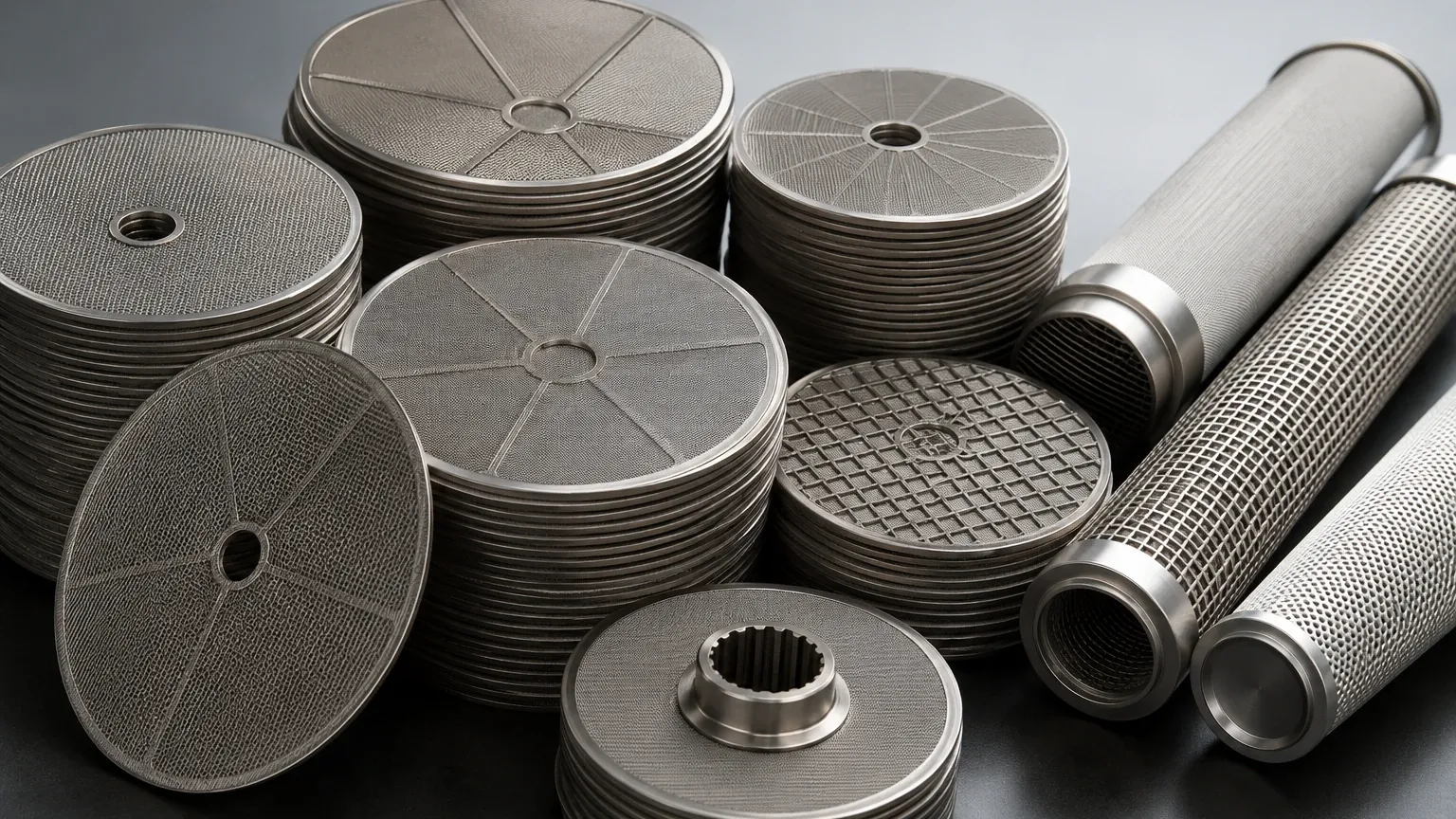
Industrial filter discs are typically fabricated from stainless steel wire mesh, though other alloys like Monel or Inconel may be used for specific high-temperature or highly corrosive applications. The construction of these filters can be categorized into two primary forms: single-layer discs and multi-layer packs.
Single-Layer Filter Discs
Single-layer discs are often used in applications where the pressure differential is relatively low and the filtration requirements are straightforward. These are precisely cut using laser, plasma, or mechanical die-cutting methods to ensure dimensional accuracy. They are commonly found in simple strainers or as support layers for finer mesh.
Multi-Layer Filter Packs
For more complex filtration tasks, such as those found in polymer melt filtration or high-pressure hydraulic systems, multi-layer Filter Discs & Packs are the industry standard. These packs consist of several layers of wire mesh with varying micron ratings. A typical configuration includes:
1. Filtration Layer: The core mesh that determines the micron rating and particle retention efficiency.
2. Support Layers: Coarser mesh layers placed on either side of the filtration layer to provide mechanical rigidity and prevent the fine mesh from deforming under pressure.
3. Drainage Layers: These facilitate the flow of the filtrate across the surface of the disc, reducing the pressure drop across the assembly.
These layers are often spot-welded together or bound by a metal rim (usually aluminum, stainless steel, or copper) to form a cohesive unit that can withstand the rigors of industrial processing.
Material Selection and Chemical Compatibility
The performance of a disc filter sourced from China is heavily dependent on the grade of stainless steel utilized. Engineers must specify the material based on the chemical composition of the fluid being filtered and the operating temperature.
* AISI 304: The most common grade, offering good corrosion resistance and mechanical properties. It is suitable for water treatment, food processing, and general industrial use where highly acidic or alkaline conditions are not present.
* AISI 316L: Containing molybdenum, 316L provides enhanced resistance to chlorides and pitting corrosion. It is the preferred choice for marine environments, pharmaceutical manufacturing, and chemical processing where high purity and corrosion resistance are non-negotiable.
* Specialty Alloys: In extreme cases involving high-temperature oxidation or aggressive chemical catalysts, manufacturers may utilize Hastelloy or Duplex stainless steels. These materials ensure the structural integrity of the filter disc over long-term exposure to harsh environments.
Understanding Mesh Weave Types
The geometry of the wire mesh weave determines the filtration characteristics, including the flow rate, dirt-holding capacity, and the shape of the particles that can be captured. When evaluating a "disc filter china" supplier, it is crucial to understand which weave type suits the application:
Plain Weave
This is the simplest weave where each warp wire crosses over and under each weft wire. It provides a consistent pore size and is easy to clean, making it ideal for general-purpose filtration.
Twill Weave
In a twill weave, each warp wire passes over and under two weft wires. This allows for the use of heavier wires in a given mesh count, resulting in a more robust mesh that can handle higher mechanical loads.
Dutch Weave (Plain and Twill)
Dutch weaves utilize a combination of different wire diameters for the warp and weft. This creates a dense, multi-layered structure within a single weave. Plain Dutch weaves offer high flow rates with relatively fine filtration, while Twill Dutch weaves provide the highest level of filtration accuracy and are capable of capturing particles in the sub-20 micron range.
Evaluating Manufacturing Capabilities in China
Sourcing from a manufacturer in China requires more than just comparing price points. Technical buyers must evaluate the factory’s ability to maintain tight tolerances and ensure material purity. High-quality production involves several critical steps:
1. Precision Cutting: Using CNC laser cutting or high-precision dies to ensure the discs fit perfectly into the housing or extruder without bypass leaks.
2. Welding Integrity: For multi-layer packs, spot welding must be precise to avoid damaging the fine filtration mesh while ensuring the layers do not separate under pressure.
3. Ultrasonic Cleaning: Post-production cleaning is vital to remove residual oils, metal fragments, or atmospheric dust. This is particularly important for pharmaceutical and food-grade applications.
4. Material Certification: Reliable suppliers provide Mill Test Reports (MTRs) to verify the chemical composition of the stainless steel, ensuring it meets ASTM or ISO standards.
Applications of Filter Discs & Packs
The versatility of these components allows them to be deployed across a wide range of industrial sectors. Understanding these applications helps in specifying the correct design parameters.
Polymer and Plastic Extrusion
In the plastics industry, filter packs (often called screen packs) are used to remove unmelted resin and contaminants from the polymer melt. This prevents defects in the final product, such as film breakage or surface irregularities. The filters must withstand high temperatures (up to 300°C) and extreme pressures.
Chemical and Petrochemical Processing
Filter discs are used to protect sensitive downstream equipment, such as pumps and valves, from particulate matter. They are also used in catalyst recovery processes where the durability of stainless steel is required to withstand aggressive solvents.
Pharmaceutical and Biotechnology
In these sectors, filtration accuracy and cleanliness are paramount. Sintered or multi-layer discs are used in chromatography, gas filtration, and sterile processing. The use of 316L stainless steel ensures that the filtration process does not introduce metallic contaminants into the product stream.
Food and Beverage
From filtering cooking oils to clarifying syrups and beverages, stainless steel discs provide a hygienic filtration solution. They are resistant to the CIP (Clean-in-Place) chemicals used in food production facilities, allowing for frequent sterilization without degradation.
Selection Criteria for Engineers
When specifying Filter Discs & Packs, engineers should provide the manufacturer with a detailed set of requirements to ensure optimal performance. Key data points include:
* Micron Rating: Define whether absolute or nominal filtration is required. Absolute filtration ensures that 100% of particles above a certain size are captured, whereas nominal filtration refers to a percentage efficiency.
* Operating Pressure and Delta P: The maximum pressure the filter will encounter and the maximum allowable pressure drop before the filter must be cleaned or replaced.
* Flow Rate: The volume of fluid passing through the filter per unit of time, which influences the required surface area of the disc.
* Housing Dimensions: The internal diameter and depth of the filter housing to ensure a proper seal and prevent fluid bypass.
* Environmental Factors: Temperature fluctuations, potential for mechanical vibration, and exposure to corrosive agents.
Quality Control and Performance Testing
To ensure the reliability of a "disc filter china" shipment, several testing protocols can be implemented. The Bubble Point Test is a common method used to verify the pore size and integrity of the filter. By submerging the filter in a liquid and measuring the pressure required to force air through the pores, technicians can determine the largest pore size and check for manufacturing defects like gaps in welds or broken wires.
Furthermore, mechanical strength tests ensure that the disc will not collapse or distort under the expected operating pressure. For high-purity applications, spectrographic analysis may be performed to confirm the grade of the stainless steel and the absence of unwanted trace elements.
Total Cost of Ownership and Sustainability
While the initial purchase price is a factor, the total cost of ownership (TCO) is a more accurate metric for industrial filtration. Stainless steel filter discs offer a lower TCO compared to disposable filters because they can be cleaned using ultrasonic baths, chemical solvents, or back-flushing techniques. This longevity reduces waste and the frequency of procurement cycles.
When sourcing from China, logistics and lead times must also be factored into the TCO. Working with a manufacturer that understands global shipping standards and maintains consistent lead times is essential for maintaining lean inventory levels and avoiding downtime in production facilities.
Conclusion
Sourcing high-quality Filter Discs & Packs from China requires a technical approach that prioritizes material integrity, weave precision, and manufacturing excellence. By understanding the specific needs of the application—from micron ratings to chemical compatibility—engineers can leverage the advanced production capabilities available in the Chinese market to achieve superior filtration performance. Whether for simple liquid straining or complex polymer extrusion, the right stainless steel filtration component is a critical investment in the efficiency and reliability of industrial processes.
