


Filter Disc Duran
In the specialized field of industrial and laboratory filtration, the term "filter disc duran" refers to a specific category of high-performance filtration components typically manufactured from borosilicate glass 3.3. These discs are engineered for applications requiring exceptional chemical resistance, thermal stability, and precise porosity. While Duran glass discs are the standard for laboratory-scale vacuum filtration and analytical chemistry, industrial-scale operations often require a transition from these glass components to more robust metal-based Filter Discs & Packs to handle higher pressures, mechanical stresses, and larger flow volumes.
Understanding the technical specifications of a filter disc duran—and knowing when to specify a stainless steel alternative—is critical for engineers and procurement teams in the chemical processing, pharmaceutical, and biotechnology sectors. This guide examines the properties of borosilicate filtration media, compares them with industrial metal filtration solutions, and provides a framework for selecting the appropriate filtration component based on operational demands.
Technical Specifications of Borosilicate Filter Discs
A filter disc duran is primarily characterized by its material composition: borosilicate glass 3.3. This material is renowned for its low coefficient of thermal expansion, which provides high resistance to thermal shock. In filtration, these discs are produced by sintering glass particles of controlled sizes to create a porous structure.
Porosity Grades and Pore Size
Glass filter discs are classified according to their porosity, typically following international standards such as ISO 4793. The porosity grade determines the nominal maximum pore size, which dictates the size of the particles the disc can effectively retain:
* Grade 00 (P 500): 250–500 µm – Used for coarse gas filtration and support for other media.
* Grade 0 (P 250): 160–250 µm – Suitable for coarse filtration and gas distribution.
* Grade 1 (P 160): 100–160 µm – Used for coarse filtration and liquid collection.
* Grade 2 (P 100): 40–100 µm – Common for medium-fine filtration and crystalline precipitates.
* Grade 3 (P 40): 16–40 µm – Standard for analytical filtration and fine precipitates.
* Grade 4 (P 16): 10–16 µm – Used for very fine analytical work and bacterial filtration support.
* Grade 5 (P 1.6): 1.0–1.6 µm – Ultrafine filtration for sterile applications.
Chemical and Thermal Resistance
The primary advantage of the filter disc duran is its near-universal chemical compatibility. Borosilicate glass is highly resistant to water, neutral and acid solutions, concentrated acids and their mixtures, as well as to chlorine, bromine, iodine, and organic substances. Only hydrofluoric acid, very hot phosphoric acid, and strong alkaline solutions (at high temperatures) significantly attack the glass surface.
Thermally, these discs can withstand temperatures up to 450°C, although the rate of heating and cooling must be carefully controlled to prevent mechanical stress. In laboratory settings, they are often used in Gooch crucibles or Buchner funnels for gravimetric analysis.
Limitations of Glass in Industrial Environments
While the filter disc duran is an excellent tool for bench-top research and small-batch chemical processing, it faces significant limitations when scaled to industrial production. Engineers must account for these factors when designing systems for continuous operation or high-throughput environments.
Fragility and Mechanical Strength
Glass is inherently brittle. In an industrial setting where vibrations, mechanical shocks, or rapid pressure fluctuations occur, glass filter discs are prone to cracking or catastrophic failure. Unlike metal Filter Discs & Packs, glass cannot be easily integrated into high-pressure housings without specialized, often expensive, sealing and support structures.
Pressure Constraints
Borosilicate filter discs are primarily designed for vacuum filtration or low-pressure gravity filtration. They generally cannot withstand the high differential pressures (ΔP) common in industrial hydraulic systems or high-viscosity polymer filtration. Exceeding the recommended pressure limits for a glass disc can lead to media migration, where glass particles contaminate the filtrate, or structural collapse of the disc.
Scale and Customization
Manufacturing large-diameter glass filter discs is technically challenging and increases the risk of internal stresses. For industrial applications requiring large surface areas or complex geometries, metal filtration components offer significantly more flexibility in design and implementation.
The Industrial Alternative: Stainless Steel Filter Discs & Packs
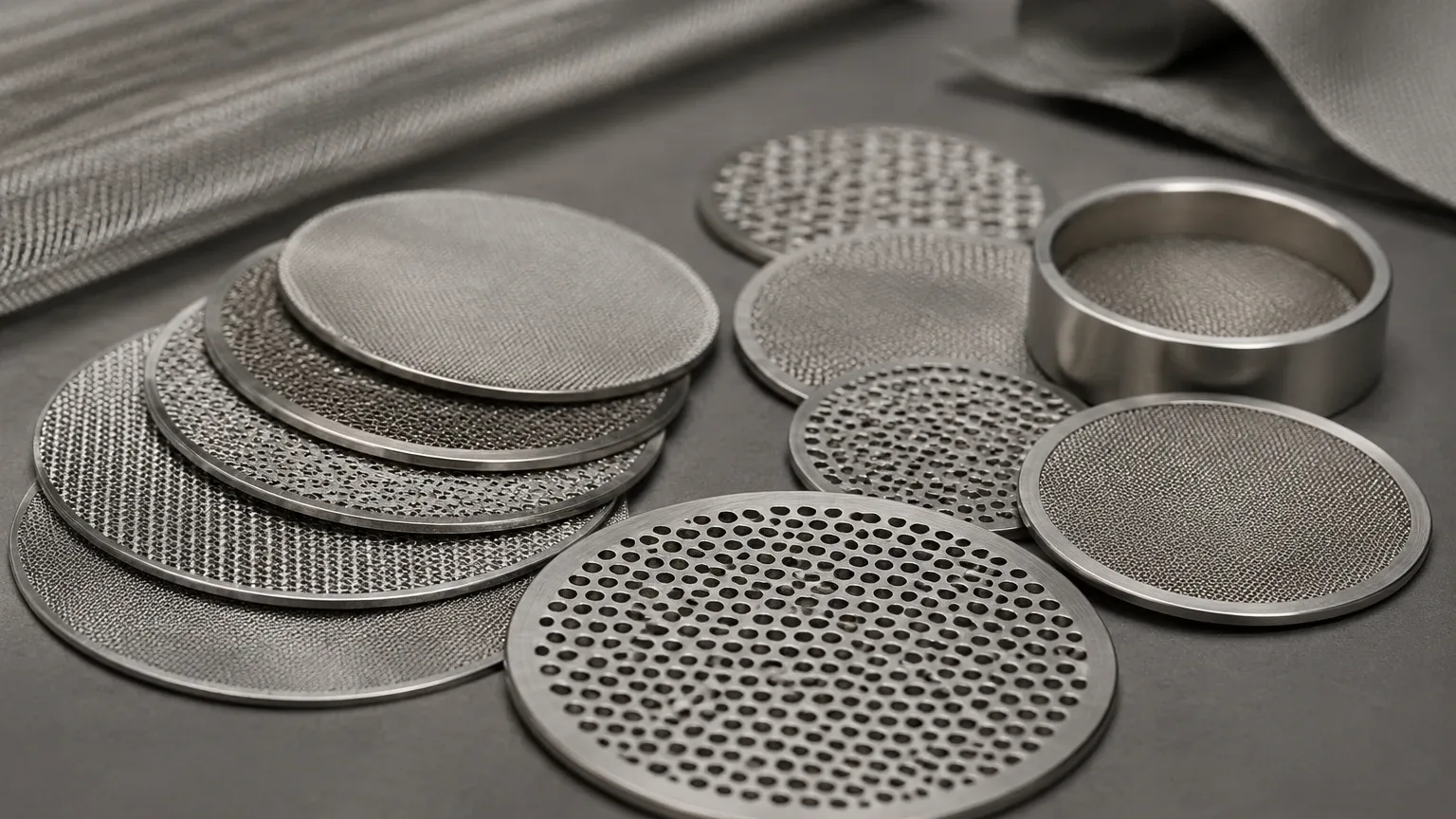
For applications that exceed the capabilities of a filter disc duran, stainless steel Filter Discs & Packs serve as the industrial-grade equivalent. These components utilize woven wire mesh or sintered metal fibers to achieve precise filtration while providing the mechanical integrity required for demanding environments.
Material Selection: 316L vs. Borosilicate
While borosilicate glass offers superior resistance to certain concentrated acids, stainless steel (specifically Grade 316L) provides excellent corrosion resistance for the majority of industrial applications, including food and beverage, pharmaceutical, and water treatment. For extreme chemical environments where even 316L may fail, specialized alloys like Hastelloy® or Monel® can be used in metal filter disc construction, offering a bridge between the chemical inertness of glass and the strength of metal.
Structural Advantages of Metal Discs
Industrial metal filter discs offer several structural advantages over their glass counterparts:
1. Multi-Layer Construction: Metal discs can be fabricated as "packs," consisting of multiple layers of wire mesh with varying micron ratings. This allows for depth filtration, where coarser outer layers protect the fine inner filtration layer, significantly extending the service life.
2. Pleatability: Unlike glass, metal mesh can be pleated to increase the effective filtration area within the same footprint, allowing for higher flow rates and lower pressure drops.
3. Cleanability: Stainless steel discs are highly durable and can be cleaned using ultrasonic baths, backwashing, or chemical solvents, making them reusable over many cycles.
4. Edge Sealing: Metal discs can be finished with various edging techniques, including spot welding, aluminum or stainless steel binding, or resin encapsulation, ensuring a leak-proof fit in the filter housing.
Engineering Considerations for Industrial Filtration
When transitioning from a laboratory filter disc duran to an industrial filtration solution, engineers must evaluate several performance metrics to ensure process efficiency and product purity.
Micron Rating and Filtration Efficiency
In industrial filtration, the micron rating is defined as either "absolute" or "nominal." An absolute rating indicates that the filter will retain 99.9% of particles at that size, whereas a nominal rating indicates a lower percentage (typically 60-90%). While glass discs are often categorized by broad porosity grades, metal Filter Discs & Packs can be manufactured to precise absolute micron ratings, ranging from 1 µm to 2000 µm, providing more predictable performance for critical processes.
Flow Rate and Differential Pressure
The flow rate through a filter disc is a function of the pore size, the open area of the media, and the viscosity of the fluid. Metal wire mesh typically offers a higher percentage of open area compared to sintered glass, resulting in lower initial differential pressure. This efficiency is vital in high-volume production where energy consumption for pumps is a significant cost factor.
Temperature and Thermal Cycling
While borosilicate glass handles high temperatures well, it is sensitive to rapid thermal cycling. Stainless steel filter discs are much more resilient to "thermal shock," making them suitable for processes that involve steam-in-place (SIP) sterilization or rapid heating and cooling cycles common in chemical synthesis.
Customization and OEM Solutions in Filtration
One of the primary reasons engineers move toward metal filtration components is the ability to customize the product to the specific geometry of their equipment. Manufacturers like Kaifil specialize in developing tailored Filter Discs & Packs that meet exact engineering specifications.
Design Flexibility
Customization options for industrial filter discs include:
* Shape and Size: From standard circular discs to oval, rectangular, or ring-shaped components.
* Layer Configuration: Combining different mesh weaves (e.g., plain weave, dutch weave) to optimize for both flow and strength.
* Reinforcement: Adding perforated metal plates or coarse mesh layers to provide structural support for high-pressure applications.
* Material Certification: Providing full traceability for materials, which is essential for pharmaceutical and food-grade applications (FDA/USP Class VI compliance).
Prototyping and Scalability
For engineers developing new processes, the ability to prototype filter designs is essential. Unlike the standardized sizes of a filter disc duran, metal discs can be produced in small batches for pilot testing and then scaled up to high-volume production without changing the filtration characteristics. This ensures that the results achieved in the lab are replicable at the industrial scale.
Selection Criteria: Glass vs. Metal
To determine whether a filter disc duran or a stainless steel filter disc is appropriate for a specific application, consider the following checklist:
1. Operating Pressure: If the process involves pressures above 1 bar (14.5 psi) or significant pressure spikes, stainless steel is required.
2. Chemical Environment: For highly concentrated hot acids (other than HF), borosilicate glass may be superior. For most other industrial chemicals, 316L stainless steel or specialized alloys are sufficient.
3. Mechanical Stress: If the filter is part of a system with moving parts, vibration, or potential for impact, glass should be avoided.
4. Sterilization Requirements: Both materials can be autoclaved, but stainless steel is better suited for repeated SIP cycles.
5. Batch vs. Continuous: Glass is excellent for discrete laboratory batches; metal is preferred for continuous industrial streams due to its durability and cleanability.
6. Filtrate Purity: If there is a risk of glass shedding (media migration) in a high-flow environment, metal mesh or sintered metal fiber is a safer choice.
Maintenance and Total Cost of Ownership (TCO)
When evaluating the cost of filtration components, it is important to look beyond the initial purchase price and consider the Total Cost of Ownership (TCO). A filter disc duran is often treated as a semi-consumable in the lab due to its fragility. In contrast, an industrial stainless steel filter disc is an investment in long-term operational stability.
Cleaning and Reusability
Metal filters can be cleaned and reused multiple times, provided the cleaning protocol does not damage the mesh structure. Common methods include:
* Backwashing: Reversing the flow of the fluid to dislodge particles from the surface.
* Ultrasonic Cleaning: Using high-frequency sound waves in a solvent bath to remove fine particles trapped deep within the mesh layers.
* Chemical Cleaning: Using acids or alkalis to dissolve organic or inorganic fouling, followed by thorough rinsing.
Replacement Cycles
The replacement cycle for a filter disc is determined by the "terminal differential pressure"—the point at which the filter is so clogged that the system can no longer maintain the required flow rate. Because metal Filter Discs & Packs can be engineered with greater dirt-holding capacity, they typically offer longer intervals between maintenance shutdowns compared to single-layer glass discs.
Conclusion
The choice between a filter disc duran and an industrial metal filter depends entirely on the scale and rigor of the application. While borosilicate glass remains the gold standard for laboratory precision and extreme acid resistance, the demands of modern industrial processing require the strength, versatility, and scalability of stainless steel filtration solutions. By understanding the technical boundaries of each material, engineers can optimize their filtration processes for maximum efficiency, safety, and cost-effectiveness. For those transitioning from lab-scale to industrial production, consulting with a manufacturer experienced in custom metal filtration is the most effective way to ensure that the chosen Filter Discs & Packs meet the specific needs of the application.
