


Coffee Filter Paper Discs
In the industrial food and beverage sector, the precision of filtration directly impacts the sensory profile, clarity, and shelf stability of the final product. Coffee filter paper discs are foundational components in both commercial brewing equipment and laboratory testing environments. While often perceived as simple consumables, the engineering behind these discs involves complex fluid dynamics and material science. For engineers and procurement teams, selecting the right filtration medium—whether it is a disposable paper disc or a permanent stainless steel alternative—requires a deep understanding of flow rates, retention efficiency, and mechanical durability.
Industrial applications for coffee filter paper discs extend beyond the standard cafe environment. They are utilized in pilot plants for flavor extraction, large-scale cold brew production, and quality control labs where consistent sediment removal is critical for chemical analysis. This article examines the technical specifications of paper filtration media, compares them with high-performance metal solutions, and provides a framework for selecting the optimal filter discs for industrial processing.
Technical Fundamentals of Paper Filtration Media
Coffee filter paper discs are typically manufactured from high-quality cellulose fibers, often sourced from softwoods or hardwoods depending on the desired porosity. The manufacturing process, known as wet-laying, creates a non-woven matrix of fibers that acts as a depth filter. Unlike surface filters, which trap particles only on the top layer, depth filters capture contaminants throughout the thickness of the material.
Pore Size and Retention Efficiency
The "pore size" of a paper disc is not a single uniform measurement but rather a distribution. In B2B applications, engineers look for the nominal micron rating, which indicates the ability of the filter to retain a specific percentage of particles of a certain size. For coffee filtration, this typically ranges from 10 to 20 microns. Finer fibers and higher density result in higher retention but lower flow rates. Conversely, a coarser matrix allows for faster throughput but may permit "fines" (microscopic coffee particles) to pass through, affecting the clarity of the extract.
Wet Strength and Burst Resistance
A critical engineering consideration is the wet strength of the paper. When saturated, cellulose fibers naturally lose a significant portion of their structural integrity. To counteract this, industrial-grade coffee filter paper discs are treated with wet-strength agents—resins that are food-safe and FDA-compliant—to ensure the disc does not rupture under the pressure of a commercial pump or the weight of a large slurry. Burst resistance is measured in kilopascals (kPa) and is a key metric for high-pressure extraction systems.
Comparing Paper Discs with Stainless Steel Filter Discs
While paper is the traditional choice for many brewing applications, industrial facilities often evaluate the transition to or the integration of Filter Discs & Packs made from stainless steel wire mesh. The choice between paper and metal depends on the specific goals of the filtration process.
1. Filtration Profile and Oil Retention
Paper is highly effective at absorbing diterpenes (such as cafestol and kahweol), which are natural oils found in coffee. For applications where a "clean" cup profile and reduced oil content are required, paper is the preferred medium. Stainless steel filter discs, however, allow these oils to pass through, resulting in a fuller body and different flavor profile. In industrial flavor extraction, the choice of material is often dictated by the desired chemical composition of the final concentrate.
2. Operational Costs and Sustainability
Paper discs are single-use consumables. While the individual unit cost is low, the cumulative expense in a high-volume industrial facility can be significant. Furthermore, the environmental impact of disposing of tons of spent paper and coffee grounds is a growing concern for corporate sustainability initiatives. Stainless steel discs represent a higher initial capital expenditure but offer a lifespan of several years, significantly reducing the total cost of ownership (TCO) over time.
3. Mechanical Integrity
In high-pressure industrial extractors, paper discs are prone to "edge bypass" if the sealing mechanism is not perfect. Metal filter discs can be manufactured with precision-machined edges or integrated gaskets to ensure a 100% seal. This is particularly important in pharmaceutical-grade extractions where bypass is unacceptable.
Engineering Considerations for Industrial Selection
When specifying coffee filter paper discs for a new processing line or laboratory setup, engineers must confirm several technical parameters to ensure system compatibility and performance.
Diameter and Dimensional Tolerance
Industrial housings require exact fits. A disc that is even 1mm too small can lead to bypass, while a disc that is too large may wrinkle, creating channels through which unfiltered liquid can flow. Custom manufacturing allows for the production of discs in non-standard diameters, ranging from small 20mm lab discs to large 1000mm industrial plates.
Basis Weight and Thickness
Basis weight, measured in grams per square meter (gsm), correlates with the thickness and density of the paper. Heavier papers (e.g., 80-100 gsm) provide better retention and higher burst strength but require more pressure to maintain flow. Lighter papers (e.g., 40-60 gsm) are suitable for gravity-fed systems or applications where high flow rates are prioritized over absolute clarity.
Surface Texture: Crepe vs. Smooth
* Creped Paper: The surface is micro-pleated during the drying process. This increases the effective surface area, allowing for higher dirt-holding capacity and preventing the premature "blinding" (clogging) of the filter by fine particles.
* Smooth Paper: Provides a more uniform pore structure and is often used in laboratory settings where precise analytical results are required.
Common Risks in Industrial Filtration
Failure to properly specify or maintain filtration components can lead to several operational risks:
1. Blinding (Clogging): If the particle size distribution of the coffee grind is too fine for the selected paper grade, the disc will clog rapidly, leading to pressure spikes and potential equipment damage.
2. Chemical Leaching: In B2B environments, it is essential to ensure that the paper is free from bleaching agents (like chlorine) that could leach into the product and alter the flavor or violate food safety standards. Oxygen-bleached or unbleached papers are the industry standard.
3. Flow Inconsistency: Variations in paper density between batches can lead to inconsistent extraction times, which is detrimental to automated processes that rely on precise timing.
The Role of Hybrid Filtration Systems
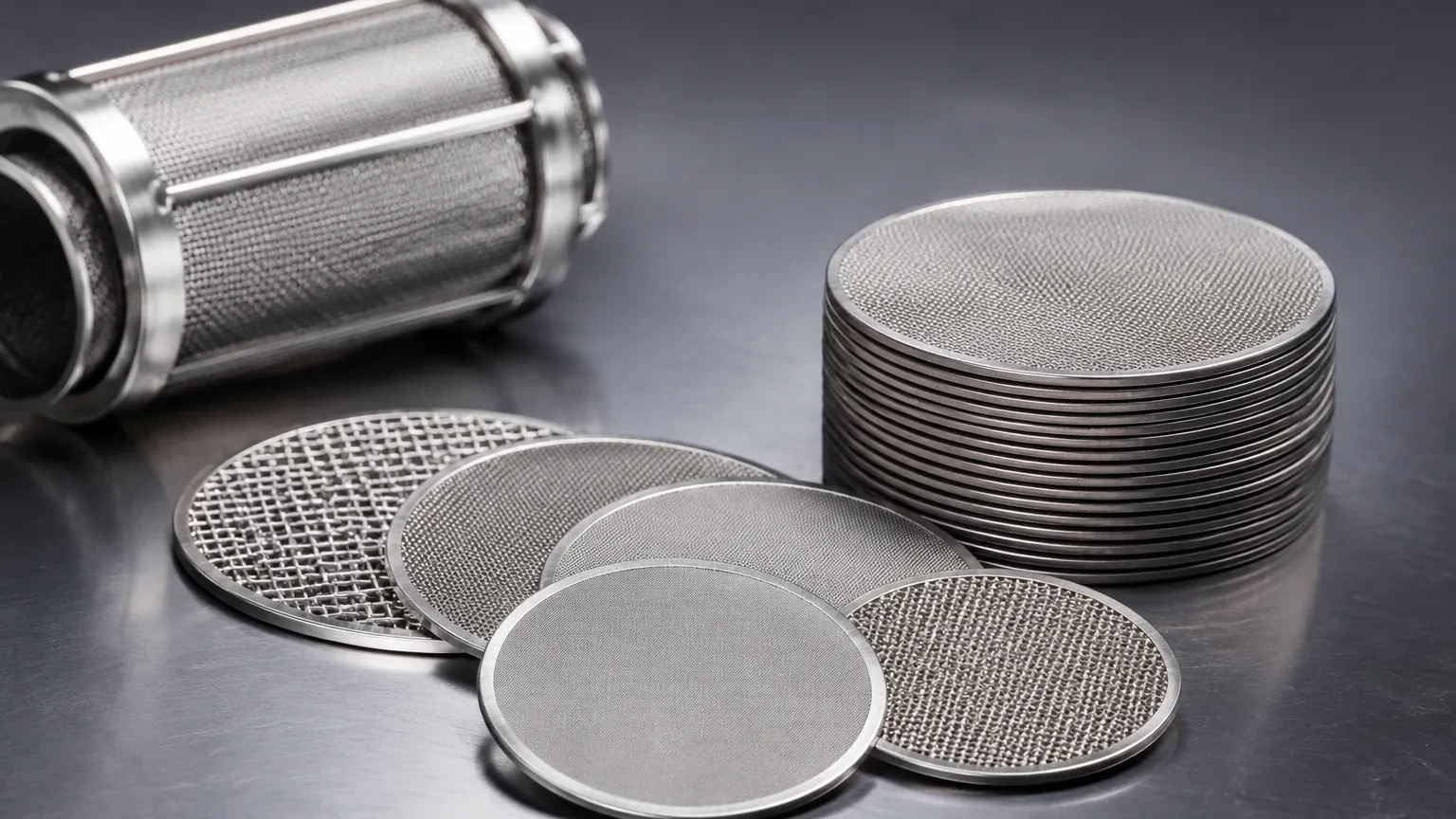
In many advanced industrial setups, a hybrid approach is utilized. A stainless steel support mesh or a multi-layered metal pack is used to provide structural rigidity, while a coffee filter paper disc is placed on top to provide the final polishing. This protects the delicate paper from tearing under high pressure and allows for easier removal of the spent cake.
Manufacturers like Kaifil specialize in creating the hardware that supports these media. By using precision-engineered Filter Discs & Packs, facilities can achieve a level of consistency that is impossible with standard off-the-shelf components. These packs can be customized with various mesh counts to act as a secondary safety layer in case of paper failure.
Maintenance and Replacement Cycles
For paper discs, the replacement cycle is straightforward: one disc per batch. However, the maintenance of the housing and support structures is often overlooked. Residual oils and micro-fines can build up in the support mesh, leading to bacterial growth or off-flavors.
Engineers should implement a Clean-in-Place (CIP) protocol for the permanent components of the filtration system. If using stainless steel discs as the primary medium, ultrasonic cleaning is often recommended to remove trapped particles from within the wire mesh pores, ensuring the flow rate remains within the design specifications over the life of the filter.
Conclusion: Making an Informed Decision
Selecting the right coffee filter paper discs involves more than just matching a diameter to a machine. It requires a balance of flow dynamics, retention requirements, and mechanical constraints. For high-volume industrial applications, evaluating the transition to permanent stainless steel filtration or a hybrid system can offer significant benefits in terms of consistency and long-term cost savings.
When sourcing filtration components, it is vital to work with manufacturers who understand the technical demands of the industry. Whether you require standard paper media or custom-engineered metal Filter Discs & Packs, confirming specifications such as micron rating, burst strength, and material compatibility is the first step toward optimizing your production process. By prioritizing engineering data over generic marketing claims, purchasing teams can ensure they invest in solutions that deliver reliable, high-performance filtration day after day.
