


Disc Filter for Borewell Water
In industrial and agricultural sectors, borewell water serves as a critical resource for cooling systems, irrigation, and raw material processing. However, groundwater is rarely pure. It typically carries a heavy load of suspended solids, including fine sand, silt, clay, and organic debris. Without effective primary filtration, these contaminants can lead to clogged nozzles, damaged pump seals, and fouled heat exchangers. The use of a disc filter for borewell water has emerged as a standard engineering solution to mitigate these risks, providing a robust barrier against particulate matter.
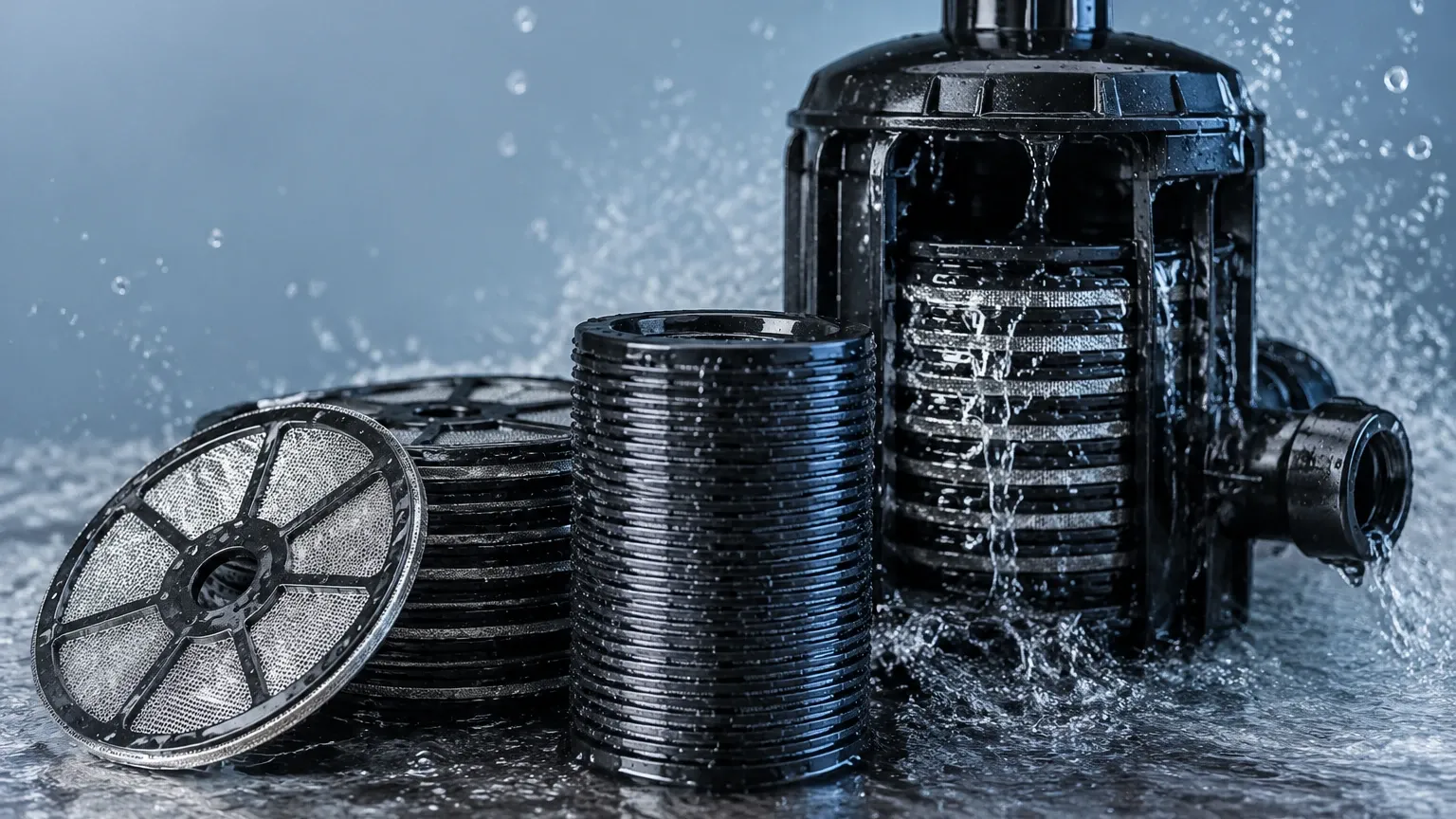
For engineers and procurement teams, selecting the right filtration medium is a balance between filtration fineness, flow capacity, and mechanical durability. While plastic disc filters are common in low-pressure irrigation, industrial-grade applications often require the precision and longevity found in stainless steel Filter Discs & Packs. These components provide the structural integrity necessary to withstand the high differential pressures often encountered in deep-well extraction and high-volume industrial water treatment.
Challenges of Borewell Water Filtration in Industrial Applications
Borewell water quality is highly variable, influenced by local geology and seasonal changes. In many industrial contexts, the water must meet specific clarity standards before it enters downstream equipment. The primary challenge lies in the nature of the contaminants. Unlike surface water, which may contain more organic algae, borewell water is often characterized by abrasive inorganic particles.
Sand and silt are particularly problematic. These particles can act as an abrasive, wearing down the internal components of valves and pumps. Furthermore, fine silt can settle in low-flow areas of a piping system, creating a breeding ground for bacterial growth or causing localized corrosion. A disc filter for borewell water must be capable of capturing these particles without becoming instantly blinded. This requires a deep understanding of the particle size distribution (PSD) of the specific well water, as a filter that is too fine will require excessive cleaning, while one that is too coarse will fail to protect downstream assets.
Engineering the Disc Filter for Borewell Water: Material and Structure
When designing or specifying a disc filter for borewell water, the material of construction is the first point of consideration. While polymer-based discs are prevalent in standard agricultural setups, stainless steel (typically Grade 304 or 316L) is preferred for industrial environments due to its resistance to corrosion and mechanical stress.
Wire Mesh Weave Types
The performance of a metal filter disc is largely determined by the weave of the wire mesh. Plain weave is common for general-purpose filtration, offering a high open area and low pressure drop. For finer filtration requirements, Dutch weave or Twill Dutch weave patterns are employed. These weaves provide a more tortuous path for particles, allowing for higher filtration accuracy and better retention of fine silts often found in borewell sources.
Multi-Layer Configurations
In many demanding applications, a single layer of mesh is insufficient. Filter packs often consist of multiple layers of wire mesh bonded together. A typical configuration might include a fine filtration layer protected by coarser drainage and support layers. This "pack" design increases the mechanical strength of the disc, preventing the mesh from deforming under the high-pressure surges that occur when a borewell pump starts up.
Performance Characteristics of Stainless Steel Filter Discs & Packs
The transition from disposable media to permanent stainless steel Filter Discs & Packs offers several technical advantages. In the context of borewell water, where the contaminant load can be unpredictable, the following performance characteristics are vital:
1. High Dirt-Holding Capacity: By utilizing specialized weaves and multi-layer structures, these filters can hold a significant volume of solids before reaching the terminal pressure drop. This extends the intervals between cleaning cycles.
2. Pressure Stability: Borewell systems often operate at higher pressures than surface water systems. Stainless steel discs maintain their pore geometry even under significant differential pressure, ensuring consistent filtration performance.
3. Chemical Resistance: If the borewell water has a low pH or high mineral content (hard water), stainless steel resists the corrosive effects that might degrade other materials. It also allows for aggressive chemical cleaning if the filter becomes fouled with mineral scale or iron bacteria.
4. Thermal Tolerance: In some industrial processes, borewell water may be used in heat recovery loops where temperatures fluctuate. Metal discs remain stable across a wide temperature range.
Selection Criteria for Borewell Filtration Systems
Choosing a disc filter for borewell water requires a systematic approach to engineering specifications. Engineers should evaluate the following criteria to ensure the selected filter aligns with the operational demands of the facility:
Micron Rating and Efficiency
The micron rating defines the size of the smallest particle the filter is designed to capture. For borewell water, ratings typically range from 50 to 200 microns for primary protection, though finer filtration may be required for sensitive downstream equipment. It is important to distinguish between nominal and absolute micron ratings; absolute ratings provide a more reliable guarantee of particle retention.
Flow Rate and Pressure Drop (ΔP)
Every filter introduces a resistance to flow. The goal is to maximize the filtration surface area to keep the initial pressure drop as low as possible. If the disc filter for borewell water is undersized, the high velocity of water through the mesh can cause "bridge-over," where particles are forced through the pores, or it can lead to rapid clogging.
Housing Compatibility
Filter discs must be precisely manufactured to fit within the filter housing. Any gaps around the edges of the disc will allow unfiltered water to bypass the system. Custom-manufactured discs ensure a tight seal, often incorporating specialized edging or gaskets to prevent bypass in high-pressure environments.
Customization Options for High-Sediment Environments
No two borewells are identical. A well drilled into a sandy aquifer will have different filtration needs than one drilled into fractured bedrock. Customization is often necessary to optimize the lifespan of the filtration system. Manufacturers like Kaifil specialize in providing tailored solutions that address these specific variables.
Customization might involve varying the mesh count to target specific sand grain sizes or using sintered mesh for applications where the filter must undergo frequent high-pressure backwashing. Sintering—a process where multiple layers of mesh are heat-treated to fuse the wires at their contact points—creates an incredibly rigid structure that is virtually immune to media migration. For a disc filter for borewell water, this means the filter can be cleaned repeatedly without losing its original micron rating.
Furthermore, the shape and size of the filter can be customized. While circular discs are standard, oval, rectangular, or multi-segmented packs can be engineered to fit proprietary housing designs used by different OEM pump and treatment system manufacturers.
Maintenance, Cleaning, and Replacement Cycles
One of the primary benefits of using stainless steel Filter Discs & Packs is that they are cleanable and reusable. In a borewell application, maintenance typically involves removing the accumulated sediment. Depending on the system design, this can be achieved through manual cleaning, ultrasonic baths, or automated backwashing.
Monitoring Performance
Engineers should monitor the differential pressure across the filter. A sudden increase in ΔP indicates that the filter is reaching its dirt-holding capacity. If the pressure drop does not return to the baseline after cleaning, it may indicate deep-seated fouling or mineral scaling, which may require a chemical soak.
Total Cost of Ownership (TCO)
While the initial cost of a stainless steel disc filter for borewell water is higher than that of a disposable cartridge or a plastic disc, the TCO is significantly lower. The durability of the metal mesh means fewer replacements, reduced waste, and less downtime. In industrial settings where operational continuity is paramount, the reliability of a robust metal filter is a significant financial advantage.
Conclusion: Optimizing Borewell Water Quality
Effective filtration is the first line of defense in any water-dependent industrial process. By implementing a high-quality disc filter for borewell water, facilities can protect their infrastructure from the damaging effects of silt and sand. The transition to precision-engineered stainless steel components ensures that the filtration system can handle the rigors of high-pressure operation while providing the flexibility for customization and long-term reuse.
When evaluating filtration components, it is essential to work with manufacturers who understand the technical nuances of wire mesh and filtration dynamics. Accurate material selection, precise micron control, and robust structural design are the hallmarks of a filtration solution that delivers consistent performance over years of service. For those managing complex industrial water systems, investing in high-performance Filter Discs & Packs is a strategic move toward operational efficiency and equipment longevity.
