


Disc Filter Hydrotech
In the landscape of industrial and municipal wastewater treatment, the demand for high-efficiency solids removal has led to the widespread adoption of microscreening technologies. Among these, the disc filter hydrotech principle stands as a benchmark for tertiary treatment, water reuse, and process water filtration. These systems utilize a series of rotating discs covered with fine filter media to separate suspended solids from liquids. For engineers and facility managers, understanding the technical nuances of the filter media—specifically the Filter Discs & Packs that facilitate this separation—is critical for maintaining operational efficiency and meeting stringent effluent standards.
As a professional manufacturer of stainless steel filtration solutions, Kaifil provides the technical expertise required to navigate the complexities of disc filter components. This article explores the engineering considerations, material requirements, and performance metrics associated with disc filter hydrotech applications.
The Engineering Principle of Disc Filter Hydrotech
The disc filter hydrotech system operates on a relatively simple but highly effective mechanical principle. Unlike traditional sand filters that require a large footprint and significant backwash water volume, disc filters utilize a modular design consisting of multiple vertical discs mounted on a central shaft.
As the influent enters the center of the drum and flows outward through the filter media attached to the discs, solids are captured on the inside of the filter cloth or mesh. As the solids accumulate, the head loss increases, triggering a cleaning cycle. The shaft rotates the discs past a series of high-pressure backwash nozzles, which flush the captured particles into a collection trough. This continuous or semi-continuous operation allows for high hydraulic loading rates in a compact space.
The efficiency of this process is almost entirely dependent on the integrity and specification of the filter media. Whether using synthetic fabrics or precision-engineered stainless steel wire mesh, the media must withstand constant immersion, mechanical stress during rotation, and the abrasive force of high-pressure backwash cycles.
Technical Specifications of Filter Discs & Packs
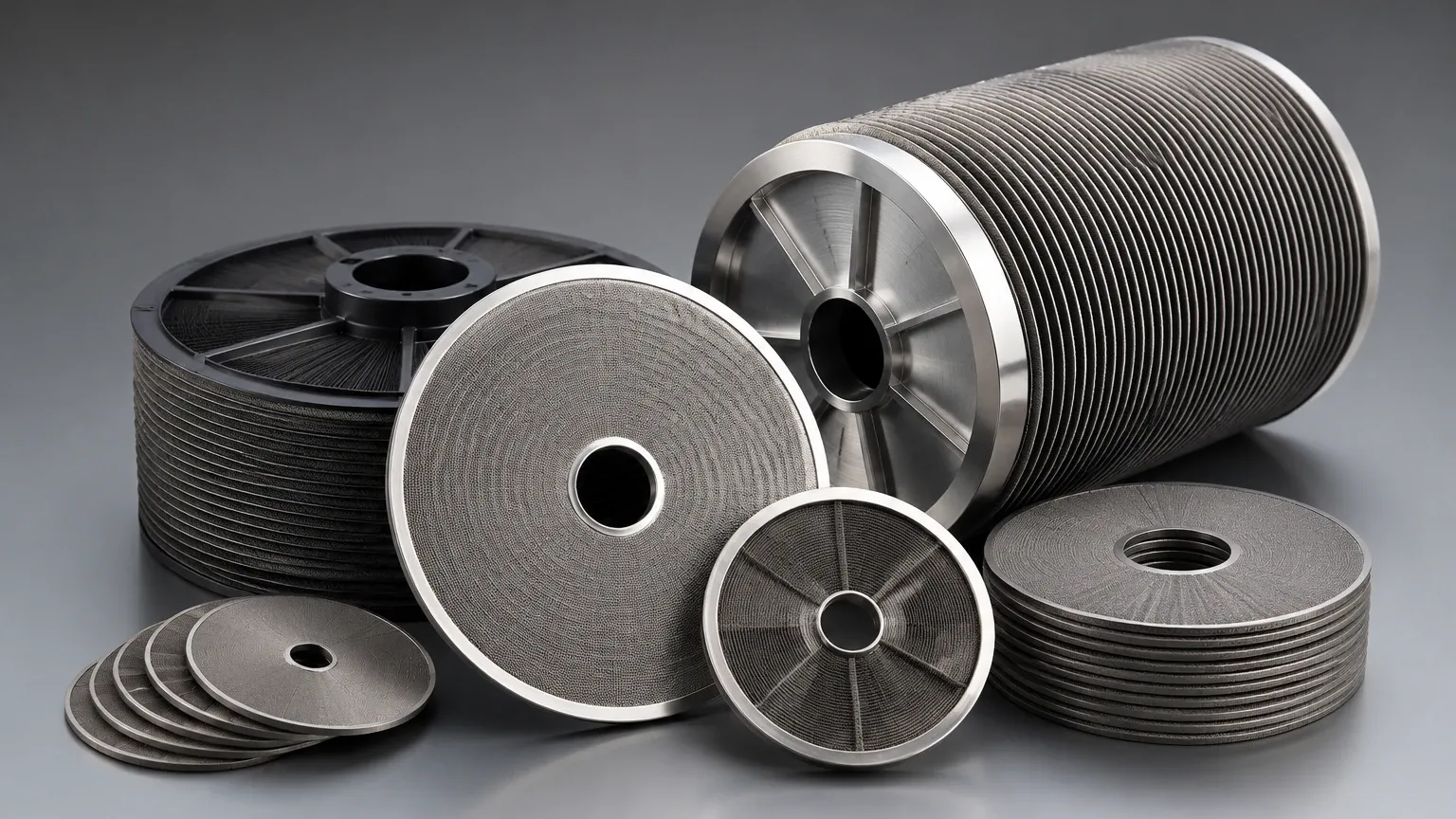
When selecting or replacing components for a disc filter hydrotech system, engineers must evaluate several technical parameters to ensure compatibility and performance. The Filter Discs & Packs used in these systems are often designed as segmented panels or circular units that must fit precisely within the support frame.
1. Micron Rating and Filtration Accuracy
Micron ratings for disc filters typically range from 10 microns to 100 microns, depending on the application. For tertiary wastewater treatment (phosphorus removal or TSS reduction), a range of 10 to 20 microns is common. In industrial process water applications, larger openings may be used to protect downstream equipment. The precision of the weave in the stainless steel mesh ensures that the "nominal" rating closely matches the "absolute" rating, providing predictable effluent quality.
2. Weave Types and Permeability
The geometry of the wire mesh weave determines both the filtration efficiency and the ease of cleaning.
* Plain Weave: Offers a straightforward aperture and high open area, suitable for general-purpose filtration.
* Dutch Weave: Provides higher mechanical strength and finer filtration by using a higher density of wires in one direction. This is often preferred for high-pressure environments where mesh stability is paramount.
* Twill Weave: Allows for thicker wires in a fine mesh, enhancing the durability of the disc against the constant flexing experienced during backwash cycles.
3. Effective Filtration Area (EFA)
The EFA is a critical calculation for any disc filter hydrotech installation. It refers to the total surface area of the mesh that is actively participating in the filtration process. Because the discs are partially submerged, only a portion of the media is filtering at any given time. High-quality filter packs maximize the open area of the mesh while maintaining structural support, ensuring the highest possible flow rate per square meter of installation.
Material Selection: The Case for Stainless Steel
While some disc filter hydrotech systems utilize polyester or other synthetic media, industrial applications often demand the durability of stainless steel. Kaifil specializes in manufacturing filter components from high-grade alloys to meet these demands.
Corrosion Resistance
In municipal wastewater, the presence of chlorides, hydrogen sulfide, and various organic acids can quickly degrade inferior materials. SS316L is the industry standard for these environments due to its superior resistance to pitting and crevice corrosion. For highly aggressive chemical processing or saltwater applications, specialized alloys like 904L or Duplex stainless steel may be required.
Mechanical Integrity
Disc filters are subject to repetitive mechanical stress. Each rotation moves the filter media through the air-water interface, and backwash nozzles apply localized pressure. Stainless steel Filter Discs & Packs offer a higher modulus of elasticity than synthetics, meaning they resist stretching and sagging over time. This maintains the precise gap between the filter surface and the backwash nozzles, which is essential for effective cleaning.
Thermal Stability
Industrial processes often involve high-temperature fluids that would soften or deform synthetic fibers. Stainless steel components maintain their structural integrity at temperatures exceeding several hundred degrees Celsius, making them the only viable option for hot process water recovery.
Optimizing Hydraulic Capacity and Solids Loading
The performance of a disc filter hydrotech system is measured by its ability to handle both hydraulic surges and high solids loading. Engineers must balance these two factors during the selection process.
* Solids Capture Rate: This is the percentage of suspended solids removed from the influent. A finer mesh increases the capture rate but also increases the frequency of backwash cycles.
* Flux Rate: Measured in m³/m²/h, the flux rate indicates how much liquid passes through the filter media. A higher flux rate allows for a smaller machine footprint but requires a filter media with a high percentage of open area to prevent excessive head loss.
In systems where the solids are particularly "sticky" or fibrous, the design of the Filter Discs & Packs must account for potential blinding. Using a smooth-surface stainless steel mesh can facilitate the release of these solids during the backwash phase, reducing water consumption and energy costs.
Customization and OEM Considerations
No two industrial filtration applications are identical. Variations in particle morphology, fluid chemistry, and flow dynamics often necessitate customized filtration solutions. When working with a manufacturer like Kaifil, engineers can specify custom parameters for their disc filter components:
1. Layer Configuration: Multi-layer sintered mesh can combine a fine filtration layer with a coarse drainage layer and a robust support layer. This "pack" configuration provides the ultimate balance of precision and strength.
2. Edge Reinforcement: The perimeter of the filter disc is a common point of failure. Custom-engineered frames or reinforced edges ensure a leak-proof seal within the disc filter hydrotech assembly.
3. Aperture Modification: For specific industrial byproducts, custom mesh weaves can be developed to target specific particle shapes, such as elongated fibers or spherical micro-plastics.
Maintenance, Replacement, and Total Cost of Ownership
While the initial capital expenditure for a disc filter hydrotech system is a primary concern for purchasing teams, the long-term total cost of ownership (TCO) is heavily influenced by the replacement cycle of the filter media.
Extending Service Life
To maximize the lifespan of Filter Discs & Packs, a proactive maintenance schedule is required. This includes:
* Regular Inspection: Checking for mesh tears or frame deformation that could lead to bypass.
* Chemical Cleaning: In applications with high organic loading or mineral scaling, periodic chemical baths (using acids or oxidizers) can restore the permeability of stainless steel mesh.
* Backwash Optimization: Adjusting the pressure and angle of backwash nozzles to ensure the entire surface of the disc is cleaned without causing mechanical erosion.
When to Replace
Filter media should be replaced when the backwash frequency becomes unsustainable or when the effluent quality consistently fails to meet specifications despite cleaning. By choosing high-quality stainless steel components, facilities can often achieve 5 to 10 years of service life, significantly outperforming synthetic alternatives and reducing the frequency of hazardous maintenance interventions.
Conclusion for Engineering and Purchasing Teams
The disc filter hydrotech approach remains one of the most efficient methods for large-scale liquid-solid separation. However, the system's success is fundamentally tied to the quality of the filter media. Engineers must prioritize material grade, weave precision, and structural durability when specifying Filter Discs & Packs.
By partnering with a specialized manufacturer like Kaifil, industrial operators gain access to advanced manufacturing capabilities—from precision wire weaving to custom component fabrication. Whether you are designing a new filtration plant or seeking high-performance replacement parts for an existing disc filter hydrotech installation, focusing on technical excellence in the filter media will ensure reliable, cost-effective, and long-term filtration performance.
