


Solvac Tm Filter Holder and Membrane Discs
In industrial and analytical filtration, the efficiency of liquid clarification and degassing is paramount to protecting downstream equipment and ensuring product purity. The Solvac TM filter holder and membrane discs represent a specialized solution designed to streamline the filtration of mobile phases, solvents, and aqueous solutions. For engineers and laboratory managers, understanding the technical nuances of these components—and how they relate to broader industrial Filter Discs & Packs—is essential for optimizing filtration workflows and reducing operational downtime.
Understanding Vacuum Filtration in Industrial and Laboratory Environments
Vacuum filtration is a fundamental process used to remove particulate matter and dissolved gases from liquids. In analytical chemistry, particularly for High-Performance Liquid Chromatography (HPLC), the presence of even minute particulates can lead to column plugging, increased backpressure, and detector noise. Similarly, in industrial processing, the removal of contaminants is critical for protecting sensitive valves and precision nozzles.
Systems like the Solvac TM filter holder are engineered to address the limitations of traditional glass funnel filtration. Traditional setups often require the transfer of filtered liquid from a collection flask to a storage reservoir, a step that introduces risks of environmental contamination and solvent loss through evaporation. By contrast, vacuum-driven holders allow for direct filtration into the final container, maintaining a closed system that preserves the integrity of the fluid.
Engineering Specifications of the Solvac TM Filter Holder
The design of the Solvac TM filter holder prioritizes chemical compatibility and ease of use. Typically constructed from high-density polypropylene, these holders are resistant to a wide array of organic solvents, acids, and bases. This material choice is significant for B2B procurement, as it offers a more durable, shatter-proof alternative to borosilicate glass components in busy industrial or lab settings.
Key engineering features include:
* Seal Integrity: The holder utilizes a specialized sealing mechanism that ensures a vacuum-tight fit without the need for O-rings that might degrade or leach contaminants into the filtrate.
* Direct-to-Reservoir Design: The unit is designed to sit directly on top of standard GL45 or similar threaded laboratory bottles. This eliminates the need for intermediate transfer vessels.
* Versatility: While optimized for 47 mm membrane discs, the internal geometry is designed to maximize the effective filtration area (EFA), which directly impacts flow rates and throughput.
For engineers managing large-scale operations, these holders serve as a bridge between bench-top testing and pilot-scale production, where the same filtration principles are applied using more robust stainless steel hardware.
Selecting the Right Membrane Discs for Specific Applications
The performance of any filter holder is ultimately dependent on the membrane discs placed within it. Selecting the appropriate membrane involves evaluating the chemical nature of the fluid, the required micron rating, and the expected particulate load.
Common Membrane Materials
1. Nylon: A versatile choice for both aqueous and organic solvents. Nylon membranes are naturally hydrophilic and offer high protein binding, making them suitable for many general-purpose industrial applications but less ideal for certain biological samples.
2. PTFE (Polytetrafluoroethylene): Known for its extreme chemical inertness. PTFE membrane discs are the standard for aggressive solvents, highly corrosive acids, and gases. They are typically hydrophobic and may require pre-wetting with an organic solvent if used with aqueous solutions.
3. PVDF (Polyvinylidene Fluoride): Offers low protein binding and high flow rates. These are often used in pharmaceutical and food-processing applications where sample recovery is critical.
4. PES (Polyethersulfone): Preferred for high-throughput aqueous filtration due to its asymmetric pore structure, which provides high dirt-holding capacity.
When specifying Filter Discs & Packs, engineers must ensure that the pore size—typically 0.2 µm for sterilization or 0.45 µm for general clarification—aligns with the specific requirements of the downstream process.
Transitioning from Lab to Process: Industrial Filter Discs & Packs
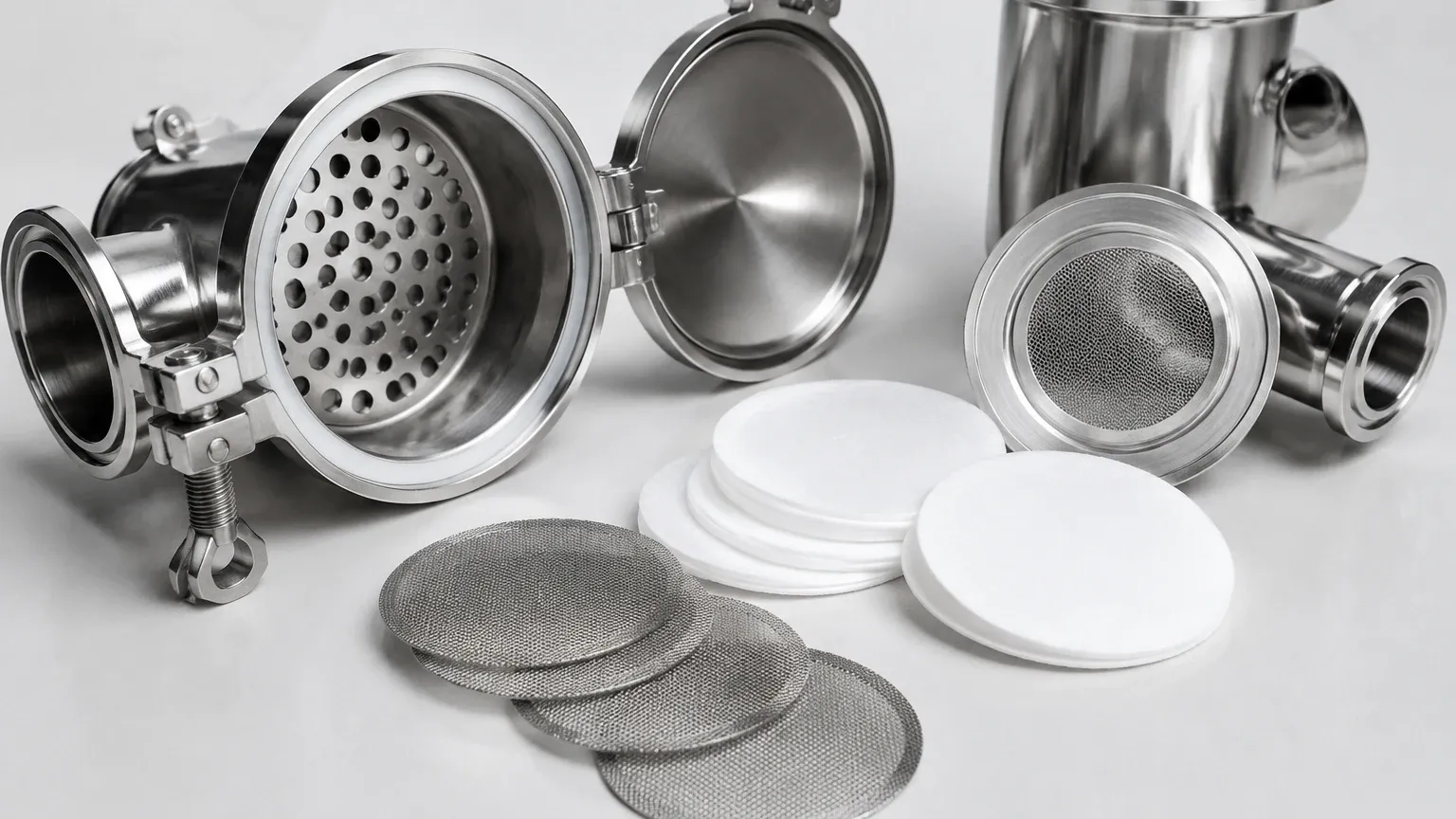
While the Solvac system is excellent for mobile phase preparation and small-batch processing, industrial-scale filtration often demands the durability of metal components. This is where the expertise of manufacturers like Kaifil becomes critical. In high-pressure hydraulic systems, chemical reactors, or high-temperature steam lines, polymer-based membrane discs may lack the necessary mechanical strength.
Industrial-grade filter discs and packs utilize multi-layer stainless steel wire mesh. These components are engineered to provide:
* Mechanical Stability: Unlike polymer membranes that may rupture under high differential pressure, sintered wire mesh discs maintain their structural integrity.
* Cleanability: Stainless steel discs can often be cleaned via backflushing or ultrasonic baths, offering a lower total cost of ownership (TCO) compared to single-use disposable membranes.
* Custom Geometry: While lab holders are standardized at 47 mm or 90 mm, industrial packs can be customized to fit specific housing diameters, with multi-stage filtration layers (coarse to fine) integrated into a single pack.
Understanding the transition from the solvac tm filter holder and membrane discs used in the lab to the robust metal filter packs used in production is vital for scaling up any chemical or pharmaceutical process.
Critical Factors in Filtration Performance and Efficiency
To achieve optimal results with a vacuum filtration system, several technical factors must be monitored:
Differential Pressure and Flow Rate
The flow rate through a membrane disc is governed by Darcy’s Law, where the rate is proportional to the pressure drop across the filter and the surface area. In vacuum filtration, the maximum pressure differential is limited by atmospheric pressure. If the flow rate is insufficient, engineers should consider increasing the effective filtration area by moving to a larger diameter holder or using a multi-layer pack that distributes the particulate load.
Chemical Compatibility and Leachable Testing
It is not enough for a filter to remain physically intact; it must not contribute impurities to the filtrate. In B2B environments, particularly in the pharmaceutical and semiconductor industries, confirming that the membrane discs and the holder material do not leach plasticizers or surfactants is a critical compliance step.
Particulate Loading and Clogging
The "dirt-holding capacity" refers to the amount of contaminant a filter can trap before the flow rate drops below an acceptable level. For fluids with high particulate concentrations, using a pre-filter disc on top of the primary membrane can significantly extend the life of the more expensive fine-pore membrane.
Maintenance and Replacement Cycles
For the Solvac TM filter holder, maintenance is relatively straightforward but essential for longevity. The polypropylene body should be inspected regularly for stress cracks, especially if it is frequently autoclaved or exposed to harsh UV light.
Membrane discs, being consumables, require a defined replacement schedule. In a production environment, this is often determined by:
* Pressure Drop: Replacing the disc when the vacuum takes significantly longer to pull the liquid through.
* Volume Throughput: Standardizing replacement after a specific number of liters have been processed.
* Batch Integrity: In regulated industries, the filter is often replaced after every batch to prevent cross-contamination.
For those utilizing stainless steel Filter Discs & Packs, the replacement cycle is much longer, but a strict cleaning validation protocol must be established to ensure that no residual contaminants remain between runs.
Customization and OEM Capabilities for Precision Filtration
Every industrial application presents unique challenges, from extreme temperatures to highly viscous fluids. Standard off-the-shelf solutions like the solvac tm filter holder and membrane discs provide a reliable baseline, but custom engineering is often required for optimized performance.
Manufacturers like Kaifil specialize in developing custom filtration components that meet exact micron ratings and material specifications. Whether it is a multi-layered sintered mesh pack for a polymer melt or a precision-cut stainless steel disc for a high-pressure valve, the ability to customize the filtration media ensures that the system operates at peak efficiency. Engineers should work closely with manufacturers to confirm material compatibility and performance expectations before finalizing a purchasing decision. By providing detailed parameters regarding the fluid's physical properties and the operating environment, technical teams can secure filtration solutions that provide the best balance of performance, durability, and cost.
Download Solvac Tm Filter Holder and Membrane Discs as a PDF
