


Synthetic Jar Lid Filter Discs
In industrial filtration and specialized laboratory environments, the requirement for sterile gas exchange is a critical engineering challenge. Synthetic jar lid filter discs serve as a primary solution for maintaining internal atmospheric purity while allowing for the necessary equalization of pressure and gas flow. These components are specifically engineered to provide a barrier against contaminants, including bacteria, mold spores, and fine particulates, making them indispensable in pharmaceutical, biotechnological, and high-precision chemical processes.
While often associated with smaller-scale applications, the industrial procurement of synthetic jar lid filter discs involves complex considerations regarding material science, pore size distribution, and thermal stability. For organizations managing large-scale cultivation or fermentation processes, selecting the correct filtration medium is essential to ensuring batch consistency and preventing costly contamination events.
Understanding the Function of Synthetic Jar Lid Filter Discs
The primary function of a synthetic jar lid filter disc is to facilitate "breathing" for a sealed environment. In many industrial processes, such as the cultivation of mycelium or the fermentation of specific biological agents, the internal environment must remain aerobic or allow for the venting of metabolic byproducts like carbon dioxide. However, this exchange cannot be open to the ambient air, which carries a high load of airborne contaminants.
Synthetic discs utilize a non-woven or microporous structure to create a tortuous path for particles. Unlike simple mesh, which relies on physical screening based on hole size, synthetic membranes often employ depth filtration or electrostatic attraction to capture sub-micron particles. This level of protection is vital for maintaining the integrity of the internal substrate or solution.
Material Composition and Technical Properties
The performance of these filter discs is largely dictated by the synthetic polymers used in their construction. The most common materials include:
* Polytetrafluoroethylene (PTFE): Known for its exceptional chemical resistance and hydrophobicity. PTFE discs are preferred in environments where moisture is present, as the material naturally repels water, preventing the "wet-out" effect that can block airflow and allow for the migration of contaminants through the filter medium.
* Polypropylene (PP): A cost-effective and durable polymer that offers good chemical resistance. Polypropylene filter discs are often used in general-purpose industrial applications where extreme chemical exposure is not a primary concern but high-efficiency particulate capture is required.
* Synthetic Fiber Blends: Some high-performance discs utilize proprietary blends of synthetic fibers to achieve specific airflow-to-retention ratios. These are often engineered for high-temperature stability, allowing them to withstand repeated sterilization cycles.
For engineers, the choice of material impacts the disc's ability to withstand the rigors of industrial processing, including exposure to cleaning agents and high-pressure steam.
Engineering Requirements for Sterile Gas Exchange
When integrating synthetic jar lid filter discs into a production workflow, technical professionals must evaluate several key performance metrics:
Pore Size and Filtration Efficiency
In the context of sterile gas exchange, pore size is typically measured in microns (µm). A standard for biological exclusion is the 0.22-micron filter, which is capable of capturing most bacterial contaminants. For applications where only larger spores or dust need to be excluded, a 0.45-micron or even a 1.0-micron disc may be used to allow for higher flow rates. It is important to distinguish between "nominal" and "absolute" micron ratings to ensure the filter meets the required safety margins.
Airflow Rates (CFM/LPM)
Filtration is always a trade-off between particle retention and airflow. In large-scale industrial jars or vessels, the rate of gas exchange (measured in Cubic Feet per Minute or Liters per Minute) must be sufficient to support the biological or chemical process occurring within. If the airflow is too restricted, the internal environment may become anaerobic or over-pressurized, leading to process failure.
Hydrophobicity
In many steam-heavy or humid environments, a hydrophilic filter (one that attracts water) will quickly become saturated. Once saturated, the filter becomes a bridge for contaminants and effectively stops gas exchange. Synthetic jar lid filter discs are typically engineered to be hydrophobic to ensure they remain functional even in high-humidity incubators or during autoclave cycles.
Comparing Synthetic Discs with Metal Filter Discs & Packs
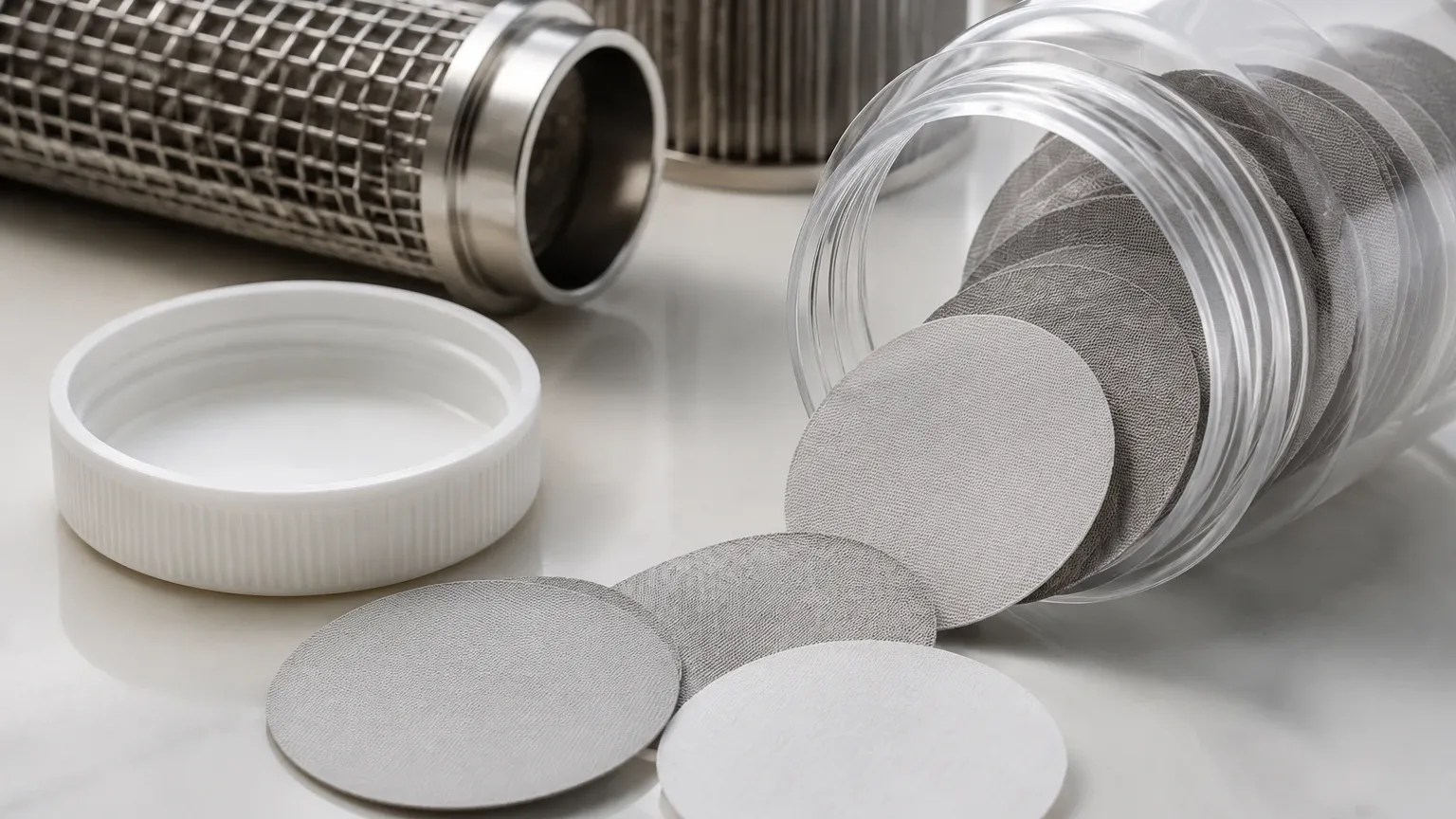
In the broader landscape of industrial filtration, it is common to compare synthetic membranes with metal-based solutions. While synthetic discs excel in biological exclusion and high-efficiency gas exchange, they are often used in conjunction with or as an alternative to Filter Discs & Packs made from stainless steel.
Stainless steel filter discs offer superior mechanical strength and can withstand much higher pressures and temperatures than synthetic polymers. However, achieving a 0.22-micron rating with woven wire mesh is technically challenging and often requires multi-layered sintered structures. In many B2B applications, a hybrid approach is used: a stainless steel mesh provides the structural support (a "pack"), while the synthetic disc provides the fine-tuned biological barrier. Understanding the synergy between these materials is key to designing a robust filtration system.
Industrial Applications and Use Cases
Synthetic jar lid filter discs are utilized across various sectors that require controlled environments:
1. Pharmaceutical R&D: Used in the small-batch production of active pharmaceutical ingredients (APIs) where sterile venting of reaction vessels is required.
2. Mycology and Agricultural Science: Essential for the commercial cultivation of mushrooms and other fungi. The discs allow for the necessary CO2/O2 exchange in spawn jars while preventing the entry of competing molds and bacteria.
3. Industrial Fermentation: In the development of enzymes or biofuels, small-scale pilot jars use these discs to maintain culture purity before scaling up to large bioreactors.
4. Specialty Chemical Storage: For chemicals that off-gas over time, synthetic filter discs allow for pressure equalization without exposing the chemical to atmospheric moisture or contaminants.
Selection Criteria for Procurement and Engineering Teams
When sourcing synthetic jar lid filter discs for industrial use, procurement teams should confirm the following specifications with their supplier:
* Autoclave Compatibility: Ensure the disc can withstand standard sterilization temperatures (typically 121°C at 15 psi) without shrinking, warping, or losing its filtration integrity. Some synthetic materials may degrade after a single cycle, while others are rated for multiple uses.
* Dimensional Accuracy: Industrial jar lids come in various sizes (e.g., standard wide-mouth, 70mm, 86mm, or custom diameters). The disc must fit perfectly within the lid assembly or be bonded to the lid to prevent bypass—where air moves around the filter rather than through it.
* Certification and Compliance: For food and beverage or pharmaceutical applications, the materials used must often be FDA-compliant or meet USP Class VI plastics requirements.
* Adhesive vs. Friction Fit: Some discs come with a pressure-sensitive adhesive (PSA) backing for easy application to a pre-drilled lid, while others are designed to be held in place by a gasket or the lid's own screw-top mechanism.
Common Risks and Mitigation Strategies
The most significant risk associated with synthetic jar lid filter discs is "bypass." If the seal between the disc and the lid is not airtight, the entire filtration process is compromised. Engineers should specify the mounting method—whether it involves ultrasonic welding, high-temperature adhesives, or mechanical clamping.
Another risk is physical damage. Synthetic membranes are thinner and more fragile than metal mesh. In industrial environments where lids are handled frequently, a protective layer of coarser synthetic mesh or a perforated metal plate may be required to prevent punctures.
Maintenance, Sterilization, and Lifecycle Management
Unlike permanent stainless steel filters, synthetic jar lid filter discs are often treated as semi-consumable components. While many are designed to be autoclaved, every heat cycle slightly alters the polymer structure. Over time, this can lead to brittleness or a shift in pore size.
Industrial users should establish a replacement protocol based on the number of sterilization cycles or a pressure-drop test. If the airflow through the disc significantly decreases, it is an indication of particulate loading or material degradation, signaling that the disc should be replaced to maintain process efficiency.
Customization and OEM Solutions in Filtration
For many B2B operations, off-the-shelf filter discs do not meet the specific requirements of a proprietary process. Customization options often include:
* Custom Diameters: Precision-cut discs to fit non-standard industrial vessel openings.
* Layered Composites: Combining different synthetic materials to achieve a specific balance of durability and filtration fineness.
* Pre-Assembled Lids: For high-volume operations, suppliers can provide complete lid assemblies with the synthetic disc already integrated, reducing labor costs and the risk of assembly errors.
By focusing on the technical specifications and the specific environmental demands of the application, engineering teams can select a synthetic jar lid filter disc that ensures long-term reliability and sterile integrity. Whether used as a standalone component or as part of a complex filtration pack, these discs remain a cornerstone of modern industrial contamination control.
