


Disc Filter Micron
In industrial filtration, the term "micron" is the primary metric for defining the performance and efficiency of a filter medium. For engineers and procurement specialists sourcing Filter Discs & Packs, understanding the nuances of the disc filter micron rating is essential for ensuring system integrity, protecting downstream equipment, and optimizing the total cost of ownership.
As a specialized manufacturer, Kaifil provides precision-engineered stainless steel filtration solutions where the micron rating is not just a number, but a calculated engineering specification. This guide explores the technical considerations of micron ratings in disc filters, the impact of material selection, and the operational variables that influence filtration accuracy in demanding environments.
Understanding Micron Ratings: Nominal vs. Absolute
When discussing a disc filter micron rating, it is critical to distinguish between nominal and absolute ratings. This distinction often determines whether a filter will successfully protect a sensitive hydraulic component or a pharmaceutical batch.
Nominal Micron Rating
A nominal rating refers to the ability of a filter to retain a major weight percentage of particles of a specific size. For example, a 10-micron nominal filter might trap 60% to 90% of particles that are 10 microns or larger. Because nominal ratings are not standardized across the industry, they are typically used for pre-filtration or applications where absolute precision is not the primary requirement. In these scenarios, the goal is often to reduce the overall particle load rather than ensuring total removal of a specific size.
Absolute Micron Rating
An absolute rating indicates the diameter of the largest hard spherical particle that will pass through the filter under specific laboratory test conditions. For stainless steel wire mesh or sintered metal discs, the absolute rating is a reflection of the largest physical opening in the media. In critical applications—such as polymer melt filtration or chemical processing—an absolute disc filter micron specification is required to prevent any particles above a certain threshold from entering the system.
Material Selection and Its Impact on Micron Precision
The material and construction method of the filter disc directly influence the stability and reliability of its micron rating. Stainless steel, particularly grades 304, 316, and 316L, is the industry standard for precision filtration due to its mechanical strength and resistance to corrosion.
Woven Wire Mesh
Woven wire mesh is the most common media for filter discs. The micron rating is determined by the wire diameter and the density of the weave (mesh count). Plain weaves offer straightforward filtration, while Dutch weaves (such as Plain Dutch or Twilled Dutch) allow for much finer micron ratings by packing more wires into a given area. Dutch weaves create a tortuous path for the fluid, which enhances the disc filter micron efficiency even at high flow rates.
Sintered Metal Mesh
For applications requiring extreme durability and fixed pore geometry, sintered metal mesh is utilized. In this process, multiple layers of wire mesh are bonded together through heat and pressure without the use of binders. This creates a rigid structure where the micron rating remains constant even under high pressure or backwashing cycles. Sintered discs are ideal for high-viscosity fluids where a standard mesh might deform, causing the pore sizes to enlarge and the micron rating to drift.
The Role of Multi-Layer Filter Discs & Packs in Fine Filtration
Single-layer discs are often insufficient for complex industrial processes. This is where Filter Discs & Packs become necessary. By combining multiple layers of varying micron ratings, engineers can achieve a balance between filtration fineness and dirt-holding capacity.
Graduated Density Structure
In a multi-layer pack, the layers are typically arranged from coarse to fine in the direction of the flow. The outer, coarser layers act as a pre-filter, capturing larger contaminants that would otherwise prematurely blind the fine inner layer. The inner layer defines the final disc filter micron rating. This graduated structure significantly extends the service life of the filter and prevents rapid pressure spikes.
Mechanical Support
Fine micron mesh (e.g., 5-micron or 10-micron) is often mechanically fragile. In a filter pack, these fine layers are sandwiched between heavier, coarser support meshes. This configuration ensures that the fine mesh can withstand the differential pressure across the filter without tearing or migrating, maintaining the integrity of the micron rating throughout the production cycle.
Engineering Considerations: Flow Rate and Pressure Drop
Selecting a disc filter micron rating is always a trade-off between filtration efficiency and hydraulic performance. As the micron rating becomes finer, the open area of the filter media typically decreases, leading to two primary engineering challenges: increased pressure drop and reduced flow capacity.
Initial Pressure Drop (ΔP)
Every filter media introduces resistance to flow. A 20-micron disc will naturally have a lower initial pressure drop than a 5-micron disc of the same diameter. Engineers must calculate the clean pressure drop to ensure the system pump can maintain the required flow rate. If the micron rating is too fine for the application, the system may reach its terminal pressure drop too quickly, leading to frequent downtime for cleaning or replacement.
Particle Loading and Surface Area
The effective filtration area (EFA) is a critical variable. When a fine disc filter micron rating is required, increasing the diameter of the disc or using multiple discs in a parallel configuration can compensate for the reduced open area. This distribution of flow lowers the face velocity, which can improve the capture efficiency of the particles and reduce the rate of pressure buildup.
Quality Control and Testing for Micron Accuracy
To ensure that a filter disc meets its specified micron rating, rigorous testing protocols must be followed. For B2B buyers, verifying these standards is a key step in the procurement process.
1. Bubble Point Test: This is a common non-destructive test used to determine the maximum pore size of a filter. The disc is submerged in a liquid, and air pressure is increased until bubbles appear. The pressure at which the first bubble appears correlates to the largest pore, defining the absolute micron rating.
2. Glass Bead Test: A controlled suspension of glass beads of known sizes is passed through the filter. The beads that pass through are measured to determine the filtration efficiency at specific micron levels.
3. Scanning Electron Microscopy (SEM): For ultra-fine or sintered media, SEM can be used to visually inspect the uniformity of the pore structure and the quality of the wire intersections.
Kaifil adheres to strict manufacturing standards to ensure that every disc filter micron specification is verified, providing consistency across large production batches.
Customization Options for Specific Applications
Industrial filtration is rarely a one-size-fits-all scenario. Customization of Filter Discs & Packs allows for the optimization of the micron rating based on the specific characteristics of the fluid and the contaminant.
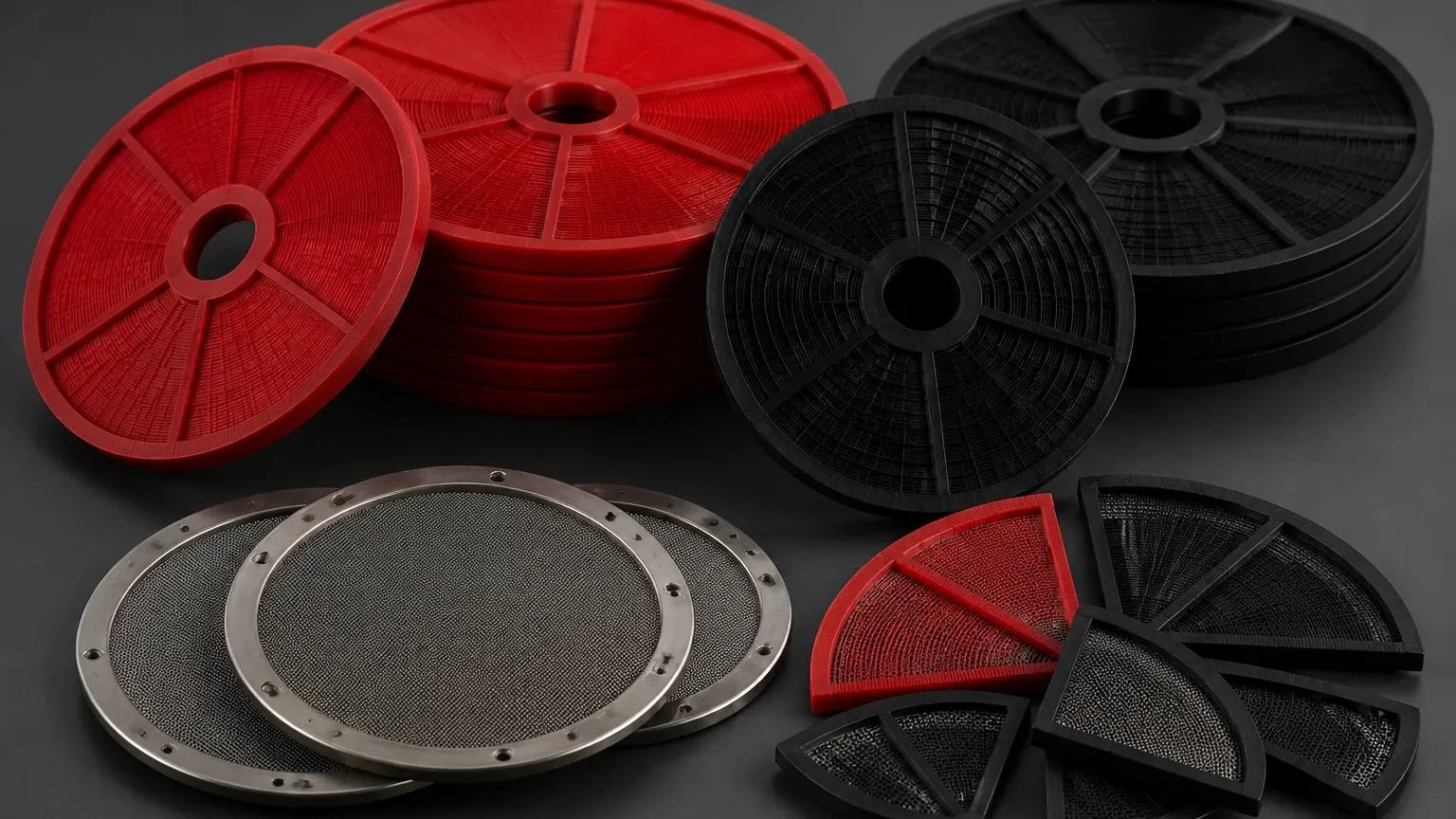
* Rim and Border Options: Discs can be supplied with aluminum, stainless steel, or copper rims. These borders provide a leak-proof seal within the filter housing, ensuring that no fluid bypasses the media. Bypassing is a common cause of "micron failure" where large particles are found downstream despite using a fine filter.
* Shape and Geometry: While circular discs are standard, custom shapes (ovals, rectangles, or kidney shapes) are often required for specialized machinery. The precision of the cut is vital; any fraying at the edges of a woven mesh can alter the effective micron rating at the periphery of the disc.
* Alloy Selection: In corrosive chemical environments, standard 304 stainless steel may degrade. Using specialized alloys like Hastelloy or Monel ensures the pore structure remains intact over time, preventing "pore enlargement" due to corrosion.
Maintenance and Replacement Cycles
The longevity of a disc filter micron rating depends on the cleaning and maintenance regime. Unlike disposable polymer filters, stainless steel discs are often cleanable and reusable.
Cleaning Methods
Ultrasonic cleaning is the most effective method for restoring the performance of a metal filter disc. It uses high-frequency sound waves to create cavitation bubbles that dislodge particles trapped deep within the mesh. Chemical cleaning (acid or alkali baths) may also be used depending on the nature of the contaminant. However, repeated cleaning can eventually wear down the wire diameters, potentially shifting the micron rating over several years of use.
Monitoring Performance
Operators should monitor the differential pressure across the filter pack. A sudden drop in pressure might indicate a media rupture (bypass), while a rapid increase indicates blinding. Establishing a baseline for "clean" and "dirty" pressure levels is the most reliable way to determine the optimal replacement cycle for a specific disc filter micron configuration.
Conclusion: Selecting the Right Specification
Choosing the correct disc filter micron rating requires a comprehensive understanding of the process fluid, the target contaminant, and the mechanical constraints of the filtration system. Overspecifying (choosing a micron rating that is too fine) leads to unnecessary costs and frequent maintenance. Underspecifying risks downstream damage and product contamination.
By focusing on high-quality Filter Discs & Packs and consulting with technical experts during the design phase, engineers can ensure they achieve the precise filtration performance required for their specific industrial application. Kaifil remains committed to delivering these high-performance components, backed by manufacturing expertise and a deep understanding of industrial filtration engineering.
