


Disc Filter Operation
In industrial filtration, the efficiency of a process often hinges on the precision and reliability of the components used to separate solids from liquids or gases. Disc filters, specifically those utilizing stainless steel wire mesh, are critical components in industries ranging from polymer extrusion and chemical processing to food and beverage production. Understanding the nuances of disc filter operation is essential for engineers and plant managers who aim to optimize throughput, maintain product purity, and extend the service life of their filtration equipment.
Effective disc filter operation is not merely about installing a mesh screen; it involves a complex interplay of fluid dynamics, material science, and mechanical engineering. This guide explores the technical aspects of how these filters function, the variables that dictate their performance, and the best practices for maintaining them in demanding industrial environments.
Understanding the Mechanics of Filter Discs & Packs
At its core, a disc filter operates on the principle of mechanical straining. As a fluid—whether it be a high-viscosity polymer melt or a low-viscosity solvent—passes through the filter medium, particles larger than the pore size are captured on the surface or within the depth of the mesh.
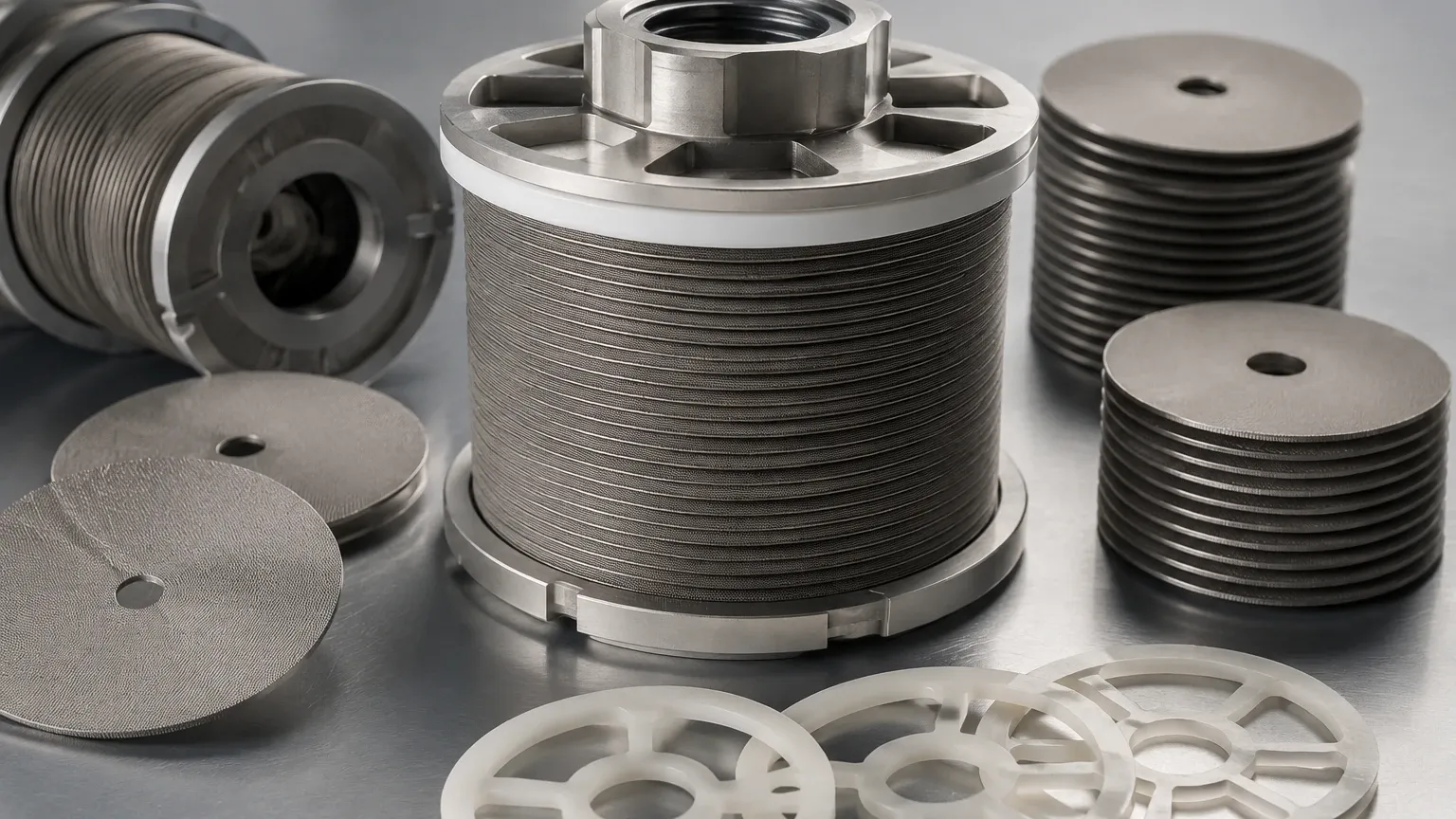
Filter Discs & Packs are often designed as multi-layer structures to enhance their performance. In a typical multi-layer pack, different mesh counts are combined to provide graduated filtration. The outer layers usually consist of a coarse mesh that provides structural support and acts as a pre-filter for larger contaminants. The inner layers feature a finer weave that determines the actual micron rating of the assembly. This layered approach prevents the fine mesh from being prematurely blinded by large particles, thereby extending the operational cycle of the filter.
In many high-pressure applications, such as hydraulic systems or plastic recycling, the disc filter must withstand significant mechanical stress. The operation relies on the integrity of the mesh weave and the quality of the boundary seals (such as spot-welding or aluminum/stainless steel rims) to ensure that no bypass occurs. If the disc deforms under pressure, the effective pore size can change, leading to inconsistent filtration results.
Key Factors Influencing Disc Filter Operation
Several variables directly impact the success of disc filter operation. Engineering teams must account for these factors during the selection and design phase to ensure the filtration system meets the specific needs of the application.
1. Fluid Viscosity and Temperature
The viscosity of the medium being filtered is perhaps the most significant factor in determining flow resistance. In polymer extrusion, for example, the high viscosity of the plastic requires substantial pressure to force the material through the filter discs. Temperature also plays a role; as temperature increases, viscosity typically decreases, which can improve flow rates but may also affect the structural integrity of the filter material if not properly specified.
2. Particle Loading and Nature of Contaminants
The concentration and type of contaminants (hard vs. soft particles) influence how quickly a filter reaches its terminal pressure drop. Hard, abrasive particles can cause wear on the wire mesh over time, while soft, deformable particles may "plug" the pores more effectively, necessitating more frequent cleaning or replacement.
3. Face Velocity
Face velocity refers to the speed at which the fluid approaches the filter surface. Operating at excessively high velocities can lead to particle "breakthrough," where contaminants are forced through the mesh pores due to high kinetic energy. Conversely, low velocities may lead to inefficient use of the total filtration area.
Material and Structural Engineering Considerations
The choice of material is foundational to successful disc filter operation. Stainless steel 304 and 316L are the industry standards due to their excellent corrosion resistance and mechanical strength.
* SS304: Suitable for general industrial applications where moderate corrosion resistance is required.
* SS316L: Preferred for pharmaceutical, food and beverage, and highly corrosive chemical environments due to its superior resistance to pitting and crevice corrosion.
Beyond the alloy, the weave type of the mesh significantly alters the operational characteristics:
* Plain Weave: Offers high flow rates and is easy to clean, making it ideal for simple straining tasks.
* Dutch Weave: Provides a much finer filtration rating and higher mechanical strength, suitable for high-pressure applications where precision is paramount.
* Twill Weave: Allows for a heavier wire diameter in a given mesh count, increasing the durability of the disc.
Operational Monitoring and Pressure Differential Management
The most critical metric in disc filter operation is the pressure differential ($ΔP$), which is the difference in pressure between the upstream and downstream sides of the filter. Monitoring this value in real-time allows operators to determine the state of the filter media.
At the start of a cycle, a clean filter disc will exhibit a "clean pressure drop." As contaminants accumulate, the effective open area of the mesh decreases, and the $ΔP$ begins to rise. Engineers typically define a "terminal pressure drop"—the point at which the filter is considered fully loaded and must be cleaned or replaced. Operating beyond this point can lead to several risks:
* Media Migration: The high pressure may cause the wire mesh to fracture, releasing metal fragments into the downstream flow.
* Filter Collapse: The structural support of the disc pack may fail, leading to a total loss of filtration.
* Pump Strain: The upstream pump must work harder to overcome the resistance, leading to increased energy consumption and potential mechanical failure.
Maintenance, Cleaning, and Replacement Protocols
One of the primary advantages of using stainless steel Filter Discs & Packs is their reusability. Unlike disposable synthetic filters, metal mesh can often be cleaned and returned to service, significantly reducing the total cost of ownership.
Cleaning Methods
* Ultrasonic Cleaning: This is the most effective method for removing fine particles trapped within the mesh. High-frequency sound waves create cavitation bubbles that dislodge contaminants without damaging the delicate wires.
* Backwashing: In some automated systems, the flow is periodically reversed to flush contaminants off the surface of the disc. This is common in water treatment and low-viscosity fluid applications.
* Chemical Cleaning: Solvents or acids can be used to dissolve organic or inorganic deposits. It is vital to ensure that the cleaning agent is compatible with the stainless steel grade and any rim materials used in the disc construction.
* Burn-off (Pyrolysis): In polymer applications, used filter packs are often placed in a vacuum oven to burn off residual plastic. This must be done under controlled conditions to avoid annealing the stainless steel, which would reduce its strength.
Determining Replacement Cycles
While cleaning is effective, it is not infinite. Each cleaning cycle and operational stint subjects the mesh to thermal and mechanical stress. Over time, the wires may thin or the weave may shift. A rigorous inspection protocol, including bubble point testing or microscopic examination, should be used to determine when a disc has reached the end of its functional life.
Troubleshooting Operational Inefficiencies
When disc filter operation does not meet performance expectations, engineers should investigate the following common issues:
1. Premature Blinding: If the filter clogs much faster than expected, the micron rating may be too fine for the incoming contaminant load, or the fluid may contain unexpected gelatinous materials. Increasing the surface area or adding a coarser pre-filter layer can often resolve this.
2. Bypass and Leaks: If contaminants are found downstream despite a low pressure drop, the disc may not be sealing correctly within the housing. Check the gaskets, O-rings, or the integrity of the disc rims.
3. Inconsistent Flow Rates: This can be caused by air entrapment within the filter housing. Proper venting during the startup of disc filter operation is essential to ensure the entire surface area of the mesh is utilized.
4. Mechanical Distortion: If discs emerge from the housing warped or cupped, the support structure (such as a perforated plate or backup mesh) is likely insufficient for the operating pressures.
Selecting the Right Filter Configuration for Your Process
Optimizing disc filter operation requires a deep understanding of the specific application requirements. There is no one-size-fits-all solution; a filter pack designed for oil refining will perform poorly in a pharmaceutical laboratory.
When specifying Filter Discs & Packs, engineers should confirm the following data points with their manufacturer:
* Required Micron Rating: The smallest particle size that must be captured.
* Operating Pressure and Temperature: Both steady-state and peak values.
* Chemical Environment: To ensure material compatibility.
* Flow Rate Requirements: To calculate the necessary total filtration area.
* Mechanical Interface: Dimensions, tolerances, and sealing methods required for the filter housing.
By focusing on these technical details, organizations can ensure that their disc filter operation remains efficient, predictable, and cost-effective. Custom-engineered solutions, tailored to the specific stresses and contaminants of a given process, consistently outperform generic off-the-shelf components, providing the reliability necessary for modern industrial manufacturing.
