


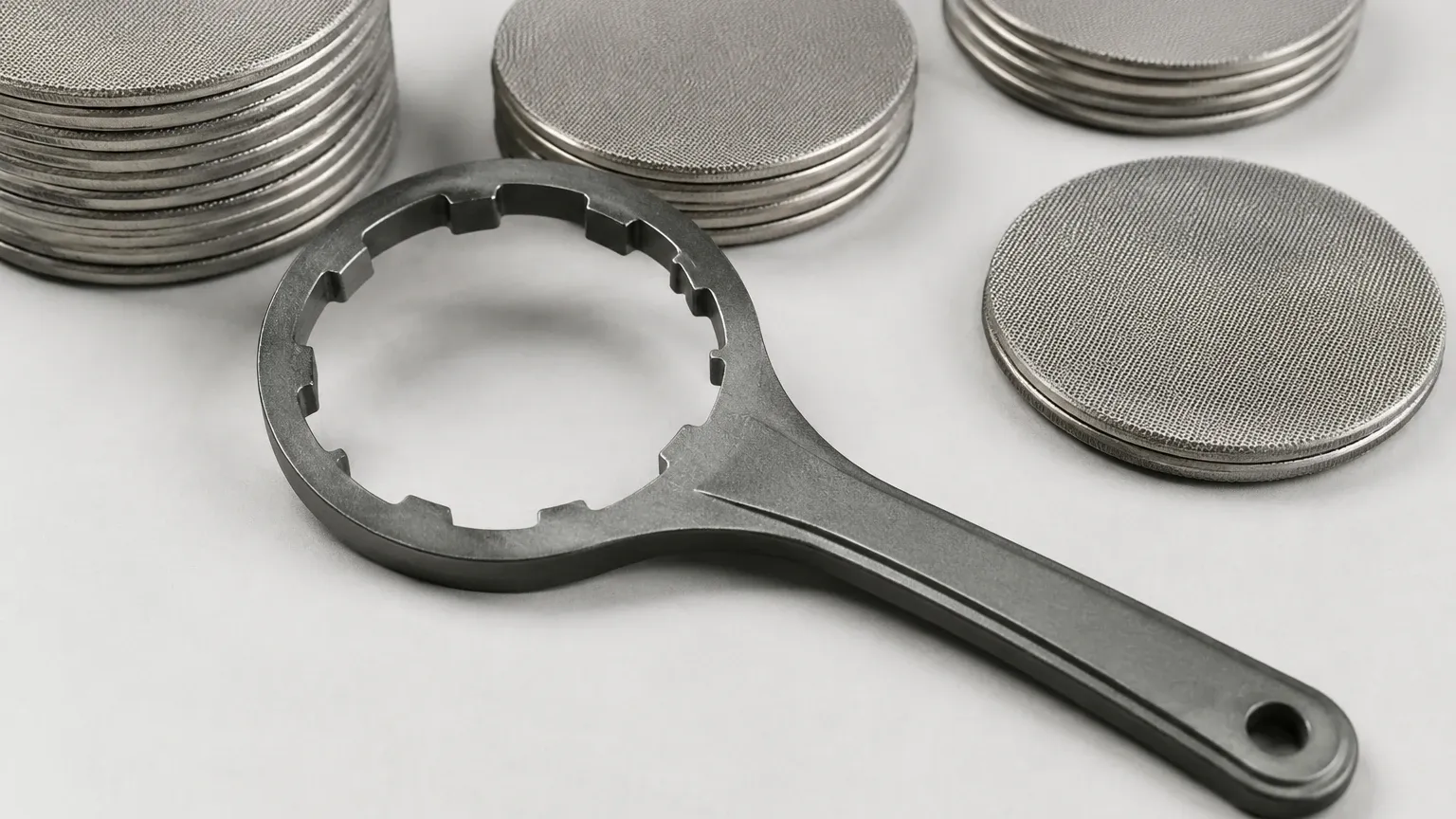
Disc Filter Wrench
In the landscape of industrial filtration, the precision of assembly is as critical as the quality of the filter media itself. For engineers and maintenance professionals operating in sectors such as chemical processing, hydraulic systems, and pharmaceutical manufacturing, the integrity of a filtration system often hinges on the mechanical interface between the filter housing and the internal components. A disc filter wrench serves as the specialized tool required to facilitate the secure installation, tightening, and removal of filter assemblies, particularly those housing high-performance Filter Discs & Packs.
While the filtration media—often multi-layered stainless steel wire mesh—is responsible for capturing contaminants at specific micron levels, the mechanical seal prevents fluid bypass. Without the correct application of torque via a disc filter wrench, even the most advanced filter packs cannot guarantee the purity of the effluent. This article explores the technical nuances of these tools, their application in industrial environments, and the engineering considerations necessary for maintaining optimal filtration performance.
The Role of the Disc Filter Wrench in Industrial Maintenance
Industrial filtration systems are frequently subjected to high pressures, fluctuating temperatures, and corrosive fluids. To withstand these conditions, filter housings are typically constructed from robust metals like 304 or 316L stainless steel. Within these housings, filter discs or packs are compressed to create a leak-proof seal. The disc filter wrench is the primary instrument used to interface with the housing caps, compression nuts, or retaining rings that hold these filters in place.
In many B2B applications, such as polymer melt filtration or hydraulic fluid cleaning, the filter elements must be changed at regular intervals based on pressure drop ($ΔP$) readings. A specialized wrench ensures that the maintenance team can perform these change-outs efficiently without damaging the precision-machined threads of the housing or the delicate edges of the filter discs. Unlike generic pipe wrenches, a dedicated disc filter wrench is designed to distribute force evenly, minimizing the risk of deformation or "out-of-round" conditions in the filter assembly.
Engineering Considerations for Filter Disc Installation
When installing Filter Discs & Packs, engineering teams must account for several variables that dictate the choice and use of a disc filter wrench. These considerations ensure that the filtration system operates within its designed safety margins and efficiency parameters.
1. Torque and Sealing Integrity
Achieving the correct compression on a filter pack is a balance between preventing bypass and avoiding the crushing of the filter media. Stainless steel mesh packs, especially those with fine micron ratings, can be compromised if the retaining nut is over-tightened. Conversely, under-tightening leads to fluid bypass, where unfiltered liquid escapes around the edges of the disc. A disc filter wrench allows for controlled torque application, often used in conjunction with torque measuring devices in high-stakes pharmaceutical or aerospace applications.
2. Material Compatibility and Galling
In systems utilizing stainless steel components, "galling" or cold welding of threads is a significant risk. When a disc filter wrench is used to tighten a stainless steel cap onto a stainless steel housing, the friction can cause the surfaces to seize. Engineers must ensure that the wrench provides a smooth, non-jerky motion and that appropriate anti-seize compounds (compatible with the process fluid) are used. The design of the wrench—whether it be a pin spanner, a strap wrench, or a socket-style tool—must match the material hardness of the housing to prevent surface marring, which could become a site for stress corrosion cracking.
3. Cleanroom and Sanitary Requirements
In the food and beverage or pharmaceutical industries, the disc filter wrench itself must meet certain cleanliness standards. Tools used in these environments are often made from polished stainless steel to prevent rust and allow for easy sterilization. The interface between the wrench and the filter pack must not generate metallic particulates that could contaminate the downstream flow.
Types of Disc Filter Wrenches and Their Applications
Not all filtration systems use the same mechanical interface. The variety of Filter Discs & Packs available—ranging from single-layer mesh discs to complex, rimmed multi-layer packs—requires different tooling approaches.
* Pin Spanner Wrenches: These are commonly used for filter housings that feature recessed holes or notches in the retaining cap. They provide a low-profile solution for tight spaces, allowing the operator to apply rotational force without needing a large clearance area.
* Strap Wrenches: Often used for large-diameter cylindrical housings where a traditional metal-to-metal grip might damage a polished surface. The strap (usually made of heavy-duty nylon or reinforced rubber) provides high friction and even pressure distribution.
* Socket-Style Disc Wrenches: For high-pressure hydraulic filters, a socket-style wrench that fits over the entire hexagonal or octagonal head of the filter bowl is preferred. This allows for the use of pneumatic or manual torque wrenches to meet specific engineering specifications.
* Custom-Engineered Wrenches: In OEM applications where a proprietary filter housing is used, manufacturers like Kaifil may recommend or provide custom-designed wrenches that match the unique geometry of the filter pack's retaining mechanism.
Best Practices for Using a Disc Filter Wrench with Stainless Steel Filter Packs
To maximize the lifespan of both the filtration media and the hardware, maintenance protocols should include specific steps for tool usage. When handling stainless steel Filter Discs & Packs, the following best practices are recommended:
1. Inspection of Threads: Before using the disc filter wrench, inspect the threads of the housing and the retaining nut for debris or damage. Even a small metal shard can cause the assembly to seize under the force of the wrench.
2. Alignment Check: Ensure the filter disc is perfectly centered within the housing seat. If the disc is offset, the wrench may apply uneven pressure, leading to a skewed seal and potential bypass.
3. Incremental Tightening: If the assembly uses multiple bolts or a large retaining ring, use the wrench to tighten in an incremental, star-pattern or cross-pattern (where applicable) to ensure the filter pack is seated flat.
4. Avoid Impact Loading: Never use a hammer or "cheater bar" with a disc filter wrench unless the tool is specifically designed for impact. Sudden shocks can fracture the spot welds on multi-layer filter packs or crack the gaskets.
Common Risks of Improper Tool Usage
The misuse of a disc filter wrench or the use of an incorrect tool can lead to several failure modes in an industrial filtration circuit. Understanding these risks is essential for risk management and operational safety.
* Media Deformation: If the wrench is used to apply excessive force, the internal support layers of the filter pack may collapse. This reduces the effective filtration area and can lead to a premature increase in pressure drop.
* Housing Fatigue: Repeated over-tightening with an oversized wrench can stretch the threads of the filter housing over time. This eventually leads to a loss of sealing capability, requiring the replacement of the entire housing—a costly outcome compared to the price of a proper wrench.
* Safety Hazards: In high-pressure gas or liquid systems, a poorly seated filter pack caused by improper wrench usage can lead to catastrophic seal failure. This poses a significant safety risk to personnel and can result in environmental contamination.
Selecting the Right Filter Discs & Packs for Your System
The effectiveness of any maintenance tool is ultimately dependent on the quality of the components it services. When selecting Filter Discs & Packs, engineers must consider the mechanical interface where the disc filter wrench will be applied.
For instance, rimmed filter packs provide a solid metallic edge that can withstand higher compression forces than raw-edge mesh discs. This makes them more suitable for high-pressure applications where a disc filter wrench must be used to create a heavy-duty seal. Furthermore, the choice of mesh weave—whether plain, twilled, or Dutch weave—will influence how the pack reacts to the compressive loads applied during installation.
Kaifil specializes in manufacturing these precision components, ensuring that the dimensions and tolerances of the filter discs are consistent. This consistency allows for predictable performance when using standard industrial tools for installation. Whether the application requires a single-layer disc for simple straining or a complex sintered multi-layer pack for fine chemical filtration, the mechanical integrity of the product ensures it can be safely and securely installed using the appropriate disc filter wrench.
Conclusion
In the B2B industrial sector, the focus is often on the "big picture" of filtration efficiency and micron ratings. However, the practical reality of maintaining these systems involves the precise application of mechanical force. The disc filter wrench is an indispensable tool that bridges the gap between high-level engineering design and daily operational reality. By understanding the relationship between the tool, the torque, and the Filter Discs & Packs, facilities can ensure longer equipment life, reduced downtime, and the highest standards of fluid purity.
When planning a filtration system or a maintenance overhaul, engineers should confirm the tool requirements alongside the filter specifications. Ensuring that the maintenance team has access to the correct disc filter wrench is a small but vital step in the total cost of ownership and the long-term reliability of industrial filtration processes.
