


Disc Filter Tank
In industrial liquid and gas processing, the disc filter tank serves as a critical pressure vessel or atmospheric housing designed to facilitate high-surface-area filtration within a compact footprint. While the tank provides the structural integrity and flow paths, the actual separation efficiency is determined by the internal Filter Discs & Packs installed within the assembly. For engineers and procurement specialists, understanding the synergy between the tank design and the filtration media is essential for optimizing throughput, ensuring filtrate purity, and minimizing operational downtime.
A disc filter tank is typically utilized in applications requiring fine to medium filtration levels, ranging from polymer melt processing and chemical catalyst recovery to food and beverage clarification. By stacking multiple filter discs, these systems achieve a significantly higher filtration area compared to standard basket or bag filters of similar dimensions. This guide examines the technical considerations of disc filter tank systems, focusing on material selection, performance evaluation, and maintenance strategies.
Engineering Principles of the Disc Filter Tank
The fundamental operation of a disc filter tank involves directing a contaminated fluid stream through a series of parallel or stacked filter elements. The design of the tank must account for hydraulic balance, ensuring that flow is distributed evenly across all discs to prevent localized blinding or premature pressure spikes.
Flow Configuration
In most industrial disc filter tanks, the fluid enters through an inlet port and is distributed into the interstitial spaces between the discs. The fluid passes through the mesh or sintered media, leaving contaminants on the surface or within the depth of the media, and exits through a central collection manifold. This "outside-in" flow path is common in high-pressure applications, such as hydraulic systems or polymer extrusion, where the structural support of the central core prevents the filter media from collapsing.
Housing Dynamics
The tank itself must be engineered to withstand the maximum operating pressure of the system, including potential surges. For corrosive environments, the interior of the disc filter tank is often lined or manufactured from high-grade alloys. However, the precision of the internal sealing surfaces is perhaps the most critical engineering aspect. Even minor bypass at the sealing points can compromise the entire filtration process, making the tolerances of the filter disc edges and the tank’s compression mechanism vital.
Material Science in Industrial Filtration
Selecting the correct material for the internal filtration components is a prerequisite for system longevity. In a disc filter tank, the media is subjected to constant mechanical stress, thermal fluctuations, and chemical exposure. Stainless steel remains the industry standard due to its versatility and durability.
* Stainless Steel 304: Suitable for general industrial applications where basic corrosion resistance is required. It is commonly used in water treatment and non-acidic food processing.
* Stainless Steel 316L: The preferred choice for pharmaceutical and chemical processing. The addition of molybdenum provides superior resistance to chlorides and pitting, while the low carbon content (316L) improves weldability and prevents intergranular corrosion.
* Specialty Alloys: For extreme environments involving high temperatures or highly aggressive chemicals, alloys such as Hastelloy, Monel, or Inconel may be utilized within the disc filter tank to ensure the media does not degrade over time.
Beyond the chemical composition, the physical structure of the media—whether it is plain weave, twill weave, or Dutch weave wire mesh—must be matched to the specific particle morphology of the contaminant. Sintered multi-layer mesh is often employed in high-pressure disc filter tanks because it provides a rigid, non-deformable structure that maintains its micron rating even under high differential pressure.
Performance Metrics: Micron Ratings and Flow Dynamics
When specifying Filter Discs & Packs for a disc filter tank, engineers must balance filtration fineness with flow resistance. This balance is quantified through several key metrics:
Micron Rating (Absolute vs. Nominal)
Industrial filters are categorized by their ability to intercept particles of a specific size. An absolute rating implies that 99.9% of particles at that size will be captured, whereas a nominal rating indicates a lower efficiency (typically 60-90%). In critical applications like pharmaceutical sterile filtration or precision hydraulic systems, absolute-rated discs are mandatory to prevent downstream component damage.
Clean Pressure Drop ($ΔP$)
The initial pressure drop across a clean disc filter tank is a function of fluid viscosity, flow velocity, and the open area of the filter media. A high initial $ΔP$ reduces the available "dirt-holding capacity" before the system reaches its terminal pressure drop, necessitating a filter change. Engineers should aim for a design where the clean pressure drop does not exceed 10-15% of the total allowable pressure differential.
Dirt-Holding Capacity
This refers to the total mass of contaminants the filter can retain before the pressure drop becomes unacceptable. In a disc filter tank, this capacity can be increased by using pleated discs or multi-layer depth-style packs, which provide more surface area and volume for particle entrapment compared to a single-layer screen.
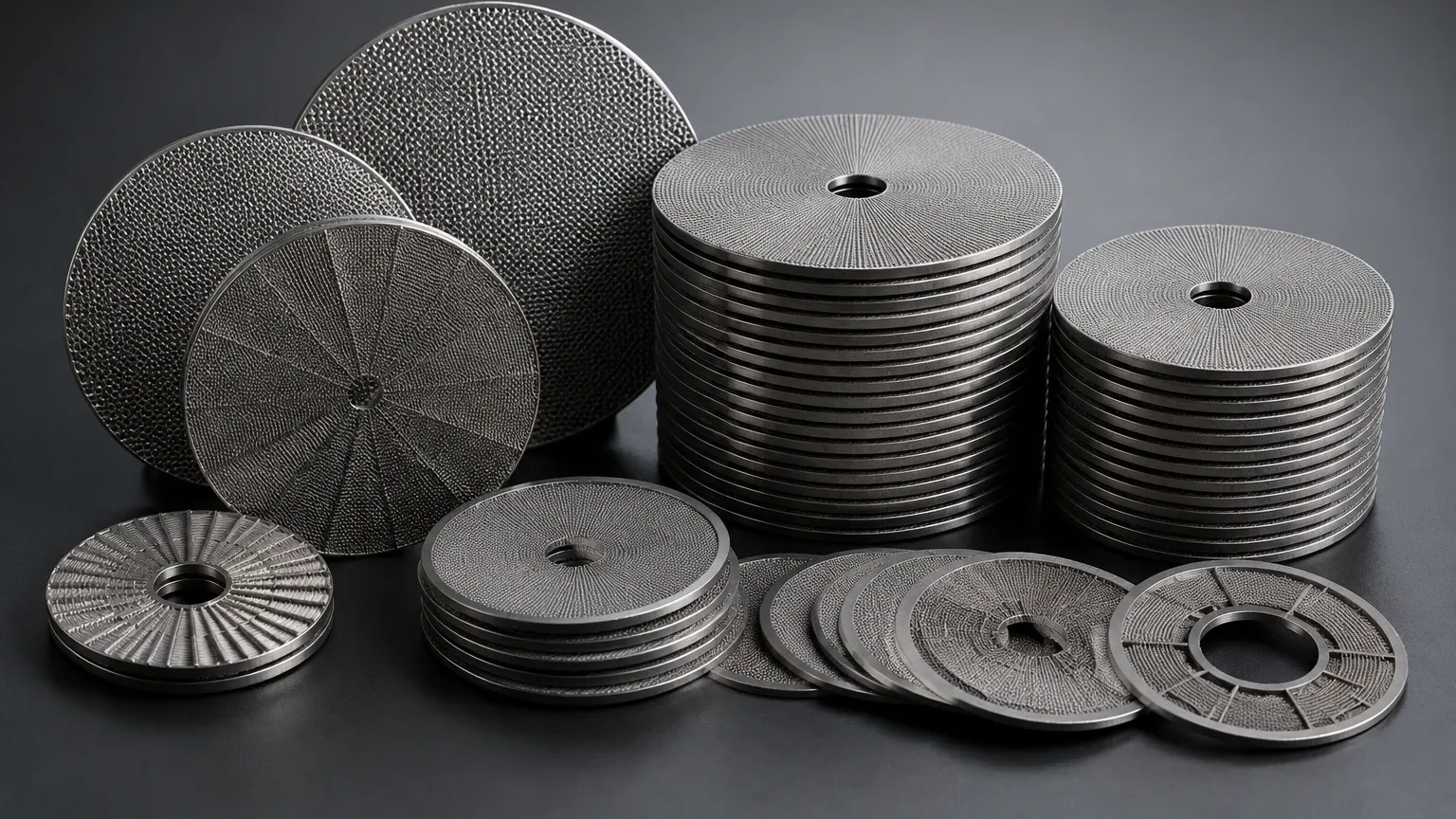
Customization Options for OEM Integration
Standardized filtration solutions often fall short in specialized industrial equipment. Customization of the internal components allows the disc filter tank to meet specific process requirements without necessitating a complete redesign of the housing.
1. Layer Configuration: Filter packs can be engineered with multiple layers, such as a fine filtration layer sandwiched between coarser support and drainage layers. This protects the delicate fine mesh from mechanical damage and improves flow distribution.
2. Edge Treatment: To ensure a leak-proof seal within the tank, discs can be finished with various edge treatments. Common options include spot-welded edges, aluminum or stainless steel rims, or specialized polymer gaskets. The choice depends on the operating temperature and the sealing mechanism of the tank.
3. Geometric Precision: Custom outer and inner diameters (OD/ID) are essential for a proper fit. Precision laser cutting or die-stamping ensures that the discs fit snugly within the tank manifold, preventing bypass and ensuring uniform compression across the stack.
Maintenance, Cleaning, and Replacement Cycles
The operational cost of a disc filter tank is heavily influenced by the frequency of maintenance. Unlike disposable cartridges, stainless steel filter discs are often cleanable, which significantly reduces the total cost of ownership over the life of the project.
Monitoring Pressure Differential
The primary indicator for maintenance is the increase in differential pressure. Most modern disc filter tank systems are equipped with $ΔP$ sensors that trigger an alarm or an automated backwash cycle when the media becomes loaded with solids. Operating beyond the recommended terminal pressure can lead to "media migration," where the mesh deforms or particles are forced through the media.
Cleaning Methodologies
Depending on the contaminant, several methods can be used to restore the performance of the filter discs:
* Backwashing: Reversing the flow of fluid to dislodge surface cake. This is often done in-situ within the disc filter tank.
* Ultrasonic Cleaning: Removing the discs and placing them in an ultrasonic bath with specialized detergents. This is highly effective for removing fine particles trapped deep within the mesh pores.
* Chemical Cleaning: Using acids, alkalis, or solvents to dissolve organic or mineral scaling. Compatibility between the cleaning agent and the filter material (e.g., 316L stainless steel) must be verified.
When to Replace
Despite their durability, filter discs will eventually exhibit signs of fatigue or permanent fouling. If the pressure drop remains high after cleaning, or if visual inspection reveals broken wires or thinning of the mesh, the discs must be replaced. Establishing a routine inspection cycle helps prevent catastrophic failure that could lead to downstream contamination.
Evaluating the Total Cost of Ownership (TCO)
For procurement teams, the initial purchase price of a disc filter tank and its internal components is only one part of the financial equation. A comprehensive TCO analysis should include:
* Operational Efficiency: High-quality Filter Discs & Packs with optimized open areas reduce energy consumption by lowering the resistance to flow.
* Labor Costs: Systems that require frequent manual cleaning or complex replacement procedures increase labor expenses. Choosing robust, easily accessible tank designs can mitigate these costs.
* Product Loss: In high-value applications (e.g., chemical catalysts or essential oils), the amount of fluid retained in the filter cake or lost during changeovers can be substantial. Efficient disc designs minimize holdup volume.
* Durability: Investing in superior materials like 316L stainless steel or sintered mesh may have a higher upfront cost but results in fewer replacement cycles and less risk of process interruption.
By focusing on these technical and economic factors, engineers can ensure that their disc filter tank operates at peak performance, providing reliable and cost-effective filtration for demanding industrial environments. For those seeking specific configurations or material advice, consulting with a specialized manufacturer like Kaifil ensures that the filtration media is precisely engineered for the intended application.
