


Disc Filter 1.5
In the realm of industrial filtration, the specification "disc filter 1.5" typically refers to a 1.5-inch diameter filtration component, a critical size utilized across diverse sectors ranging from laboratory testing to high-pressure hydraulic systems. These precision-engineered components are fundamental to maintaining fluid purity and protecting downstream equipment. For engineers and procurement specialists, selecting the correct Filter Discs & Packs involves a deep understanding of material science, mesh geometry, and mechanical structural integrity.
At Kaifil, we recognize that a 1.5-inch disc is rarely a "one-size-fits-all" solution. The performance of these discs depends heavily on the specific weaving pattern of the wire mesh, the number of layers utilized, and the edge finishing techniques applied during manufacturing. This guide provides a technical overview of the engineering considerations necessary for optimizing filtration performance in demanding B2B environments.
Understanding the Role of 1.5-Inch Filter Discs in Industrial Systems
The 1.5-inch diameter is a standard dimension often found in pilot plants, small-scale chemical processing units, and specialized hydraulic manifolds. Because of its compact size, the disc filter 1.5 must often perform under significant pressure while maintaining a high degree of filtration accuracy.
In industrial applications, these discs serve as the primary barrier against particulate contamination. Whether they are used in the extrusion of polymers, the processing of pharmaceutical ingredients, or the protection of sensitive nozzles in food production, their reliability is paramount. A failure in a single disc can lead to system-wide contamination, unplanned downtime, and significant financial loss. Therefore, the selection process must move beyond simple dimensions to include rigorous performance criteria.
Material Selection and Chemical Compatibility
The choice of material is the first and most critical decision in the engineering of a disc filter 1.5. Stainless steel is the industry standard due to its mechanical strength and resistance to environmental stressors.
Stainless Steel 304
SS304 is the most common material for general industrial use. It offers excellent strength and basic corrosion resistance, making it suitable for water treatment, hydraulic oils, and non-acidic food processing applications. It is cost-effective but may struggle in environments with high chloride concentrations.
Stainless Steel 316 and 316L
For more aggressive environments, SS316 or its low-carbon variant, SS316L, is preferred. The addition of molybdenum enhances resistance to pitting and crevice corrosion, particularly in the presence of chlorides. SS316L is specifically chosen for applications requiring welding, as the low carbon content prevents carbide precipitation during the welding process, ensuring the structural integrity of multi-layer packs remains intact.
Specialized Alloys
In extreme cases involving high temperatures or highly corrosive chemicals (such as concentrated acids), exotic alloys like Hastelloy, Monel, or Inconel may be specified. These materials ensure that the disc filter 1.5 maintains its pore geometry and structural stability even under the most punishing conditions.
Structural Variations: Single Layer vs. Multi-Layer Filter Discs & Packs
The architecture of a filter disc determines its dirt-holding capacity, flow rate, and pressure resistance. Engineers must decide between a simple single-layer mesh or a complex multi-layer assembly.
Single-Layer Discs
Single-layer discs are typically used in low-pressure applications or as a secondary safety screen. They are easy to clean and provide a clear, defined filtration surface. However, they lack the mechanical depth required for high-viscosity fluids or high-pressure differentials.
Multi-Layer Filter Discs & Packs
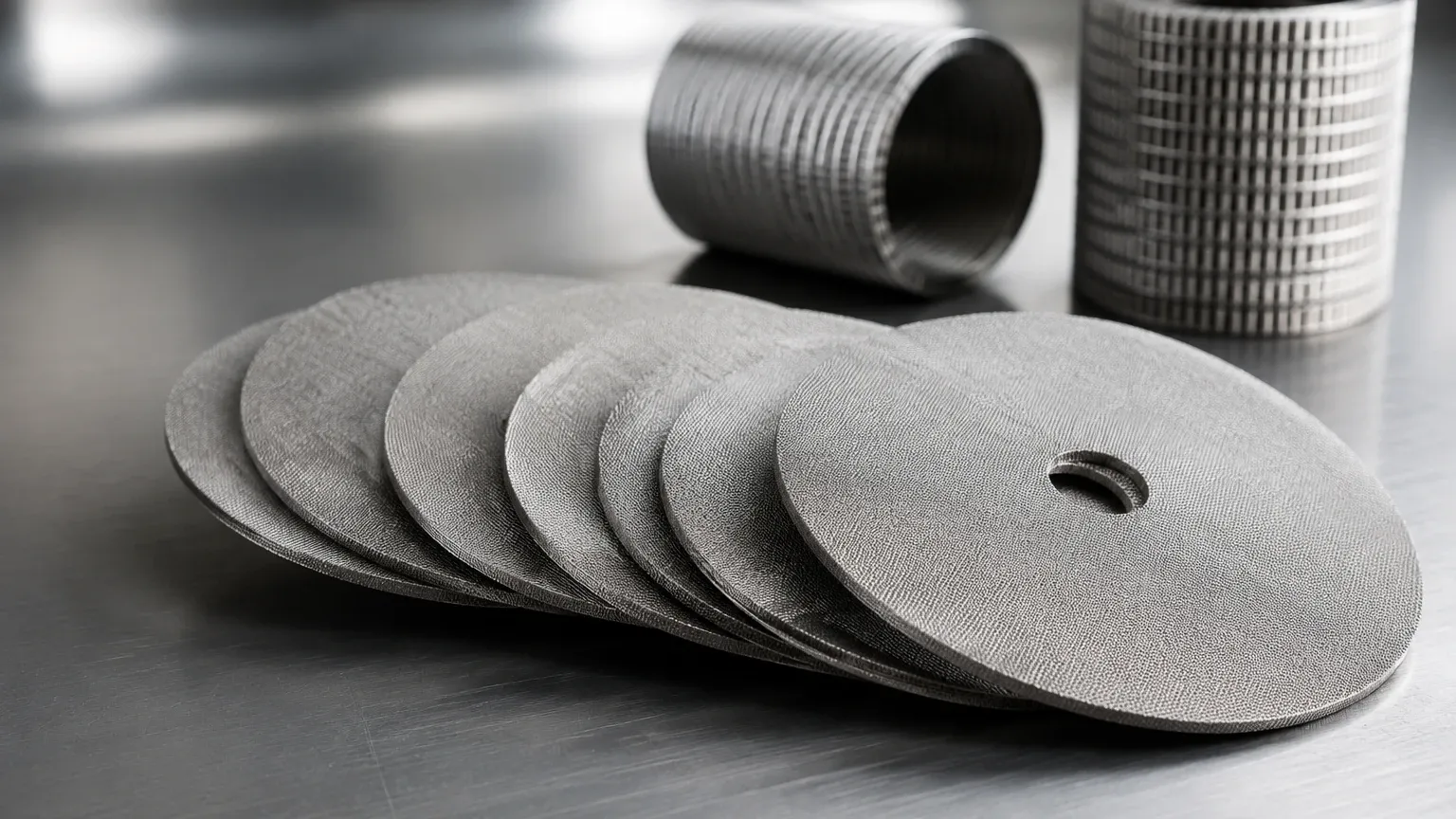
To achieve higher filtration efficiency and structural rigidity, multiple layers of wire mesh are often combined. A typical multi-layer disc filter 1.5 might consist of:
1. Filtration Layer: The middle layer with the specific micron rating required for the application.
2. Support Layers: Coarser mesh layers on either side of the filtration layer to provide mechanical strength and prevent the fine mesh from deforming under pressure.
3. Drainage Layers: Additional layers that facilitate the flow of the filtrate away from the filtration zone, reducing the overall pressure drop.
These layers can be spot-welded together or bound by a metal rim (edging) to ensure they function as a single, cohesive unit. This multi-layer approach significantly increases the service life of the component compared to single-layer alternatives.
Engineering Precision: Dimensions, Tolerances, and Edge Treatments
When specifying a disc filter 1.5, "1.5 inches" is the nominal size, but the actual engineering tolerances are what determine the fit within a housing. A disc that is slightly too large will not seat properly, while one that is too small may allow "bypass," where fluid flows around the filter rather than through it.
Tolerance Standards
Precision manufacturing ensures that the diameter of the disc is held within strict tolerances, often +/- 0.1mm or tighter, depending on the application. This precision is vital for automated assembly lines and high-pressure seals.
Edge Finishing
The treatment of the disc's edge is a critical safety and performance factor. There are three primary types of edge treatments:
* Unrimmed (Raw Edge): The mesh is simply cut to size. This is common for discs that will be clamped tightly within a housing, but it carries a risk of loose wires if not handled carefully.
* Spot-Welded Edge: The layers of a multi-layer pack are spot-welded at the perimeter. This keeps the pack together without adding thickness to the edge.
* Rimmed/Bound Edge: A metal U-shaped channel (usually aluminum, copper, or stainless steel) is wrapped around the edge and compressed. This provides a smooth, burr-free edge and can act as a gasket to improve the seal within the filter housing.
Filtration Performance Metrics: Micron Ratings and Flow Dynamics
The primary function of a disc filter 1.5 is to remove particles of a specific size. This is defined by the micron rating, which can be expressed as "absolute" or "nominal."
Absolute vs. Nominal Micron Ratings
An absolute rating indicates that 99.9% of particles larger than the specified size will be captured. A nominal rating is more of an average, indicating that the mesh will capture a large percentage of particles but may allow some larger ones through due to the nature of the weave. For critical pharmaceutical or chemical processes, absolute-rated Filter Discs & Packs are essential.
Weave Patterns
The way the wires are woven affects both the micron rating and the flow characteristics:
* Plain Weave: The simplest pattern, offering high open area and low pressure drop. Best for coarse filtration.
* Dutch Weave: Uses larger diameter warp wires and smaller diameter shute (weft) wires. This creates a dense, strong mesh capable of very fine filtration (down to 5-10 microns) while maintaining high mechanical strength.
* Twill Weave: Allows for thicker wires in a given micron rating, increasing the durability of the mesh for high-pressure applications.
Pressure Drop (Delta P)
Engineers must calculate the expected pressure drop across the disc filter 1.5. A high initial pressure drop limits the amount of contaminant the filter can hold before it must be cleaned or replaced. By optimizing the weave and layer configuration, Kaifil helps engineers maximize flow rates without compromising filtration accuracy.
Manufacturing Excellence and Quality Control
Producing a high-quality disc filter 1.5 requires advanced manufacturing capabilities. At Kaifil, our process involves several key stages to ensure every component meets industrial standards.
1. Material Verification: Using PMI (Positive Material Identification) to ensure the stainless steel grade matches the customer's specifications.
2. Precision Cutting: Utilizing CNC stamping or laser cutting to achieve exact dimensions and clean edges.
3. Ultrasonic Cleaning: Industrial filters must be free of oil, grease, and metal burrs from the manufacturing process. Ultrasonic cleaning ensures the discs are "clean-room ready" for sensitive applications.
4. Inspection: Every batch undergoes rigorous inspection for mesh consistency, diameter accuracy, and weld integrity.
Application-Specific Considerations
The environment in which the disc filter 1.5 operates dictates its design. Here are a few common scenarios:
Polymer and Plastic Extrusion
In these applications, the discs must withstand extremely high temperatures and pressures. Multi-layer packs are used to filter out gels and impurities from the melt, ensuring the quality of the final plastic product. The discs must be strong enough to resist "blow-out" under the force of the extruder.
Hydraulic and Pneumatic Systems
Here, the focus is on protecting sensitive valves and actuators. The disc filter 1.5 serves as a last-chance filter. It must have a high burst pressure and be compatible with various hydraulic fluids.
Food and Beverage Processing
Filters in this sector must be made from food-grade materials (typically SS316L) and be easy to clean (CIP – Clean In Place). The absence of crevices where bacteria can grow is a critical design requirement, making smooth, rimmed edges or specialized welding techniques necessary.
Procurement and Total Cost of Ownership
When purchasing industrial filtration components, the initial price is only one part of the equation. Technical buyers should consider the total cost of ownership (TCO), which includes:
* Service Life: How long does the disc last before it becomes blinded (clogged)? A slightly more expensive multi-layer pack may last three times longer than a cheap single-layer disc, reducing labor and replacement costs.
* Cleanability: Stainless steel discs are often reusable. Evaluating the ease of backwashing or ultrasonic cleaning can lead to significant long-term savings compared to disposable synthetic filters.
* System Protection: The cost of a 1.5-inch disc is negligible compared to the cost of repairing a damaged high-pressure pump or contaminated batch of product. Investing in high-quality filtration is an insurance policy for the entire production line.
Conclusion
The disc filter 1.5 is a small but vital component in the industrial landscape. Its performance is a result of careful engineering, from the selection of the stainless steel alloy to the precision of the final edge treatment. By understanding the technical nuances of mesh weaves, layer structures, and manufacturing tolerances, engineers can ensure their systems operate at peak efficiency with minimal downtime.
Kaifil specializes in providing customized filtration solutions that meet the exact needs of our global partners. Whether you require a standard single-layer disc or a complex, multi-layer pack for high-pressure environments, our engineering team is ready to support your selection process. To explore our full range of capabilities and technical specifications, we invite you to Review product options and application support and discover how our precision-manufactured components can optimize your industrial filtration processes.
