


Disc Filter 20mm
In the landscape of industrial filtration, precision is often measured in millimeters. The disc filter 20mm is a critical component used across diverse sectors, including chemical processing, hydraulic systems, and pharmaceutical manufacturing. These small-diameter filtration elements are designed to remove particulate matter from fluids and gases, ensuring the integrity of downstream equipment and the purity of the final product. As a specialized manufacturer, Kaifil provides engineered Filter Discs & Packs that meet the rigorous demands of high-pressure and high-temperature environments.
Selecting the correct 20mm disc filter requires a deep understanding of material science, mesh geometry, and the mechanical stresses of the specific application. This guide explores the technical parameters and engineering considerations essential for procurement and system design.
Understanding the Role of 20mm Disc Filters in Industrial Systems
A disc filter with a 20mm diameter is frequently utilized in applications where space is constrained but filtration efficiency cannot be compromised. These components serve as the primary defense mechanism in precision instruments, fuel injectors, and laboratory-scale processing units. Their primary function is to intercept solid contaminants while maintaining a predictable flow rate and pressure drop.
In industrial settings, the 20mm size is often a standard for manifold assemblies and valve protection. Because of their compact size, they must be manufactured to extremely tight tolerances. Even a minor deviation in diameter or thickness can lead to bypass—where unfiltered fluid escapes around the edges of the disc—rendering the filtration process ineffective. Therefore, engineering teams must prioritize dimensional accuracy and edge finishing when sourcing these components.
Material Selection and Engineering Properties
The performance of a disc filter 20mm is largely dictated by the material from which it is constructed. Stainless steel is the industry standard due to its mechanical strength and resistance to environmental degradation.
Stainless Steel 304 vs. 316L
* Stainless Steel 304: This is the most common material for general industrial use. It offers excellent strength and basic corrosion resistance, making it suitable for water treatment, food and beverage processing, and standard hydraulic fluids.
* Stainless Steel 316L: For more demanding environments, 316L is preferred. The addition of molybdenum provides enhanced resistance to pitting and crevice corrosion, particularly in chloride-rich environments or acidic chemical processing. The "L" denotes low carbon content, which improves weldability and prevents intergranular corrosion in sintered or welded packs.
Specialized Alloys
In extreme cases involving highly corrosive chemicals or temperatures exceeding 500°C, manufacturers may utilize exotic alloys such as Hastelloy, Monel, or Inconel. These materials ensure that the 20mm disc maintains its structural integrity and filtration rating under conditions that would cause standard stainless steel to fail.
Construction Types: Single Layer vs. Sintered Multi-Layer Packs
The internal structure of the filter determines its dirt-holding capacity and pressure resistance. Depending on the application, a disc filter 20mm may be constructed in several ways.
Single-Layer Mesh Discs
Single-layer discs are cut from a single sheet of wire cloth. They are cost-effective and ideal for low-pressure applications where the primary goal is to remove large particles. However, they lack the mechanical rigidity required for high-differential pressure environments.
Multi-Layer Spot-Welded Packs
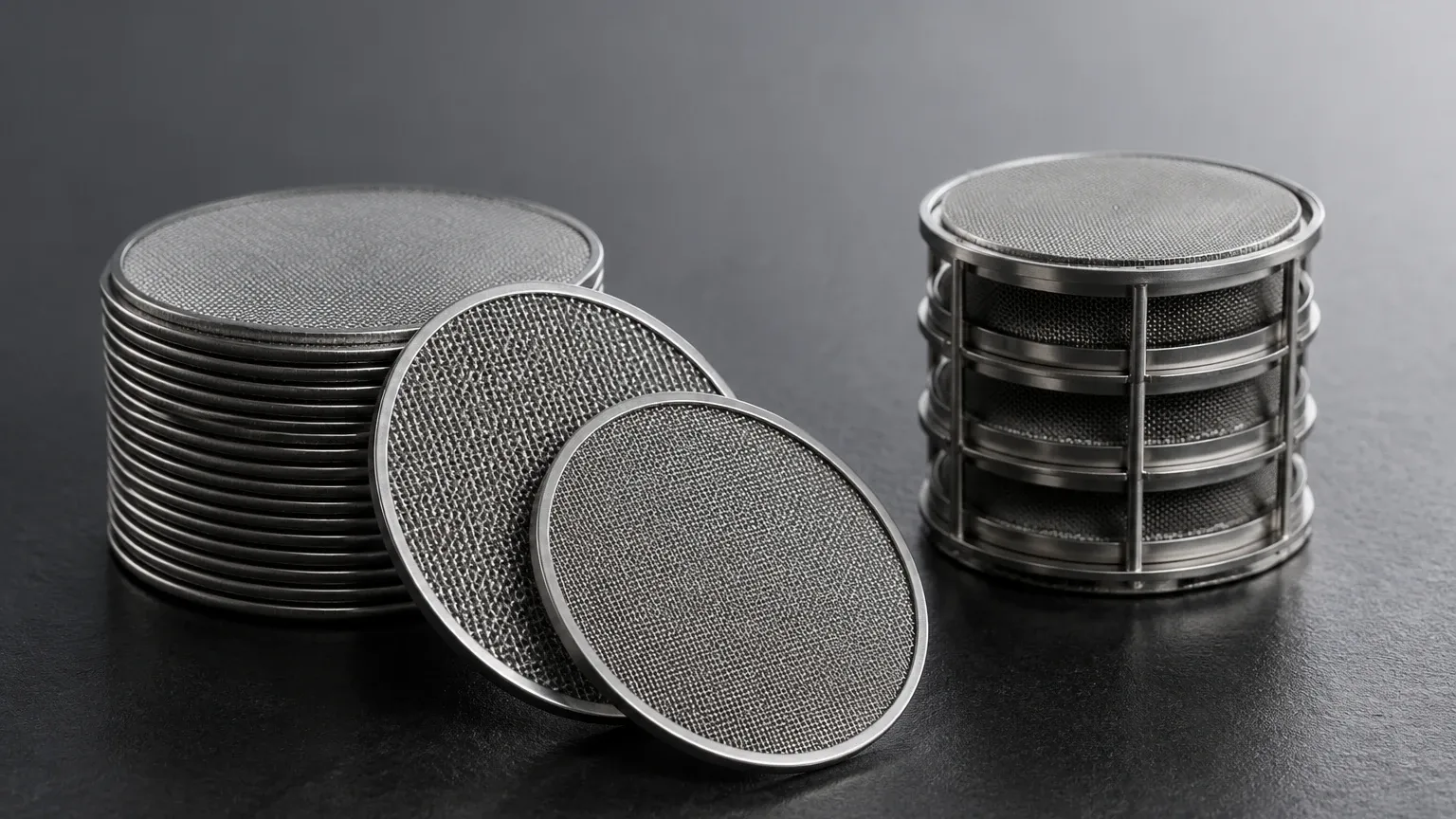
For increased depth filtration and structural support, multiple layers of wire mesh are stacked and spot-welded together. These Filter Discs & Packs often combine a fine filtration layer with coarser support layers. This configuration prevents the fine mesh from deforming under the force of the fluid flow.
Sintered Mesh Discs
Sintering is a process where multiple layers of mesh are bonded together using heat and pressure without the use of binders. This creates a monolithic structure that is incredibly strong and has a fixed pore size. A sintered 20mm disc is the gold standard for high-pressure hydraulic systems and polymer melt filtration, as it cannot migrate or shed wires into the process stream.
Key Performance Metrics: Micron Rating and Pressure Drop
When specifying a disc filter 20mm, engineers must balance filtration fineness with system efficiency. Two metrics are paramount: the micron rating and the pressure drop ($ΔP$).
Absolute vs. Nominal Filtration
* Nominal Rating: Refers to the ability of the filter to retain a major percentage (usually 60% to 90%) of particles of a specific size. This is suitable for non-critical applications.
* Absolute Rating: Refers to the diameter of the largest hard spherical particle that will pass through the filter under specified test conditions. In precision engineering, absolute ratings are required to ensure that no particles larger than the clearance of downstream components (such as a 20μm valve orifice) pass through.
Managing Pressure Drop
The pressure drop across a 20mm disc is influenced by the mesh weave type (Plain, Twill, or Dutch weave) and the total open area. A Dutch weave, for instance, provides a much finer filtration rating but results in a higher initial pressure drop compared to a plain square weave. Engineers must calculate the $ΔP$ to ensure the pump or system pressure can overcome the resistance of the filter as it begins to load with contaminants.
Manufacturing Precision and Customization Options
Manufacturing a 20mm disc requires precision cutting techniques to ensure the edges are clean and the diameter is exact. Common methods include:
1. Stamping/Punching: The most efficient method for high-volume production. Custom dies are used to punch the 20mm shape from mesh rolls. This method is fast but requires careful maintenance of the tooling to avoid frayed edges.
2. Laser Cutting: Ideal for small batches or complex geometries. Laser cutting provides a sealed edge for certain synthetic meshes and extremely high dimensional accuracy for metal meshes.
3. EDM (Electrical Discharge Machining): Used for very thick sintered packs where mechanical punching might distort the internal pore structure.
Edge Treatments
To prevent bypass and facilitate installation, 20mm discs can be finished with different edge treatments:
* Unrimmed: The raw mesh edge is exposed. These are typically used when the disc is compressed within a housing that provides its own seal.
* Rimmed/Framed: The disc is enclosed in a metal rim (often aluminum, copper, or stainless steel). This provides a superior sealing surface and makes the disc easier to handle during replacement.
Industrial Applications for 20mm Filtration Components
The versatility of the disc filter 20mm allows it to be integrated into various specialized industrial processes.
Plastic and Rubber Extrusion
In the extrusion of polymers, "screen packs" consisting of multiple 20mm discs are used to remove un-melted resin and impurities. This ensures the final extruded product has a smooth surface finish and consistent mechanical properties.
Hydraulic and Pneumatic Systems
High-performance hydraulic valves often have internal clearances of only a few microns. A 20mm disc filter is frequently placed at the inlet of these valves to protect them from "built-in" debris (metal shavings from assembly) or generated wear particles.
Pharmaceutical and Biotech
In laboratory-scale filtration and chromatography, 20mm discs are used to clarify solvents and protect sensitive analytical columns. In these applications, 316L stainless steel is mandatory to meet stringent sanitary standards and resist aggressive cleaning agents.
Maintenance, Cleaning, and Replacement Cycles
Unlike disposable polymer filters, stainless steel 20mm discs are often cleanable and reusable, which significantly reduces the total cost of ownership (TCO). However, the cleaning process must be handled correctly to avoid damaging the mesh.
Cleaning Methods
* Ultrasonic Cleaning: The most effective method for removing fine particles trapped within the mesh pores. High-frequency sound waves create cavitation bubbles that dislodge contaminants.
* Backwashing: For simpler mesh structures, reversing the flow of a clean fluid can flush out surface-loaded debris.
* Chemical Cleaning: Using solvents or acids to dissolve organic or mineral deposits. This requires careful material compatibility checks to ensure the cleaning agent does not degrade the stainless steel.
Determining Replacement
A disc filter 20mm should be replaced if it shows signs of mechanical deformation (bowing), mesh blinding that cannot be cleared by cleaning, or if the pressure drop remains high even after a cleaning cycle. In critical applications, a fixed replacement schedule based on operating hours or processed volume is recommended to prevent catastrophic failure.
Procurement Considerations for Engineering Teams
When sourcing Filter Discs & Packs, procurement departments and engineers should confirm several factors with the manufacturer to ensure the product is fit for purpose:
1. Mesh Certification: Request material test reports (MTRs) to verify the grade of stainless steel and the wire diameter.
2. Filtration Efficiency Validation: For critical roles, ask for bubble point test data or glass bead challenge test results to confirm the absolute micron rating.
3. Dimensional Tolerance: Specify the allowable variance in the 20mm diameter. In high-precision housings, a tolerance of +/- 0.05mm may be necessary.
4. Packaging and Cleanliness: For pharmaceutical or electronic applications, specify the required cleanliness level (e.g., oil-free, ultrasonic cleaned, and vacuum-sealed).
By focusing on these technical details, industrial operators can ensure that their choice of a disc filter 20mm provides reliable, long-term performance, protecting both their equipment and their bottom line. Kaifil remains committed to delivering high-performance filtration solutions tailored to the specific needs of global industrial leaders.
