


Disc Filter 3 4
In the landscape of industrial filtration, precision is the primary determinant of system efficiency and equipment longevity. The specification of a "disc filter 3 4"—typically referring to a 3/4-inch diameter filtration component or a component designed for a 3/4-inch housing—represents a critical intersection of compact design and high-performance throughput. These small-diameter filtration solutions are foundational in industries ranging from polymer extrusion and chemical processing to hydraulic systems and pharmaceutical manufacturing.
Selecting the correct Filter Discs & Packs requires a deep understanding of material science, fluid dynamics, and mechanical engineering. When dealing with a disc filter 3 4, engineers must account for the specific micron rating, the structural integrity of the wire mesh, and the environmental conditions of the application, including temperature and chemical exposure.
Engineering Specifications of the Disc Filter 3 4
The performance of a 3/4-inch filter disc is dictated by its construction. These components are rarely monolithic; instead, they are engineered assemblies designed to balance particle retention with flow resistance. The primary material for these filters is stainless steel, specifically grades 304, 316, and 316L, due to their exceptional mechanical properties.
Wire Mesh Weave Types
For a disc filter 3 4, the choice of weave affects both the filtration accuracy and the pressure drop across the media:
* Plain Weave: The most common structure where the warp and shute wires cross over and under each other. It provides a consistent aperture size and is ideal for general-purpose liquid and gas filtration.
* Twill Weave: This allows for a heavier wire diameter in a given mesh count, increasing the strength and durability of the disc for high-pressure applications.
* Dutch Weave: Characterized by a higher density of wires, Dutch weaves (plain or twill) offer superior filtration fineness, often reaching down to the sub-micron level. This is particularly useful in hydraulic systems where fine particulate can cause catastrophic component failure.
Dimensional Accuracy
In a 3/4-inch specification, tolerances are tight. Even a minor deviation in the outer diameter can lead to bypass—a condition where the process fluid flows around the filter rather than through it. Precision die-cutting or laser-cutting processes are employed to ensure that each disc filter 3 4 fits perfectly within its designated housing or recessed seat.
Applications and Industrial Use Cases
The 3/4-inch size is a standard in many industrial sub-systems. Its compact footprint makes it suitable for integrated filtration where space is at a premium but performance cannot be compromised.
Polymer and Fiber Extrusion
In the production of synthetic fibers and plastics, molten polymers are forced through spinnerets at high pressures. A disc filter 3 4 is often used as part of a multi-stage pack to remove gels, agglomerates, and foreign particles. The small diameter allows for localized filtration just before the polymer enters the final extrusion die, ensuring a clean, defect-free final product.
Hydraulic and Pneumatic Systems
Precision hydraulic valves and actuators are sensitive to particulate contamination. A 3/4-inch disc filter is frequently installed in inline housings to protect sensitive downstream components. These filters must withstand significant differential pressures (ΔP) without deforming, making the choice of reinforced mesh or multi-layer packs essential.
Chemical and Pharmaceutical Processing
In laboratory-scale reactors or pilot plants, 3/4-inch connections are common. Stainless steel filter discs are used here for their inertness and ability to be sterilized. They are critical for the recovery of catalysts or the removal of precipitates from aggressive chemical solvents.
Single-Layer vs. Multi-Layer Filter Discs & Packs
When specifying a disc filter 3 4, engineers must decide between a single-layer disc and a multi-layer pack. This decision is based on the required filtration depth and the mechanical load the filter will encounter.
Single-Layer Discs
Single-layer discs are cost-effective and suitable for applications with low particulate loads or where the filter is frequently replaced. They provide surface filtration, meaning particles are trapped on the upstream side of the mesh. While simple, they are limited in their dirt-holding capacity compared to their multi-layer counterparts.
Multi-Layer Filter Packs
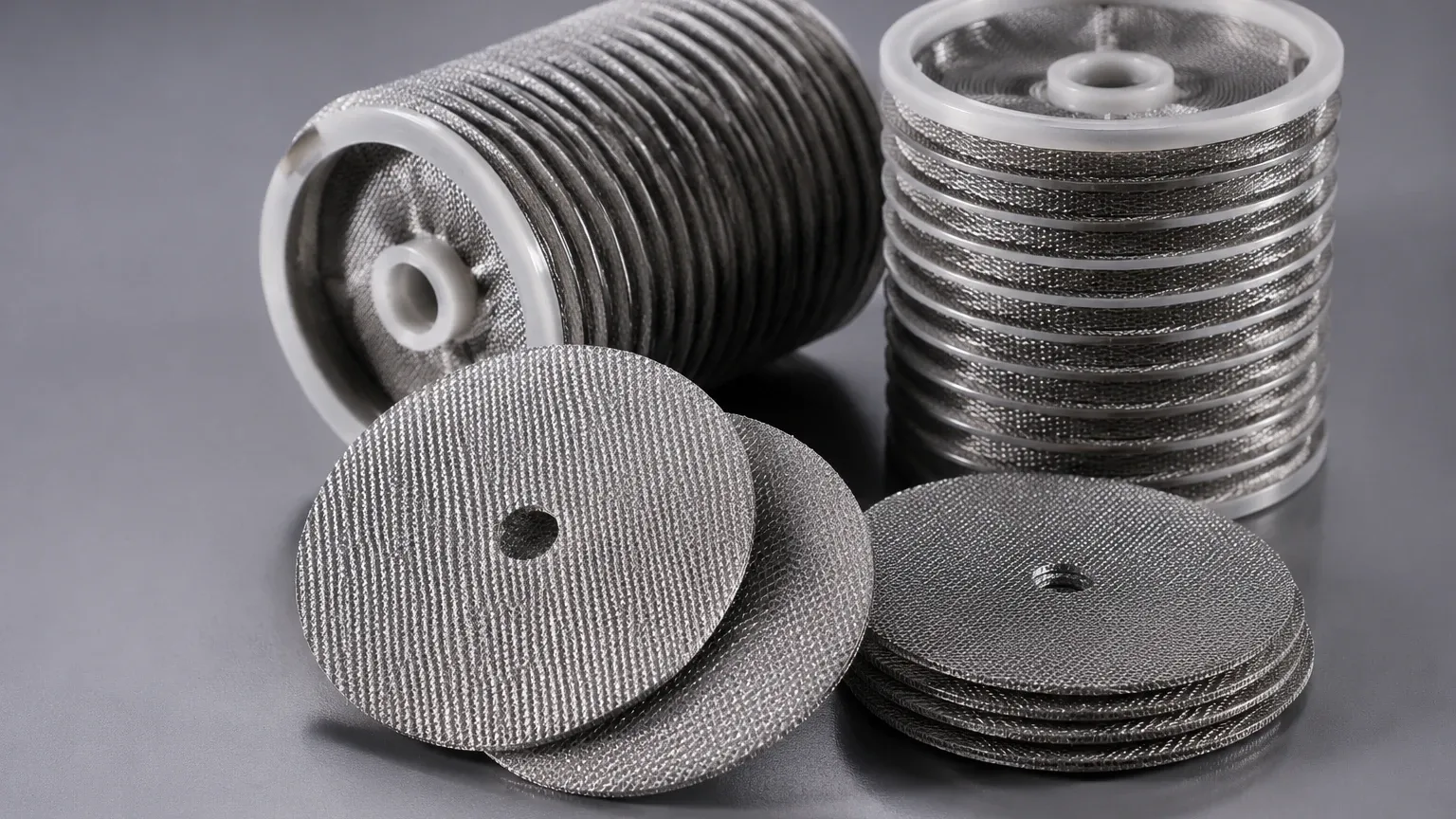
Multi-layer packs consist of several layers of wire mesh with varying micron ratings. Typically, a coarse mesh acts as a support layer, a medium mesh serves as a drainage layer, and a fine mesh performs the actual filtration. These layers are often spot-welded together or bound with a metal rim (aluminum, stainless steel, or copper) to form a rigid, cohesive unit.
The advantage of using multi-layer Filter Discs & Packs in a 3/4-inch configuration is the increased structural rigidity. Under high-pressure flow, a single layer might bow or rupture, whereas a pack maintains its shape, ensuring consistent filtration across the entire surface area.
Material Selection and Chemical Compatibility
The longevity of a disc filter 3 4 is heavily dependent on its compatibility with the process fluid. Stainless steel is the industry standard for several reasons:
1. Corrosion Resistance: Grade 316L contains molybdenum, which provides enhanced resistance to pitting and crevice corrosion in chloride-rich environments or acidic solutions.
2. Temperature Stability: Stainless steel filters can operate at temperatures exceeding 400°C (750°F), far beyond the capabilities of polymer-based filter media. This is essential for steam filtration or high-temperature oil systems.
3. Mechanical Strength: The high tensile strength of stainless steel wire allows for the creation of thin, high-porosity filters that can still withstand significant mechanical stress.
In specialized cases, other alloys like Monel, Inconel, or Hastelloy may be used for extreme chemical resistance, though these are typically reserved for highly specialized disc filter 3 4 applications where standard stainless steel would fail prematurely.
Customization and OEM Manufacturing Considerations
Industrial filtration is rarely a one-size-fits-all field. For engineers and purchasing teams, the ability to customize the disc filter 3 4 is a significant advantage. Customization options usually include:
* Micron Ratings: Ranging from 2 microns to 2000 microns, allowing for precise control over particle retention.
* Rim Materials: The use of a rim or "binding" helps in sealing the filter within the housing. Choosing the right rim material (e.g., annealed copper for high-pressure seals) is as important as the mesh itself.
* Shape Variations: While "disc" implies a circle, the term often covers various geometric shapes, including oval, rectangular, or ring-shaped filters, all tailored to specific equipment geometries.
* Layer Configuration: Customizing the sequence of mesh layers to optimize the balance between filtration efficiency and service life.
When working with an OEM manufacturer, it is vital to provide detailed drawings or specifications regarding the operating pressure, flow rate, and the type of contaminant being targeted. This ensures the resulting disc filter 3 4 is fit for purpose.
Maintenance, Cleaning, and Replacement Cycles
One of the primary benefits of stainless steel filter discs is that they are often cleanable and reusable, which significantly reduces the total cost of ownership compared to disposable filters.
Cleaning Methods
* Ultrasonic Cleaning: This is the most effective method for wire mesh filters. High-frequency sound waves create cavitation bubbles that dislodge deeply embedded particles without damaging the delicate wire structure.
* Backwashing: In some systems, the flow can be reversed to flush contaminants off the surface of the disc.
* Chemical Cleaning: Using solvents or detergents to dissolve organic or chemical buildup, provided the chemicals are compatible with the stainless steel grade.
Determining Replacement Cycles
Despite being cleanable, a disc filter 3 4 will eventually reach the end of its service life. The primary indicator for replacement is the "terminal pressure drop." As the mesh becomes permanently blinded or the wire structure fatigues from repeated pressure cycles, the ΔP will rise more rapidly after each cleaning. Establishing a baseline ΔP for a clean filter and a set limit for replacement helps prevent system downtime and ensures consistent process quality.
Conclusion
The disc filter 3 4 is a small but indispensable component in modern industrial processes. Whether it is used in a single-layer configuration for simple straining or as a complex, multi-layered pack for high-precision extrusion, its performance is a product of rigorous engineering and material selection. By focusing on the technical requirements—from mesh weave and micron rating to material grade and structural reinforcement—engineers can ensure that their filtration systems operate at peak efficiency. For those seeking reliable, high-performance solutions, exploring the diverse range of Filter Discs & Packs is the first step toward optimizing industrial filtration performance and protecting critical equipment.
