


Wedge Wire Screen for Sale
In industrial filtration and separation, the choice of media directly impacts operational efficiency, maintenance frequency, and the total cost of ownership. For engineers and procurement professionals searching for a wedge wire screen for sale, understanding the technical nuances of these components is essential to ensuring long-term performance. Wedge wire, also known as profile wire or V-wire, is a specialized filtration medium characterized by its precision-engineered V-shaped profiles resistance-welded onto support rods.
Unlike traditional woven wire mesh or perforated plates, wedge wire offers a unique combination of high mechanical strength and a non-clogging surface. This makes it the preferred solution for demanding applications in water treatment, mining, food and beverage processing, and petrochemical refining. When evaluating options, it is critical to look beyond the initial price and focus on the engineering specifications that match your specific process requirements.
Technical Principles of Wedge Wire Filtration
The primary advantage of Wedge Wire Screens lies in their geometric design. The V-shaped profile wire is oriented so that the narrowest part of the aperture is at the surface of the screen. As particles pass through the slot, the opening widens inwardly. This design creates a "two-point contact" system, which significantly reduces the risk of blinding or clogging. If a particle is small enough to enter the slot, it will pass through freely without becoming wedged.
From an engineering perspective, this geometry provides a high percentage of open area relative to the structural integrity of the screen. This allows for high flow rates with minimal pressure drop. Furthermore, the continuous slot design ensures that the effective filtration area is maximized, which is particularly important in high-solids loading environments where surface area is at a premium.
Material Selection and Corrosion Resistance
When sourcing a wedge wire screen for sale, material selection is the first line of defense against premature failure. Industrial environments often involve corrosive fluids, high temperatures, or abrasive slurries. Kaifil specializes in manufacturing these components from high-grade stainless steel to ensure durability.
* Stainless Steel 304: The standard choice for general industrial applications. It offers good corrosion resistance and is cost-effective for water treatment and food processing where chemical exposure is moderate.
* Stainless Steel 316L: Containing molybdenum, this grade provides superior resistance to chlorides and pitting. It is the industry standard for marine environments, pharmaceutical production, and chemical processing.
* Duplex Stainless Steels: For extreme environments involving high stress and highly corrosive media, Duplex alloys offer nearly double the yield strength of austenitic grades and exceptional resistance to stress corrosion cracking.
* Special Alloys: In specific cases involving high-temperature acids or specialized chemical catalysts, alloys like Hastelloy or Monel may be required to prevent material degradation.
Selecting the correct material ensures that the screen maintains its slot tolerances over its service life, preventing bypass and ensuring consistent filtrate quality.
Engineering Considerations: Slot Size and Open Area
The most critical specification for any wedge wire component is the slot size (aperture). Slot sizes for wedge wire screens can range from as small as 20 microns to several millimeters, depending on the application. Precision in slot width is paramount; even a minor deviation can lead to the loss of valuable media or the contamination of the downstream process.
Calculating Open Area
The open area percentage is a function of the slot width and the width of the profile wire used. The formula is generally expressed as:
Open Area % = (Slot Width / (Slot Width + Wire Width)) x 100
Engineers must balance the need for a high open area (to maximize flow and reduce pressure drop) with the need for mechanical strength. A narrower profile wire increases the open area but reduces the screen's ability to withstand hydrostatic pressure and mechanical impact. Conversely, a heavier profile wire increases durability but may necessitate a larger pump or more frequent cleaning cycles due to reduced flow capacity.
Structural Configurations and Customization
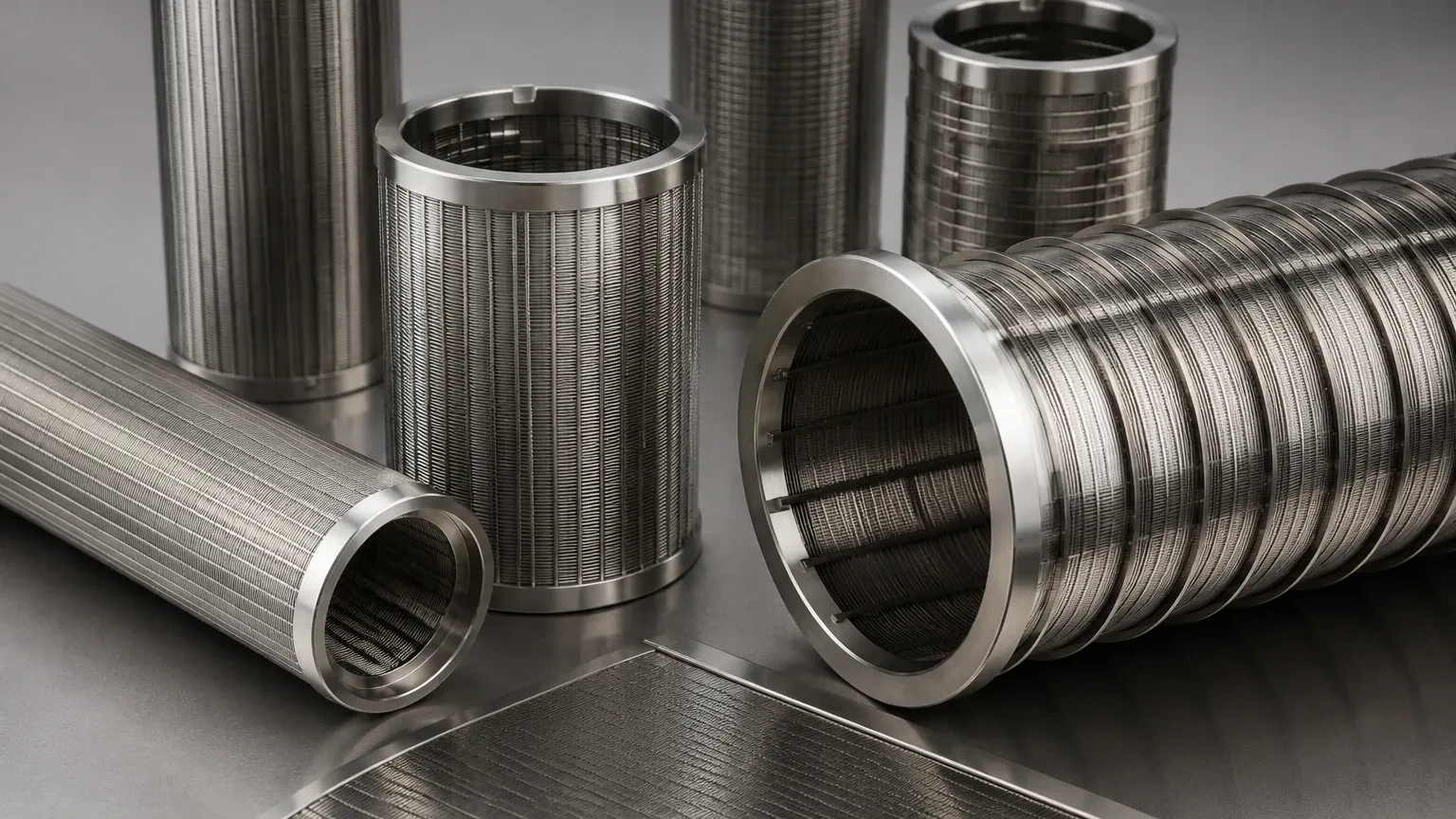
Wedge wire is a highly versatile medium that can be fabricated into various geometries to suit specific equipment designs. When looking for a wedge wire screen for sale, you should confirm the manufacturer’s capability to produce the following configurations:
1. Flat Panels: Used in vibrating screens, floor drains, and intake screens. These can be reinforced with frames or stiffeners to handle heavy loads.
2. Cylindrical Cartridges: Often used in pressurized filter housings or as intake strainers. These can be designed for outside-to-inside (O-I) or inside-to-outside (I-O) flow.
3. Sieve Bends (DSM Screens): Curved panels used in gravity-fed separation. The curved geometry utilizes the Coanda effect to strip liquid from the solids more efficiently than a flat screen.
4. Support Grids: Large-diameter circular screens used in reactor vessels to support catalyst beds or ion exchange resins. These require high load-bearing capacity to support the weight of the media and the fluid pressure.
Customization is a core part of the Kaifil manufacturing process. OEM requirements often dictate specific end fittings, such as flanges, threaded couplings, or reinforced rings, to ensure seamless integration into existing systems.
Evaluating Quality and Manufacturing Standards
Not all wedge wire screens are manufactured to the same standard. When evaluating a wedge wire screen for sale, technical professionals should inquire about the welding technology and quality control measures employed by the supplier.
Modern wedge wire production utilizes advanced resistance welding (fusion welding). In this process, the profile wire and support rods are welded at every intersection point. This creates a rigid, single-piece structure that is far more durable than mechanical assembly or point welding. High-quality welding ensures that the slot widths remain uniform even under significant vibration or thermal expansion.
Key quality checkpoints include:
* Slot Tolerance: Verification that the aperture remains consistent across the entire surface.
* Verticality and Straightness: Ensuring cylindrical screens are perfectly round and flat panels are not warped, which is essential for proper sealing in housings.
* Surface Finish: For food and pharmaceutical applications, screens may require electropolishing or mechanical polishing to remove burrs and ensure a smooth, sanitary surface.
Application-Specific Performance Expectations
The performance of a wedge wire screen is best measured by its ability to handle the specific stresses of its intended application.
* Water Treatment: In sand filters or carbon towers, wedge wire nozzles and laterals must prevent the loss of expensive media while maintaining low head loss. The non-clogging nature of the V-wire is essential for efficient backwashing.
* Mining and Aggregates: Screens used in dewatering or sizing must be made from abrasion-resistant materials and heavy-duty profiles to withstand the constant impact of ores and rocks.
* Food and Beverage: In mashing tuns or juice extraction, the screen must provide high flow rates while being easy to clean (CIP – Clean In Place) to prevent bacterial growth.
* Pulp and Paper: Wedge wire cylinders are used in pressure screens to remove contaminants from fiber. Here, the precision of the slot is vital to ensuring paper quality.
Maintenance, Cleaning, and Replacement Cycles
One of the primary reasons engineers specify Wedge Wire Screens is their ease of maintenance. Because the slots are wider on the discharge side, most debris can be removed through simple backwashing or mechanical scraping.
However, even the most durable screens eventually require inspection. Factors that influence the replacement cycle include the abrasiveness of the process fluid, the frequency of pressure spikes, and the chemical compatibility of the cleaning agents used. A well-designed wedge wire screen can often last several times longer than a wire mesh equivalent, leading to lower long-term costs despite a higher initial purchase price.
When sourcing a wedge wire screen for sale, it is advisable to discuss the expected pressure differential (ΔP) limits with the manufacturer. Operating a screen beyond its design pressure can lead to structural deformation, which compromises filtration accuracy and may lead to catastrophic failure of the component.
Conclusion: Making an Informed Purchase
Choosing the right wedge wire screen requires a thorough understanding of your process variables, including flow rate, particle size distribution, chemical environment, and mechanical load. By focusing on precision manufacturing, material integrity, and customized engineering, you can ensure that your filtration system operates at peak efficiency with minimal downtime.
Kaifil provides professional-grade filtration solutions tailored to the rigorous demands of global industry. Whether you require a standard replacement part or a custom-engineered component for a new installation, our technical team is available to assist with material selection, slot calculations, and design optimization to ensure you receive the highest value from your investment.
