


Wedge Wire Fish Screen
In industrial water intake systems, the protection of aquatic life is both an environmental necessity and a regulatory requirement. The wedge wire fish screen has emerged as the industry standard for balancing high-volume water extraction with the safety of local fish populations. These specialized components utilize the unique geometry of Wedge Wire Screens to provide a non-clogging, low-maintenance solution that prevents fish impingement and entrainment. For engineers and procurement teams, understanding the technical nuances of these screens—from hydraulic performance to material durability—is essential for ensuring long-term operational efficiency and environmental compliance.
The Role of Wedge Wire in Fish Protection
Industrial facilities, such as power plants, desalination units, and chemical processing sites, often require vast amounts of water from natural sources like rivers, lakes, or oceans. Traditional intake methods pose significant risks to aquatic life. Fish can be trapped against the screen surface by the force of the water (impingement) or pulled through the screen into the system’s internal machinery (entrainment).
A wedge wire fish screen is engineered to mitigate these risks through precise hydraulic control. By utilizing a V-shaped wire profile, these screens offer a high percentage of open area while maintaining a very narrow slot width. This design allows for a low "approach velocity," which is the speed of the water as it moves toward the screen surface. When the approach velocity is kept sufficiently low—typically below 0.5 feet per second (fps) depending on local regulations—most fish species are able to detect the flow and swim away from the intake without becoming trapped.
Technical Design Principles: Hydraulics and Slot Geometry
The effectiveness of a wedge wire fish screen depends on two primary hydraulic factors: approach velocity and sweeping velocity.
Approach Velocity
Approach velocity is the most critical metric for fish safety. It must be uniform across the entire surface of the screen to prevent "hot spots" where suction is too high. Engineers achieve this uniformity through internal flow modifiers or by optimizing the screen's surface area relative to the pump's intake capacity. High-quality manufacturing ensures that slot tolerances are strictly maintained, as even minor deviations can lead to localized velocity spikes.
Sweeping Velocity
Sweeping velocity refers to the flow of water moving parallel to the screen surface. In a well-designed intake system, the sweeping velocity should be higher than the approach velocity. This encourages fish and debris to be "swept" past the screen rather than being pulled against it. The smooth, continuous slots of Wedge Wire Screens facilitate this movement, reducing the likelihood of organic material becoming lodged in the gaps.
Slot Width Selection
The slot width, or the distance between individual V-shaped wires, is determined by the size of the aquatic species being protected. For larval fish or small fry, slot widths as narrow as 0.5mm to 1.0mm may be required. For larger species, widths of 2.0mm to 4.75mm are common. Because Kaifil specializes in custom filtration solutions, these slot widths can be tailored to meet the exact biological requirements of a specific site.
Material Selection for Longevity and Performance
Fish screens operate in some of the most demanding environments, ranging from silt-heavy riverbeds to corrosive saltwater estuaries. Material selection is therefore a primary concern for ensuring the structural integrity and lifespan of the screen.
1. Stainless Steel 304/304L: Suitable for freshwater applications where corrosion levels are relatively low. It provides excellent structural strength and resistance to physical impact from debris.
2. Stainless Steel 316/316L: The standard for brackish water or mildly corrosive environments. The addition of molybdenum improves resistance to pitting and crevice corrosion.
3. Duplex and Super Duplex Stainless Steel: For marine environments with high salinity, Duplex alloys offer superior yield strength and exceptional resistance to chloride-induced stress corrosion cracking. These are often used in offshore oil and gas or desalination intakes.
4. Copper-Nickel Alloys: In environments where biofouling (the growth of algae, mussels, or barnacles) is a major concern, copper-nickel alloys provide natural antimicrobial properties that inhibit growth on the screen surface, though they are generally more expensive and less common than stainless steel for large-scale structures.
Structural Configurations and Customization
Wedge wire fish screens are not one-size-fits-all components. They must be integrated into the specific geography and infrastructure of the intake site. Common configurations include:
T-Intake Screens
These are cylindrical screens shaped like a "T," typically mounted on a submerged pier or directly on the floor of a water body. The cylindrical shape provides a large surface area in a compact footprint, which helps in achieving the low approach velocities required for fish protection.
Drum Screens
Rotating drum screens are often used in irrigation diversions or river intakes where debris loads are high. As the drum rotates, the wedge wire surface is continuously cleaned by a spray bar or a mechanical brush, ensuring that the slots remain open for water passage.
Flat Panel and Diversion Screens
In canal systems or hydro-power bypasses, flat wedge wire panels are installed at an angle to the flow. This orientation utilizes the natural sweeping velocity of the water to guide fish toward a bypass channel while allowing clean water to pass through the screen into the intake.
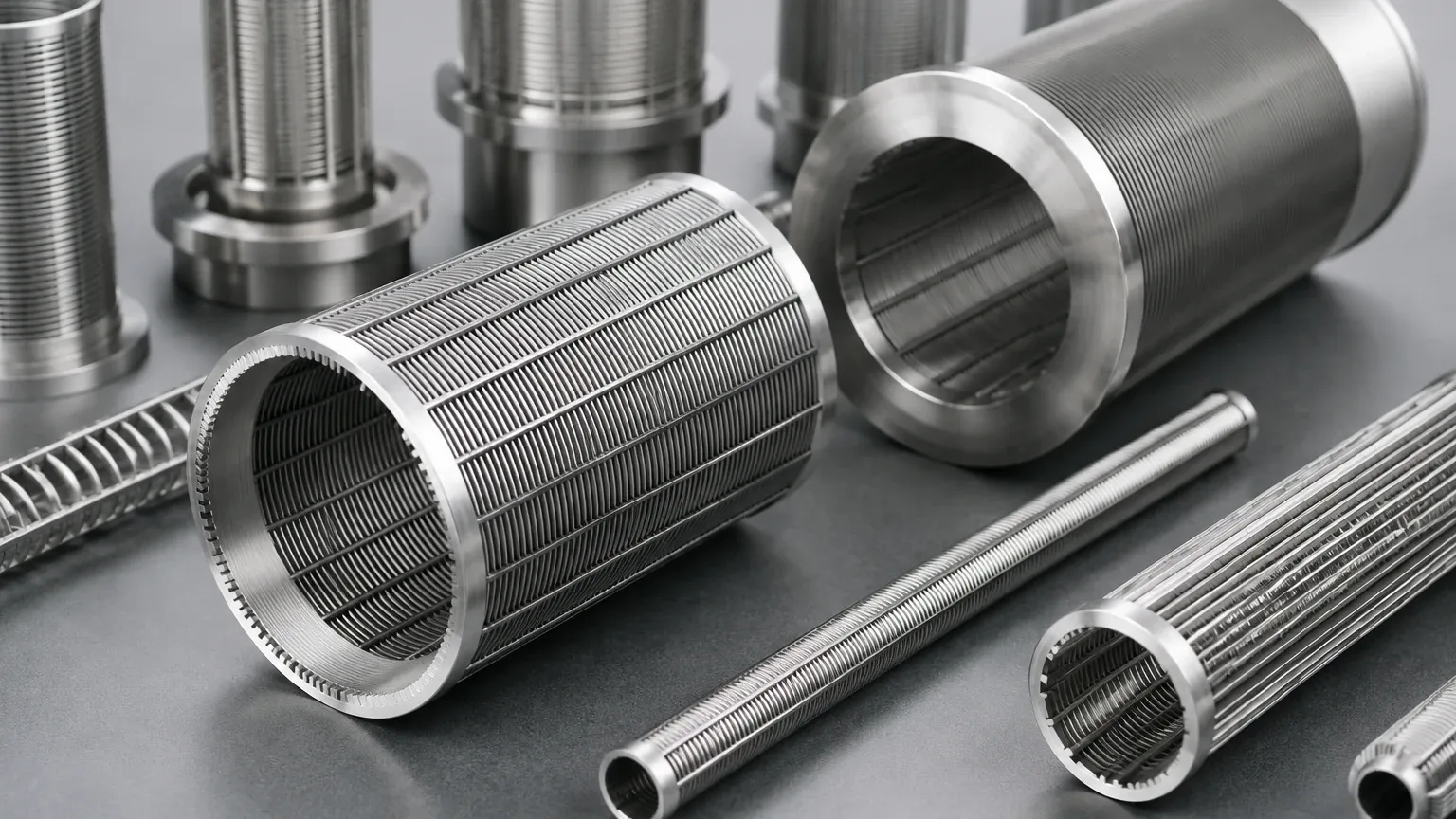
Kaifil’s manufacturing capabilities allow for the customization of support rods and wire profiles to handle specific hydrostatic pressures. In deep-water applications, the screen must be able to withstand the pressure differential if the slots become partially blinded, requiring robust internal reinforcement.
Maintenance and Self-Cleaning Mechanisms
One of the primary advantages of using Wedge Wire Screens for fish protection is their inherent resistance to clogging. The V-shaped wire creates a "two-point contact" for any particle passing through the slot. If a particle can fit through the narrowest part of the slot at the surface, it will easily clear the widening gap behind it.
However, in environments with high organic matter or biofouling, additional cleaning systems are necessary to maintain hydraulic performance:
* Air Burst Systems: This is the most common cleaning method for submerged fish screens. A burst of compressed air is released from inside the screen, creating a pressure wave that dislodges debris from the surface. These systems can be automated to trigger based on a specific differential pressure (dP) threshold.
* Mechanical Brushes: For drum screens or flat panels, internal or external brushes can be used to physically sweep the surface. The durability of stainless steel wedge wire is essential here, as it must resist the abrasive wear of the brushes over thousands of cycles.
* Passive Cleaning: In high-velocity rivers, the natural flow of the water (sweeping velocity) often provides sufficient cleaning for wedge wire surfaces, making them a "passive" solution that requires very little energy consumption.
Evaluation Criteria for Engineers and Purchasing Teams
When specifying a wedge wire fish screen for a project, engineers should evaluate several key factors to ensure the component meets both environmental and operational goals:
1. Total Open Area
Calculate the required open area based on the maximum design flow of the intake and the maximum allowable approach velocity. A higher open area reduces the overall size (and cost) of the screen structure needed to meet velocity limits.
2. Structural Load and Collapse Strength
Consider the maximum head loss the screen might experience during a heavy debris event. The support rods must be spaced and sized to prevent the screen from collapsing under suction if the slots become obstructed.
3. Regulatory Alignment
Ensure the slot width and velocity profiles comply with local environmental agencies (such as the EPA in the United States or equivalent bodies globally). Documentation of the screen's hydraulic performance is often required for permitting.
4. OEM and Manufacturing Precision
Because fish screens are often large, custom-engineered structures, working with a manufacturer that understands the nuances of wedge wire fabrication is critical. Precision in the resistance welding process ensures that every slot is uniform, which is the foundation of both fish safety and screen longevity.
Conclusion
The wedge wire fish screen represents a sophisticated intersection of hydraulic engineering and environmental stewardship. By leveraging the non-clogging characteristics and structural strength of Wedge Wire Screens, industrial facilities can achieve reliable water intake while protecting delicate aquatic ecosystems.
As a professional manufacturer, Kaifil provides the technical expertise and manufacturing precision required to develop custom fish screening solutions. From selecting the appropriate stainless steel grade for corrosive marine environments to engineering the internal flow modifiers for uniform velocity, Kaifil works closely with engineering teams to deliver durable, high-performance filtration components. Investing in a well-designed wedge wire system not only ensures regulatory compliance but also reduces long-term maintenance costs and protects the operational integrity of the entire water intake infrastructure.
