


Wedge Wire Screen Meaning
In the landscape of industrial filtration and separation, the term "wedge wire" refers to a specific type of precision-engineered metal profile used to create screens with high mechanical strength and exceptional resistance to clogging. Understanding the wedge wire screen meaning requires looking beyond its simple appearance as a metal grate; it is a sophisticated engineering solution designed to handle high-pressure differentials, abrasive materials, and continuous flow requirements in demanding industrial environments.
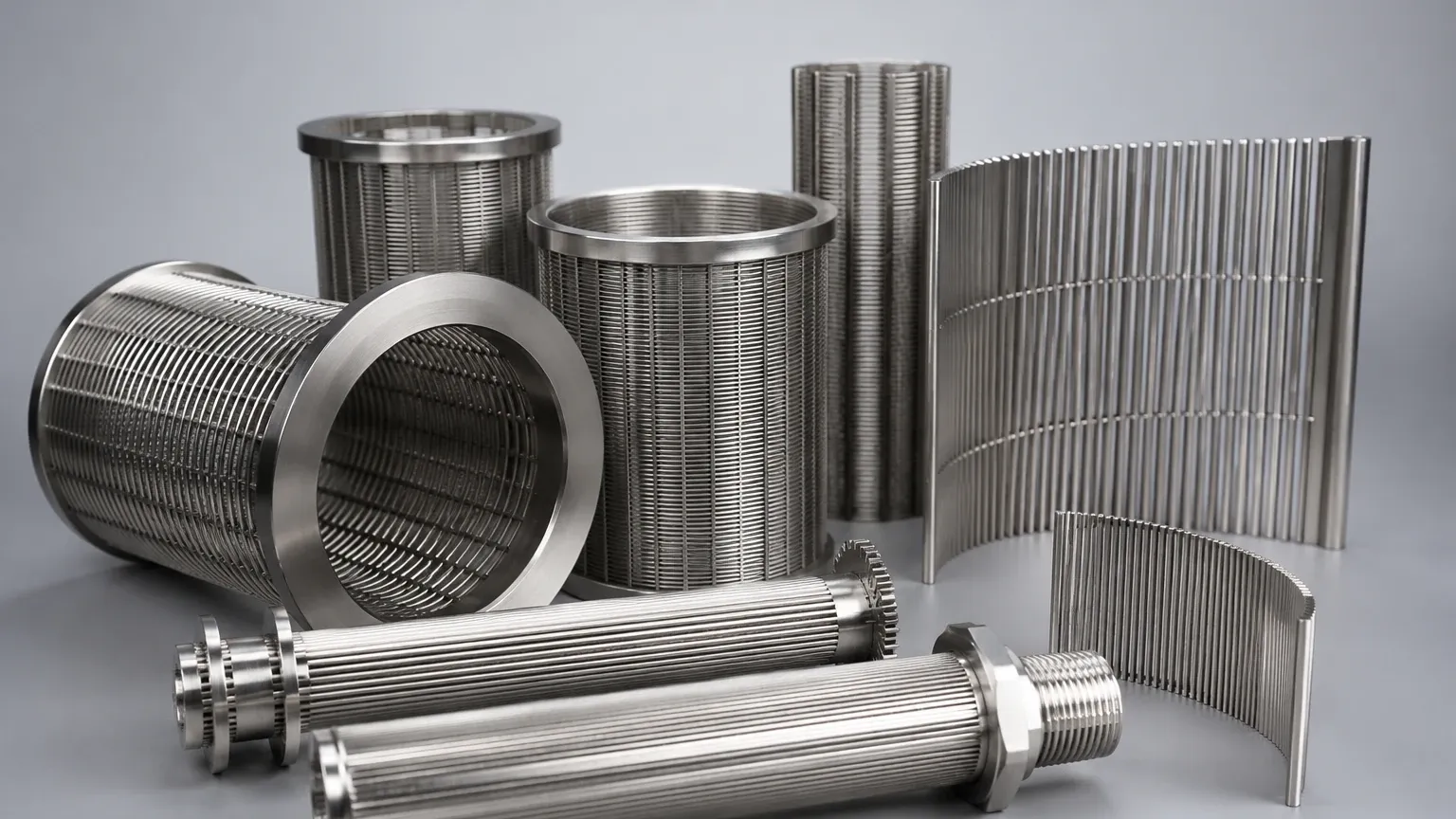
At its core, a wedge wire screen is a fusion-welded structure composed of V-shaped (wedge-shaped) profiles and support rods. Unlike traditional woven wire mesh or perforated plates, these screens are manufactured using a specialized welding process that ensures every intersection of the wire and the rod is securely bonded. This construction results in a rigid, durable component that maintains its structural integrity under extreme mechanical stress.
The Fundamental Structure of Wedge Wire Screens
To grasp the technical wedge wire screen meaning, one must examine the geometry of the components. The "wedge" refers to the cross-section of the surface wire. This wire is typically triangular or V-shaped, with the widest part of the triangle facing the incoming flow of the medium.
Behind these surface wires are support rods, which are oriented perpendicularly to the surface profiles. During the manufacturing process, the surface wire is wrapped around the support rods, and each contact point is resistance-welded. This creates a continuous slot that remains consistent across the entire surface of the screen. Because the slot is formed by the gap between two V-shaped wires, the opening widens inwardly.
This specific geometry is the defining characteristic of Wedge Wire Screens. It allows for a precise "slot size"—the distance between the surface wires—which determines the filtration rating. In industrial applications, these slot sizes can range from as small as 20 microns to several millimeters, depending on the separation requirements of the specific process.
The Engineering Principle: Two-Point Contact and Non-Clogging
One of the most critical aspects of the wedge wire screen meaning in an engineering context is the "non-clogging" or "self-cleaning" principle. In traditional filtration media, such as woven mesh, particles that are roughly the same size as the opening can become lodged within the aperture. This phenomenon, known as "blinding" or "pegging," significantly reduces the open area and increases the pressure drop across the filter.
In contrast, the V-shaped profile of wedge wire creates a two-point contact for any particle. Because the slot widens in the direction of the flow, any particle that passes through the initial narrow opening at the surface will easily pass through the rest of the screen without getting stuck. This divergent slot design ensures that the screen remains functional for longer periods, even when dealing with high-solids loading or sticky materials.
For engineers, this translates to:
* Reduced Downtime: Fewer interruptions for manual cleaning or screen replacement.
* Consistent Flow Rates: Maintaining a stable pressure drop over the life of the filter.
* Effective Backwashing: If the screen is used in a self-cleaning system, the V-shaped slots allow for highly efficient back-pulsing or mechanical scraping.
Material Selection and Chemical Compatibility
Industrial filtration often occurs in environments that are corrosive, high-temperature, or subject to strict hygiene standards. Therefore, the wedge wire screen meaning extends to the metallurgical properties of the materials used. Stainless steel is the industry standard due to its balance of strength and corrosion resistance.
* Grade 304 Stainless Steel: The most common grade, suitable for general industrial applications, water treatment, and food processing where moderate corrosion resistance is required.
* Grade 316L Stainless Steel: Contains molybdenum, providing superior resistance to chlorides and pitting. This is essential for marine environments, chemical processing, and pharmaceutical applications.
* Duplex Stainless Steels: Used in highly aggressive environments, such as oil and gas or desalination plants, where both high mechanical strength and exceptional corrosion resistance are required.
* Specialty Alloys: In cases of extreme heat or specific chemical exposure, alloys like Monel or Hastelloy may be utilized.
Selecting the correct material is vital for ensuring the total cost of ownership remains low. A screen that fails prematurely due to chemical attack or mechanical fatigue represents a significant loss in both replacement costs and lost production time.
Technical Specifications: Slot Size, Open Area, and Flow Dynamics
When specifying wedge wire components, engineers must focus on three primary technical metrics: slot size, percentage of open area, and the profile of the wire itself.
Slot Size Accuracy
Slot size refers to the clear distance between the surface profiles. Unlike perforated metal, where hole sizes are fixed by a die, wedge wire slot sizes can be customized with extreme precision. This allows for tailored filtration where the screen is designed exactly for the particle size distribution of the process fluid.
Open Area Calculation
The "open area" is the ratio of the total slot area to the total surface area of the screen. A higher open area results in lower approach velocities and lower pressure drops. However, there is a trade-off: increasing the open area usually requires using thinner wires or wider slots, which can impact the mechanical strength of the screen. Engineers must calculate the optimal balance to ensure the screen can withstand the differential pressure (ΔP) expected during operation.
Profile Wire and Support Rod Selection
The size and shape of the profile wire (the surface wire) and the support rod (the structural backing) are chosen based on the load requirements. For high-pressure applications, such as deep-well sand control or heavy-duty vibratory sifting, larger support rods and heavier profile wires are necessary to prevent deformation.
Industrial Applications and Performance Requirements
The versatility of wedge wire screens makes them indispensable across various sectors. Each application emphasizes a different facet of the wedge wire screen meaning.
Water Treatment and Intake
In municipal and industrial water treatment, wedge wire is used for intake screens. Because of the low-velocity flow and the non-clogging nature of the V-wire, these screens protect pumps and downstream equipment from debris while minimizing the impact on aquatic life. Their durability is essential for components that are often submerged and difficult to access for maintenance.
Food and Beverage Processing
In the brewing industry, wedge wire screens serve as "false bottoms" in lauter tuns. They provide a precise gap that allows wort to flow through while supporting the grain bed. The smooth surface of the stainless steel allows for easy CIP (Clean-In-Place) procedures, meeting the stringent hygiene requirements of the industry.
Petrochemical and Refining
Refineries utilize wedge wire for catalyst bed supports and center pipes in reactors. These components must withstand high temperatures and significant mechanical loads while ensuring that catalyst particles do not escape into the fluid stream. The structural integrity of the fusion-welded wedge wire is a key safety and performance factor here.
Pulp and Paper
In the processing of pulp, wedge wire screens are used in pressure screens and fiber recovery systems. The ability to handle high-consistency fluids without plugging is the primary reason for choosing wedge wire over other media.
Selection Criteria for Engineering and Procurement
For procurement teams and engineers tasked with sourcing filtration components, several factors must be confirmed before finalizing a design. A comprehensive understanding of the wedge wire screen meaning involves evaluating the following:
1. Direction of Flow: Is the flow from the outside in (FOTI) or from the inside out (FITO)? This determines whether the profile wires are wrapped on the exterior or the interior of the support rods.
2. Mechanical Load: What is the maximum differential pressure the screen will face? This dictates the spacing and size of the support rods.
3. Filtration Cut-off: What is the specific particle size that must be retained? This determines the slot width.
4. Surface Treatment: Does the application require pickling, passivating, or electro-polishing to enhance corrosion resistance or reduce surface friction?
5. Connection Types: How will the screen be integrated into the system? Options include flanges, threaded fittings, or custom weld rings.
By addressing these criteria, technical teams can ensure that the selected wedge wire solution is optimized for both performance and longevity.
Maintenance, Cleaning, and Service Life
While wedge wire screens are inherently resistant to clogging, they are not maintenance-free. However, their design makes the cleaning process significantly more effective than with other media.
In liquid-solid separation, the smooth surface of the V-wire allows for mechanical scrapers to remove accumulated cake without damaging the screen. In gas or liquid filtration systems with back-pulsing capabilities, the diverging slots ensure that the back-flush fluid effectively dislodges particles from the surface.
Furthermore, because the screens are made of heavy-duty stainless steel, they can often be refurbished. If a screen becomes fouled with mineral scale or organic matter, it can be treated with chemical cleaners that might destroy a thinner wire mesh. This capability to be cleaned and reused multiple times is a core part of the value proposition of wedge wire, contributing to a lower total cost of ownership over the life of the industrial equipment.
In summary, the wedge wire screen meaning encompasses a unique combination of structural rigidity, precision slot control, and a non-clogging geometry. For industrial professionals, it represents a high-performance alternative to traditional filtration media, offering reliability in environments where failure is not an option.
