


Wedge Wire Screen Nozzle
In industrial fluid processing, the efficiency of a filtration system often depends on the smallest components. Among these, the wedge wire screen nozzle serves as a critical interface between the process fluid and the filter media. These precision-engineered components are designed to facilitate uniform flow distribution and effective media retention in pressure vessels, ion exchange units, and gravity filters. As a specialized application of Wedge Wire Screens, these nozzles provide a robust, non-clogging solution for demanding industrial environments.
For engineers and procurement professionals, understanding the technical nuances of a wedge wire screen nozzle is essential for optimizing system performance and minimizing downtime. This guide explores the engineering principles, material considerations, and selection criteria necessary for implementing effective filtration solutions.
Engineering Principles of Wedge Wire Geometry
The primary advantage of a wedge wire screen nozzle lies in its unique V-shaped profile wire construction. Unlike traditional mesh or perforated pipe filters, wedge wire is manufactured by wrapping a continuous V-shaped wire around longitudinal support rods. Each intersection is fusion-welded, creating a rigid, high-strength structure.
This geometry creates a "two-point" contact for particles. Because the slot opens inwardly, any particle that manages to pass through the narrowest point of the slot will flow freely through the widening gap without getting stuck. This self-cleaning characteristic is vital for applications involving resin beads, activated carbon, or sand media, where clogging can lead to significant pressure drops and system failure. The structural integrity of the wedge wire design also allows the nozzle to withstand high differential pressures that would typically deform or rupture standard wire mesh.
Key Components and Construction
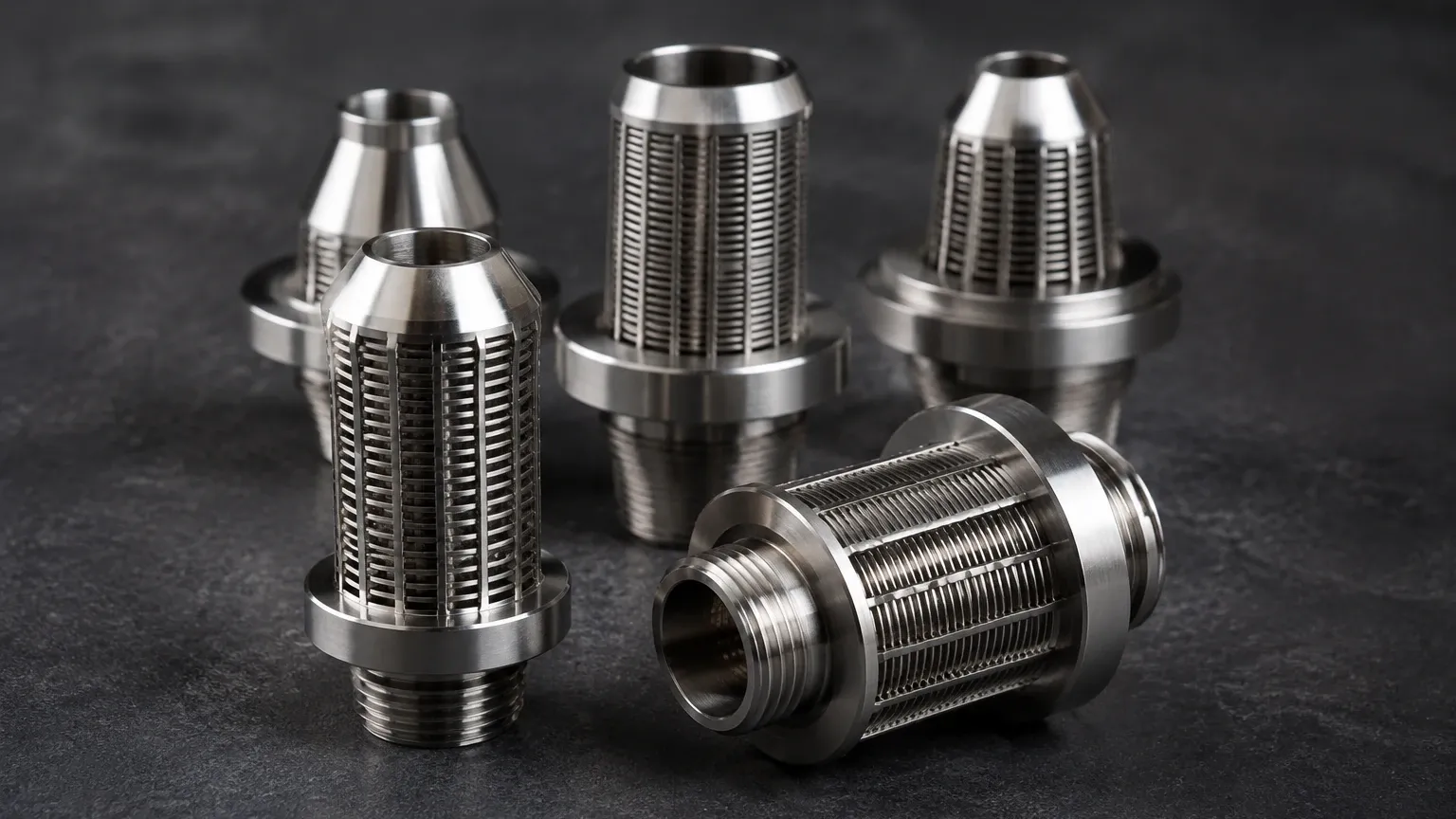
A standard wedge wire screen nozzle consists of several integrated parts, each designed for specific mechanical and hydraulic functions:
1. The Screen Element: The cylindrical section made of V-shaped wire that performs the actual filtration or retention.
2. The Base Plate/Head: A solid metal plate that seals the end of the screen element, ensuring fluid only passes through the slots.
3. The Threaded Nipple/Stem: The connection point that attaches the nozzle to the vessel's header or lateral piping. Common thread types include NPT, BSP, or customized metric threads.
4. Gaskets and Washers: Critical for ensuring a leak-proof seal between the nozzle and the mounting plate, preventing media bypass.
By varying the length and diameter of the screen element, manufacturers like Kaifil can customize the total open area of the nozzle to meet specific flow rate requirements without increasing the overall footprint of the filtration vessel.
Material Selection for Industrial Environments
Material durability is a primary concern in B2B filtration procurement. The choice of alloy directly impacts the nozzle's lifespan, especially in corrosive or high-temperature environments. Most industrial applications utilize stainless steel due to its balance of mechanical strength and chemical resistance.
* Type 304 Stainless Steel: Suitable for general-purpose applications, including water treatment and food and beverage processing where corrosion risks are moderate.
* Type 316L Stainless Steel: The preferred choice for chemical processing and pharmaceutical applications. The addition of molybdenum and a lower carbon content provides superior resistance to pitting and crevice corrosion, particularly in chloride-rich environments.
* Duplex and Super Duplex Alloys: For highly aggressive environments, such as seawater desalination or oil and gas processing, these materials offer exceptional yield strength and resistance to stress corrosion cracking.
Selecting the correct material ensures that the wedge wire screen nozzle maintains its slot tolerances over years of service, preventing media loss and protecting downstream equipment.
Applications in Media Retention and Fluid Distribution
The versatility of the wedge wire screen nozzle makes it a staple in various industrial sectors. Its primary role is often the retention of expensive filter media while allowing the process fluid to pass through with minimal resistance.
Ion Exchange and Demineralization
In ion exchange vessels, nozzles are installed in the underdrain system to support the resin bed. The precise slot widths—often as fine as 0.2mm—ensure that resin beads are not lost during the service cycle or backwash phase. High-quality nozzles ensure uniform flow across the entire bed, preventing "channeling," which can lead to premature resin exhaustion.
Water and Wastewater Treatment
In large-scale sand filters or activated carbon towers, nozzles are used to distribute influent water evenly and collect treated effluent. The robust design of the wedge wire allows for high-velocity backwashing, which is necessary to expand the filter bed and remove captured solids without damaging the internal components.
Chemical and Petrochemical Processing
Nozzles are frequently used in reactor internals to retain catalysts. Given the high temperatures and pressures involved in these processes, the mechanical stability of the welded wedge wire construction is a significant advantage over alternative filtration methods.
Engineering Selection Criteria: Flow, Pressure, and Slot Size
When specifying a wedge wire screen nozzle, engineers must balance several conflicting variables to achieve optimal performance. The following criteria are essential for a successful installation:
Slot Width and Tolerance
The slot width must be sized based on the smallest particle size of the media being retained. A general rule of thumb is to select a slot width that is half the diameter of the smallest media bead. For example, if the resin beads are 0.4mm, a 0.2mm slot is typically recommended. Precision manufacturing is required to ensure that slot tolerances are consistent across the entire nozzle surface.
Flow Capacity and Pressure Drop
Each nozzle has a maximum flow capacity determined by its total open area (TOA). Excessive flow through a single nozzle can create a high pressure drop and localized turbulence, which may abrade the filter media. Engineers must calculate the total number of nozzles required based on the vessel's total flow rate to ensure that the velocity through the slots remains within acceptable limits (usually below 0.5 m/s for liquid applications).
Mechanical Loading
Nozzles must be able to withstand the weight of the media bed as well as the hydraulic forces exerted during downward flow and upward backwashing. The collapse strength and burst strength of the wedge wire cylinder are critical specifications, particularly in high-pressure vessels.
Installation and Maintenance Considerations
Proper installation is as important as the design of the nozzle itself. Most wedge wire screen nozzles are installed on a "nozzle plate" or a series of lateral pipes. Ensuring a tight seal is paramount; even a small gap between the nozzle and the plate can allow media to bypass the filter, leading to contamination of the downstream process.
Customization Options
Different vessel designs require different mounting configurations. Options include:
* Single-Head Nozzles: Standard for most underdrain systems.
* Double-Head Nozzles: Used when fluid needs to be collected or distributed from both sides of a plate.
* Long-Stem Nozzles: Designed for vessels with a concrete sub-floor or thick insulation.
Maintenance and Replacement Cycles
While wedge wire is inherently durable, regular inspection is recommended. In systems with high solids loading, nozzles should be checked for signs of erosion or chemical scaling. Because wedge wire is easy to clean through backpulsing or ultrasonic baths, the total cost of ownership is often lower than disposable filter elements. However, if slot widths have widened due to abrasion, the nozzles must be replaced to prevent media loss.
Conclusion: Selecting the Right Filtration Partner
Choosing the correct wedge wire screen nozzle involves more than just selecting a part number from a catalog. It requires a deep understanding of fluid dynamics, material science, and the specific requirements of the industrial process. Working with a manufacturer like Kaifil, which specializes in custom stainless steel filtration solutions, allows engineers to tailor the nozzle design—from slot size to connection type—to their exact application.
By prioritizing high-quality materials and precision welding, facilities can achieve more efficient filtration, longer equipment life, and reduced maintenance costs. Whether you are designing a new ion exchange system or retrofitting an existing sand filter, the wedge wire screen nozzle remains a fundamental component in achieving reliable, high-performance industrial filtration.
For more information on customized filtration components and technical specifications, Review product options and application support.
