


Wedge Wire Screen Profile
In industrial filtration and separation, the efficiency of a system often hinges on the specific geometry of its components. Among the various technologies available, the wedge wire screen stands out for its precision and durability. At the heart of this technology is the wedge wire screen profile, a critical engineering specification that determines how a filter interacts with process fluids, manages solids, and withstands mechanical stress.
For engineers and procurement professionals, understanding the nuances of the profile—including the wire shape, the support rod configuration, and the resulting slot geometry—is essential for optimizing throughput and minimizing downtime. This guide explores the technical considerations of wedge wire profiles and how they influence performance in demanding industrial environments.
The Fundamentals of Wedge Wire Geometry
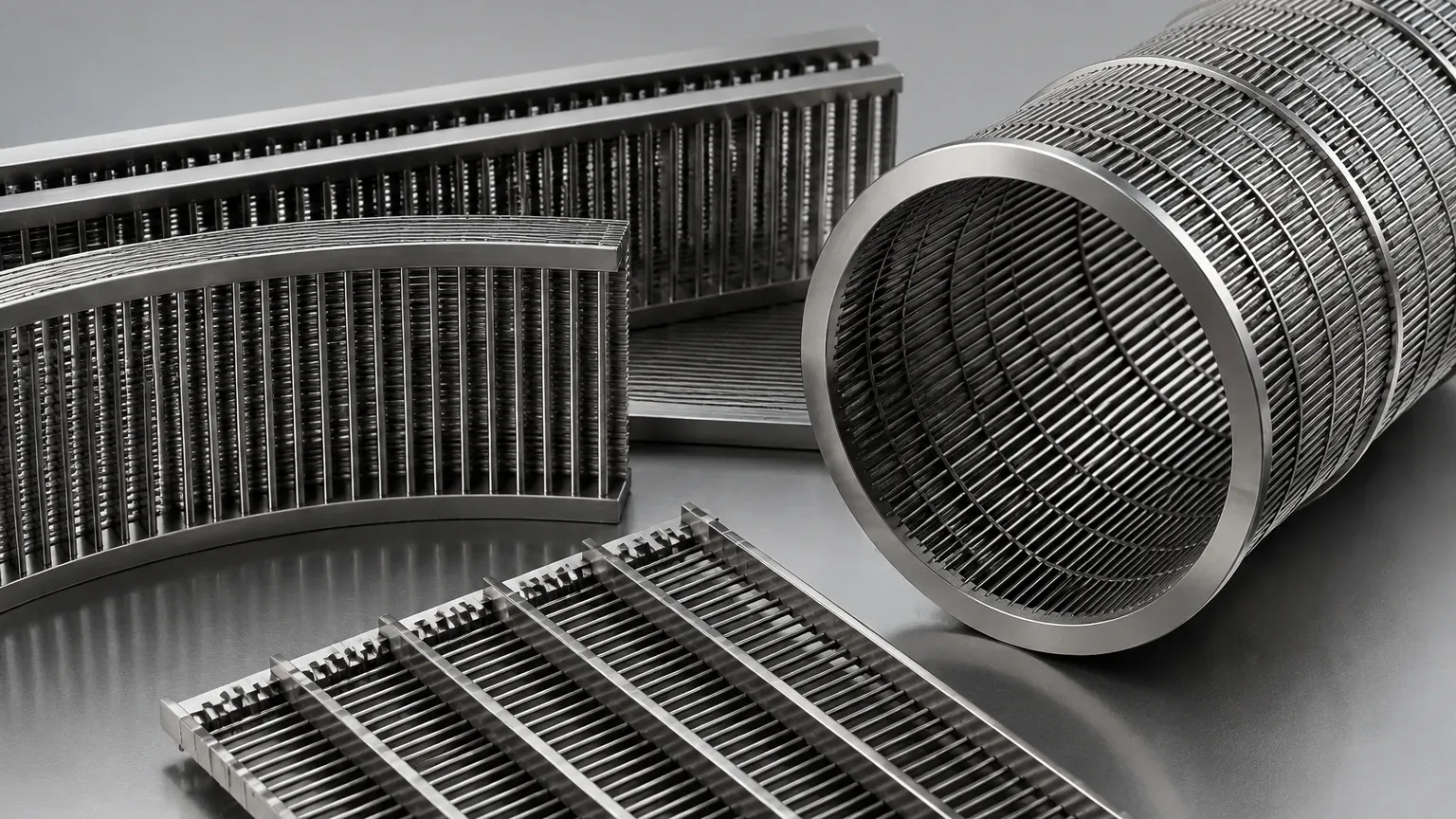
A wedge wire screen is constructed by welding V-shaped stainless steel wires onto support rods. The "profile" refers to the cross-sectional shape of these surface wires. Unlike traditional woven wire mesh, which consists of interlaced wires that can shift or trap particles, the wedge wire profile creates a rigid, non-clogging surface.
The primary characteristic of the Wedge Wire Screens profile is the V-shape, which is oriented with the wide part of the wedge facing the flow and the narrow part pointing away. This design creates a slot that widens inwardly. If a particle is small enough to pass through the initial opening at the surface, it will easily clear the rest of the screen without getting stuck. This "two-point contact" principle is what gives wedge wire its superior anti-blinding properties compared to round-wire or perforated plate alternatives.
Technical Dimensions of the Wedge Wire Screen Profile
When specifying a wedge wire screen profile, engineers must consider three primary dimensions: the width of the wire, the height of the wire, and the relief angle. These dimensions are not arbitrary; they are selected based on the specific requirements of the application, such as particle size, pressure, and the abrasiveness of the media.
1. Wire Width and Height
The width of the surface wire determines the total open area of the screen. Narrower wires allow for more slots per inch, increasing the open area and flow capacity. However, narrower wires also have less mass and may wear down faster in abrasive environments. The height of the wire contributes to the structural rigidity of the screen. In high-pressure applications, such as hydraulic systems or deep-well intake screens, a taller profile is often required to prevent deformation.
2. The Relief Angle
The angle of the V-shape, or the relief angle, is critical for the self-cleaning effect. A steeper angle provides a more rapid expansion of the slot opening, which is ideal for viscous fluids or sticky solids. Conversely, a shallower angle might be used when the structural integrity of the wire tip is a priority. Finding the balance between these factors is a key part of the custom engineering process at Kaifil.
3. Slot Opening Precision
The slot opening is the distance between two adjacent profile wires. Because wedge wire is manufactured using advanced resistance welding, these slots can be maintained with extreme precision, often down to 20 microns. This level of accuracy is vital for pharmaceutical and chemical processing applications where precise particle retention is mandatory.
Mechanical Strength and Support Rod Configuration
The wedge wire screen profile is only one half of the structural equation. The surface wires must be supported by a secondary set of rods, known as support profiles. The relationship between the surface wire and the support rod determines the overall burst strength and collapse resistance of the filter cartridge or panel.
Support rods come in various shapes, including round, rectangular, and even teardrop profiles. Round rods are common for general-purpose applications, while rectangular or "high-profile" rods are used when the screen must span large distances without intermediate support. The pitch (spacing) of the support rods is another critical variable; closer spacing increases the load-bearing capacity but may slightly impact the flow dynamics if the rods are particularly large.
In heavy-duty industrial applications, such as mining or large-scale water intake, the combination of a heavy surface wire profile and a robust support rod configuration ensures that the screen can withstand the weight of heavy media and the force of high-velocity backwashing.
Non-Clogging Performance and Flow Efficiency
One of the most significant advantages of a well-engineered wedge wire screen profile is its impact on flow efficiency. In any filtration system, the goal is to achieve the desired level of separation with the lowest possible pressure drop.
The smooth, flat surface created by the V-wire profile minimizes friction as fluid moves across the screen. This is particularly important in lateral systems or rotating drum screens where the media moves tangentially to the screen surface. Furthermore, the widening slot design ensures that the "effective" open area remains consistent over time. While woven mesh may gradually blind as particles become wedged in the intersections of the weave, wedge wire remains clear, maintaining a steady flow rate and extending the intervals between cleaning cycles.
For engineers, this translates to lower energy costs for pumps and fewer interruptions for manual cleaning or chemical backstripping. When evaluating total cost of ownership (TCO), the initial investment in a precision-profiled wedge wire screen is often offset by these long-term operational savings.
Material Considerations for Industrial Environments
The performance of a wedge wire screen profile is also dependent on the material from which it is manufactured. Kaifil specializes in stainless steel solutions, as these materials offer the best combination of strength, corrosion resistance, and fabricability.
* Grade 304 Stainless Steel: The standard choice for food and beverage applications and general industrial use. It provides excellent corrosion resistance in most non-acidic environments.
* Grade 316L Stainless Steel: Contains molybdenum, which provides superior resistance to chlorides and pitting. This is the preferred material for pharmaceutical processing, chemical plants, and marine environments.
* Duplex and Exotic Alloys: For highly corrosive or high-temperature applications, specialized alloys may be used to ensure the profile maintains its sharp edges and structural integrity over years of service.
The choice of material affects how the profile wears. In abrasive slurry applications, a harder material or a specialized surface treatment may be necessary to prevent the V-shape from rounding off, which would compromise the non-clogging characteristics of the screen.
Customization and Engineering Support
No two industrial filtration challenges are identical, which is why a "one-size-fits-all" approach to screen profiles is rarely successful. Customization is at the core of Kaifil’s manufacturing philosophy. When developing a filtration solution, several factors must be confirmed to select the optimal profile:
1. Media Characteristics: Is the fluid corrosive? What is the viscosity? Are the solids abrasive, fibrous, or granular?
2. Flow Requirements: What is the required flow rate per unit area? What is the maximum allowable pressure drop?
3. Mechanical Loads: Will the screen be subjected to high-pressure backpulsing, mechanical scraping, or heavy static loads?
4. Installation Constraints: Does the profile need to be formed into a specific shape, such as a cylindrical cartridge, a conical basket, or a curved sieve bend?
By working closely with an experienced manufacturer, purchasing teams can ensure that the Wedge Wire Screens they receive are tailored to their specific operational parameters. This includes selecting the right combination of wire width, slot size, and support rod frequency to balance filtration fineness with mechanical durability.
Common Risks and Evaluation Criteria
When sourcing wedge wire components, engineers should be aware of common risks associated with poor profile manufacturing. Inconsistencies in the weld quality can lead to "hot spots" where the wire may detach under pressure. Similarly, if the slot width is not uniform across the entire surface of the screen, the filtration efficiency will be compromised, allowing oversized particles to pass through the wider gaps.
To mitigate these risks, evaluate potential suppliers based on the following criteria:
* Welding Precision: Advanced resistance welding technology is required to ensure every intersection of the profile wire and support rod is fused securely without distorting the slot opening.
* Surface Finish: For food and pharmaceutical applications, the profile must be free of burrs and pits where bacteria could lodge. Electropolishing or mechanical polishing may be required.
* Dimensional Accuracy: Request documentation or certifications that confirm the slot tolerances meet your engineering specifications.
* Material Traceability: Ensure the manufacturer provides Mill Test Reports (MTRs) to verify the grade and quality of the stainless steel used.
Conclusion: Taking the Next Step in Selection
The wedge wire screen profile is more than just a component; it is a precision-engineered solution to complex separation problems. By focusing on the V-wire geometry, structural support, and material science, industrial facilities can achieve higher purity levels, protect downstream equipment, and optimize their process economics.
Before finalizing a purchase, engineers should confirm the exact particle size distribution of their media and the maximum differential pressure the screen will encounter. With these facts in hand, Kaifil can assist in selecting the specific profile dimensions that will deliver the most reliable and cost-effective performance for your application. Whether you are replacing an existing filter or designing a new system from the ground up, the right profile makes all the difference in long-term operational success.
