


Wedge Wire Flat Panel Screen
Industrial filtration and separation processes demand components that can withstand high mechanical stress while maintaining precise aperture tolerances. Among the various technologies available to process engineers, the wedge wire flat panel screen stands out as a high-performance solution for solid-liquid and solid-solid separation. Characterized by its unique V-shaped profile wire and robust support structure, this component is engineered to solve the common challenges of clogging, structural deformation, and frequent maintenance cycles found in traditional woven mesh or perforated plate systems.
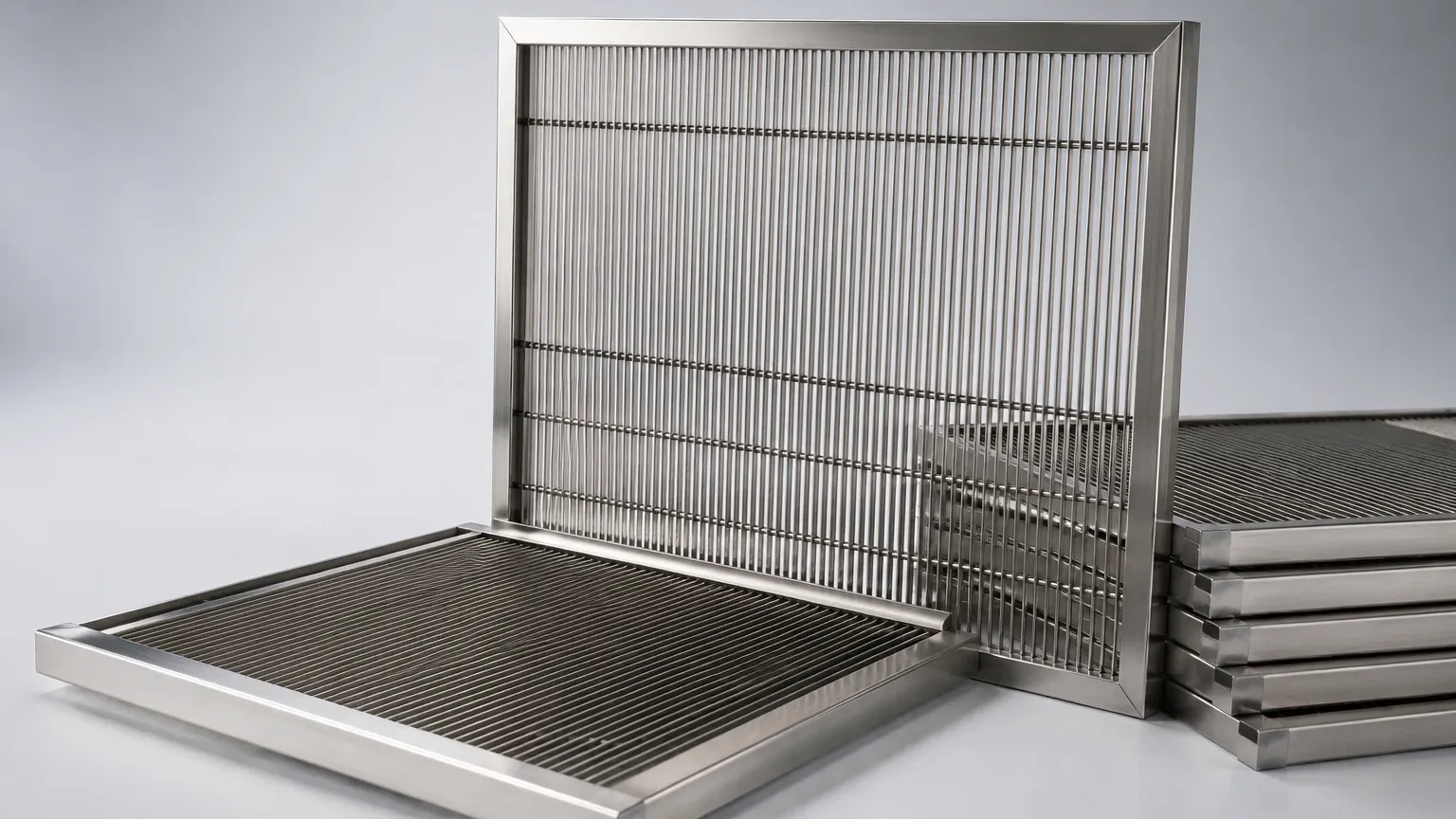
At its core, a wedge wire flat panel screen is a precision-welded structure. It consists of surface profiles—typically V-shaped—that are resistance-welded onto underlying support rods at every intersection. This construction creates a rigid, one-piece assembly that offers superior strength-to-weight ratios and a consistent slot width that is critical for industrial accuracy.
Technical Principles of Wedge Wire Geometry
The primary advantage of the wedge wire design lies in its geometric profile. Unlike square mesh or round-hole perforations, the V-shaped wire creates a slot that widens inwardly. This design ensures that any particle small enough to pass through the narrowest point of the slot will continue through the screen without becoming wedged or "pegged."
The Non-Clogging Mechanism
In a wedge wire flat panel screen, the two-point contact between the particle and the V-wire prevents the accumulation of solids within the aperture. This is particularly vital in applications involving sticky or fibrous materials, such as in pulp and paper processing or food waste management. By minimizing the risk of blinding, these screens maintain a constant flow rate and reduce the energy requirements of the pumping system.
Structural Integrity and Load Bearing
Because the surface wires and support rods are fused through high-pressure resistance welding, the resulting panel functions as a single structural unit. This allows the screens to handle significant static and dynamic loads. In vibrating screen applications, for instance, the flat panel must endure constant high-frequency oscillation while supporting the weight of the processed media. The selection of support rod spacing and wire size is a critical engineering calculation to prevent sagging or fatigue failure over time.
Key Evaluation Criteria for Industrial Selection
When specifying a Wedge Wire Screens solution, engineers must balance several variables to ensure the component meets the specific needs of the application. A wedge wire flat panel screen is rarely a "one-size-fits-all" product; it requires careful configuration based on the following criteria:
1. Slot Size and Tolerance
The slot size (aperture) determines the filtration rating. For precision applications in the pharmaceutical or chemical sectors, tolerances must be strictly controlled. Even a minor deviation in slot width can lead to the passage of oversized particles, potentially contaminating the downstream product or damaging sensitive equipment like high-pressure pumps.
2. Open Area Calculations
The percentage of open area directly impacts the flow velocity and pressure drop across the screen. A higher open area allows for greater throughput but may necessitate thinner surface wires, which can reduce the lifespan of the screen in abrasive environments. Engineers must calculate the "Effective Open Area" by considering the ratio of the slot width to the sum of the wire width and the slot width.
3. Material Grade Selection
Material selection is dictated by the chemical environment and temperature of the process. Kaifil specializes in stainless steel filtration solutions, typically utilizing:
* Grade 304: Suitable for general industrial use and standard water treatment.
* Grade 316L: Preferred for food, beverage, and pharmaceutical applications due to its superior corrosion resistance and low carbon content, which prevents intergranular corrosion after welding.
* Duplex Steels: Utilized in highly corrosive or high-chloride environments, such as seawater intake or aggressive chemical processing, offering both high strength and resistance to stress corrosion cracking.
Applications Across Critical Industries
The versatility of the wedge wire flat panel screen makes it a staple in diverse industrial sectors. Its ability to be customized in terms of dimensions, framing, and reinforcement allows it to be integrated into both new installations and existing OEM equipment.
Mining and Mineral Processing
In the mining sector, flat panels are used for dewatering, sizing, and media recovery. The abrasive nature of ores requires the use of heavy-duty V-wires that can withstand constant friction. The flat surface ensures an even distribution of material across the screen, optimizing the separation efficiency of vibrating decks.
Food and Beverage Industry
Hygiene and cleanability are paramount in food processing. Wedge wire screens are frequently used as "false bottoms" in brewery mash tuns and lauter tubs. The smooth surface and non-clogging characteristics allow for efficient wort drainage while supporting the heavy grain bed. Furthermore, the stainless steel construction is compatible with Clean-in-Place (CIP) protocols, ensuring that no bacterial growth occurs in the filtration gaps.
Water and Wastewater Treatment
From intake screens that protect pumps from debris to sludge dewatering panels, wedge wire technology provides a durable alternative to plastic or woven media. In urban wastewater treatment, flat panels are used in static or vibrating configurations to remove solids from the influent, significantly reducing the load on downstream biological treatment stages.
Customization and Engineering Considerations
To achieve optimal performance, a wedge wire flat panel screen often requires custom engineering beyond the basic wire and slot specifications. At Kaifil, the focus is on providing reliable OEM and customized filtration solutions that address specific operational constraints.
Framing and Reinforcement
Depending on how the panel is mounted, it may require specialized framing. Options include angle iron frames, flat bar edging, or custom-machined flanges. For panels spanning large widths, internal reinforcement rods or "U-bars" are welded to the underside to provide additional stiffness without obstructing the flow on the process side.
Surface Treatments
To further enhance performance, various surface treatments can be applied. Electropolishing is common in the pharmaceutical industry to create an ultra-smooth, burr-free surface that minimizes particle adhesion. For highly abrasive applications, specialized coatings or surface hardening techniques can extend the wear life of the V-wires.
Flow Direction and Wire Orientation
The orientation of the V-wires relative to the flow (either parallel or perpendicular) significantly affects the separation efficiency. In many dewatering applications, the wires are oriented perpendicular to the material flow to "cut" the water film and encourage rapid drainage. Conversely, in some sizing applications, parallel orientation may be preferred to facilitate the movement of solids across the screen surface.
Maintenance and Total Cost of Ownership
While the initial investment in a stainless steel wedge wire flat panel screen may be higher than that of synthetic or woven alternatives, the total cost of ownership (TCO) is often significantly lower. This is due to several factors:
1. Extended Service Life: The robust welded construction resists mechanical wear and chemical degradation, leading to fewer replacements.
2. Reduced Downtime: The non-clogging nature of the V-wire reduces the frequency of manual cleaning and prevents unplanned shutdowns caused by screen blinding.
3. Ease of Cleaning: Most wedge wire panels can be cleaned effectively using backwashing, high-pressure water jets, or mechanical brushing without damaging the screen structure.
4. Energy Efficiency: By maintaining a consistent open area and low pressure drop, the system requires less pumping power over its operational life.
Technical Confirmation Before Procurement
For engineers and purchasing teams, providing accurate data during the design phase is essential to ensure the final product performs as expected. Before moving forward with a custom wedge wire flat panel screen, the following information should be confirmed:
* Particle Size Distribution: What is the minimum and maximum particle size to be retained or passed?
* Flow Rate and Pressure: What is the operational flow rate (m³/h) and the maximum allowable pressure drop (ΔP)?
* Chemical Environment: What is the pH level, chloride concentration, and operating temperature of the fluid?
* Mechanical Loading: Will the screen be subject to vibration, heavy static loads, or pressure surges?
* Installation Constraints: Are there specific dimensional tolerances or framing requirements for the existing equipment housing?
By addressing these technical parameters, Kaifil helps global customers develop high-performance filter products that meet demanding industrial environments. Whether for chemical processing, hydraulic systems, or large-scale water treatment, the wedge wire flat panel screen remains a cornerstone of efficient and reliable industrial separation technology.
