


Wedge Wire vs Mesh
In the field of industrial liquid-solid separation, selecting the appropriate filtration medium is a critical engineering decision that impacts system efficiency, maintenance frequency, and long-term operational costs. Two of the most prevalent technologies used in demanding industrial environments are wedge wire and wire mesh. While both serve the fundamental purpose of removing contaminants from a process stream, their mechanical structures, performance characteristics, and ideal application environments differ significantly.
For engineers and procurement teams, the debate of wedge wire vs mesh is not about which is "better" in an absolute sense, but rather which technology aligns with the specific hydrodynamic and mechanical requirements of the application. This guide provides a technical comparison to help professionals make informed decisions based on filtration precision, durability, and total cost of ownership.
Structural Mechanics and Design Principles
To understand the performance differences, one must first look at how these two media are constructed. The structural integrity of a filter determines its ability to withstand pressure differentials and mechanical stress.
Wedge Wire Screens
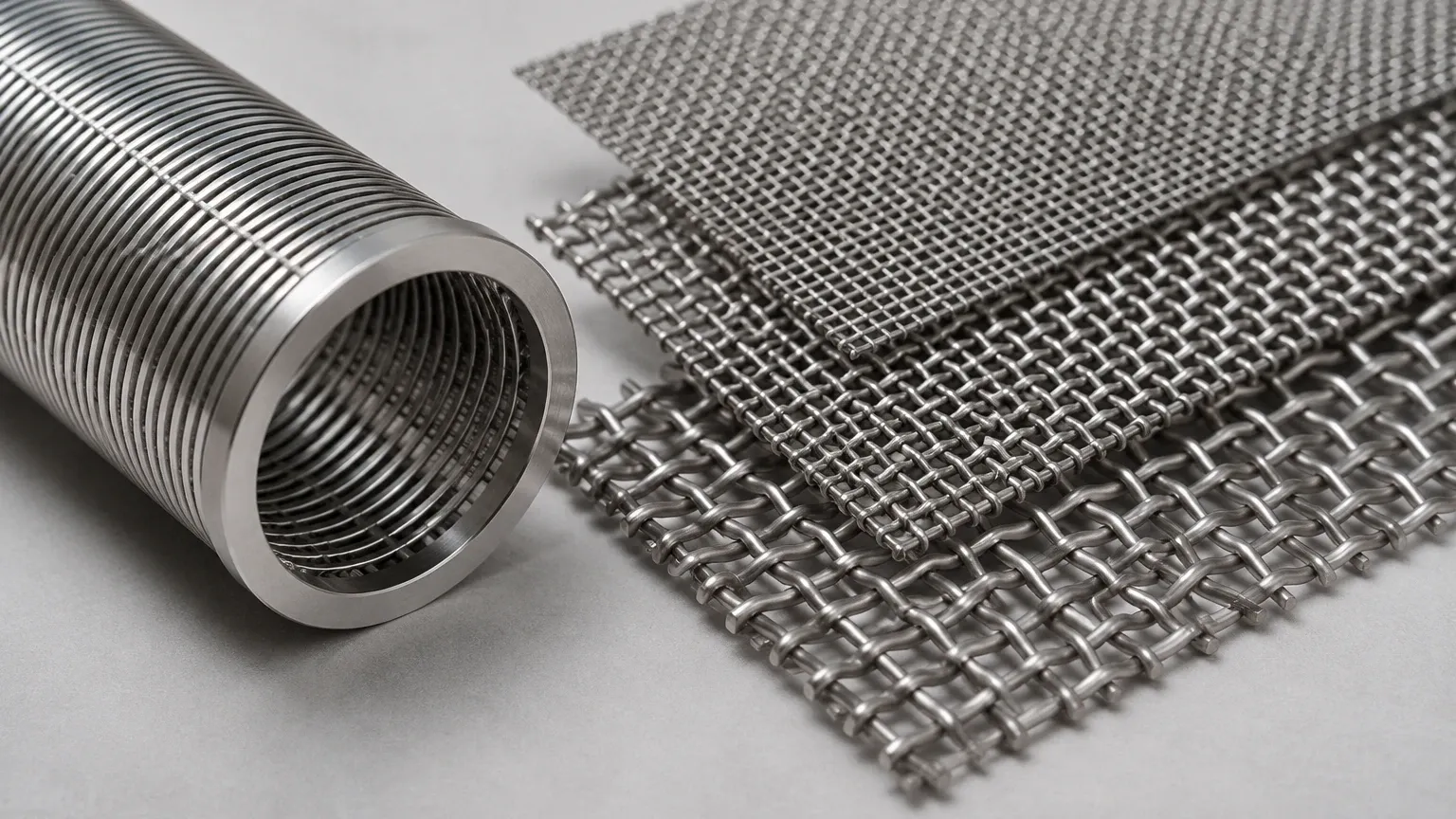
Wedge Wire Screens are manufactured by wrapping a continuous V-shaped profile wire around a series of longitudinal support rods. Each intersection is resistance-welded to create a robust, rigid structure. The "V" profile is oriented so that the narrowest part of the opening is at the filtering surface. As particles pass through the slot, the opening widens, which significantly reduces the risk of particles becoming trapped—a phenomenon known as "pegging" or "blinding."
Wire Mesh
Industrial wire mesh is created by weaving individual wires together in various patterns, such as plain weave, twill weave, or Dutch weave. Unlike the rigid, welded structure of wedge wire, mesh relies on the tension and overlap of the wires. While mesh can be produced with extremely fine openings (down to 1 micron or less), it is inherently more flexible and often requires a secondary support structure, such as a perforated metal core or a reinforced cage, to prevent collapsing under high-pressure conditions.
Filtration Precision and Open Area
When evaluating wedge wire vs mesh, the required filtration rating is often the first deciding factor. The two technologies operate at different ends of the filtration spectrum.
Micron Ratings and Slot Sizes
Wire mesh is the preferred choice for high-precision filtration. Because wires can be drawn to very thin diameters and woven tightly, mesh can achieve extremely fine filtration levels that are impossible for wedge wire. Mesh is typically measured in "mesh count" (the number of openings per linear inch) or microns.
In contrast, wedge wire is defined by its "slot size," which is the distance between the V-shaped wires. While modern manufacturing allows for wedge wire slots as small as 20 to 50 microns, it is most commonly utilized for applications requiring 100 microns and above. Wedge wire excels in "coarse" to "medium" filtration where high flow rates and mechanical strength are prioritized over sub-micron particle capture.
Effective Open Area (EOA)
The open area of a filter determines the flow velocity and pressure drop across the media. Wedge wire typically offers a higher effective open area compared to mesh of a similar filtration rating. This is because the support rods are spaced further apart, and the continuous slots allow for a more streamlined flow path. A higher EOA results in lower energy consumption for pumps and longer intervals between cleaning cycles.
Performance Under Pressure: Flow and Resistance
Hydrodynamic efficiency is a key concern for engineers designing hydraulic or chemical processing systems. The geometry of the filter media directly influences the flow patterns and the resulting pressure drop.
Pressure Drop (Delta P)
Because wire mesh involves overlapping wires, it creates a more tortuous path for the fluid. This increased turbulence can lead to a higher initial pressure drop. Furthermore, as particles begin to accumulate in the intersections of the weave, the pressure drop increases rapidly.
Wedge Wire Screens provide a more direct flow path. The V-shaped profile creates a "two-point contact" for any particle that is larger than the slot. Because the slot widens immediately after the surface, the fluid experiences less resistance once it passes the initial barrier. This characteristic makes wedge wire ideal for high-viscosity fluids or high-velocity systems where maintaining a low pressure differential is essential.
Mechanical Integrity
In applications involving high-pressure surges or mechanical vibration, wedge wire is significantly more durable. The welded construction allows it to function as a self-supporting structural element. Wire mesh, being a flexible fabric, is susceptible to "wire migration" or tearing if the pressure differential exceeds the material's yield strength. If a mesh filter fails, the resulting downstream contamination can be catastrophic for sensitive equipment like pumps and valves.
Maintenance, Cleaning, and Life Cycle
The total cost of a filtration system is heavily influenced by how easily it can be cleaned and how often the media must be replaced.
Backwashing and Self-Cleaning Systems
one of the most significant advantages in the wedge wire vs mesh comparison is the ease of cleaning. Wedge wire is the industry standard for automatic backwashing filters. During a backwash cycle, the flow is reversed; because the wedge wire slots widen inward, the trapped particles are easily dislodged and flushed away. The smooth surface of the profile wire also prevents fibers or sticky solids from adhering to the media.
Wire mesh is notoriously difficult to clean thoroughly. Particles often become wedged in the "knuckles" of the weave. Over time, this leads to permanent blinding, where the filter can no longer be restored to its original flow capacity through backwashing. Consequently, mesh elements are often treated as consumables that require periodic replacement, whereas wedge wire elements are typically designed to last for the life of the equipment.
Durability and Wear Resistance
In abrasive environments—such as mining, pulp and paper, or wastewater treatment—the thickness of the wire becomes a factor. Wedge wire uses much heavier gauge wire than mesh. This provides a significant "wear allowance," allowing the screen to withstand abrasive particles for years without losing its structural integrity or filtration accuracy. Mesh, with its thin wires, can be quickly eroded by abrasive slurry, leading to a rapid increase in the effective pore size and a loss of filtration efficiency.
Application Suitability: Choosing the Right Media
To help engineers select the correct technology, it is useful to categorize applications based on their primary requirements.
When to Choose Wedge Wire
* High-Load Solids: Applications with high concentrations of solids that require frequent cleaning.
* Backwashing Systems: Automatic filtration systems where downtime for manual cleaning must be eliminated.
* Abrasive Media: Processes involving sand, grit, or mineral slurries.
* Structural Applications: Situations where the filter must also act as a support (e.g., resin traps, reactor internals, or intake screens).
* High Viscosity: Fluids that require low resistance to maintain flow rates.
When to Choose Wire Mesh
* Fine Filtration: Any application requiring the removal of particles smaller than 50 microns.
* Gas Filtration: Removing fine mist or dust from gas streams where high precision is required.
* Weight Sensitivity: Applications where a lightweight, flexible filter is necessary.
* Low-Cost Consumables: Simple, low-pressure systems where the filter element is replaced rather than cleaned.
* Complex Shapes: Mesh can be easily pleated or formed into complex geometries to increase surface area in a small footprint.
Engineering Considerations for Customization
When specifying either wedge wire or mesh, several technical parameters must be confirmed with the manufacturer to ensure performance.
1. Material Selection: Both media are commonly available in Stainless Steel 304 and 316L. However, for highly corrosive environments (e.g., seawater or acidic chemical processing), specialized alloys like Duplex stainless steel or Hastelloy may be required. Kaifil provides material consultation to ensure compatibility with the process fluid.
2. Flow Direction: For wedge wire, it is critical to specify whether the flow is "out-to-in" (FOTI) or "in-to-out" (FITO). This determines whether the flat surface of the wire is on the exterior or interior of the cylinder.
3. Support Requirements: If choosing mesh for a high-pressure application, the engineer must calculate the collapse pressure and specify the appropriate support core.
4. Surface Treatment: Options such as electropolishing can be applied to both media to improve corrosion resistance and reduce the adhesion of organic materials, which is particularly important in food and beverage or pharmaceutical applications.
Total Cost of Ownership (TCO)
While the initial purchase price of Wedge Wire Screens is generally higher than that of a comparable wire mesh element, the Total Cost of Ownership (TCO) often favors wedge wire in industrial settings.
The higher CAPEX of wedge wire is offset by:
* Reduced Labor Costs: Less frequent manual cleaning and easier maintenance.
* Lower Replacement Costs: A lifespan that can be 5 to 10 times longer than wire mesh in the same environment.
* Increased Production Uptime: Reliable backwashing means fewer system shutdowns.
* Energy Savings: Lower pressure drops reduce the load on pumping systems.
Conversely, for light-duty applications or processes requiring ultra-fine precision, wire mesh remains the most cost-effective and technically viable solution. The key is to evaluate the frequency of replacement and the cost of potential downtime versus the initial investment in more robust media.
Conclusion
The choice between wedge wire vs mesh is a balance of precision, strength, and maintainability. Wire mesh remains the gold standard for fine filtration and versatility, while wedge wire provides unmatched durability and cleaning efficiency for heavy-duty industrial processes.
By understanding the mechanical differences and flow dynamics of each, engineers can optimize their filtration systems for maximum reliability. Whether you are designing a new chemical reactor or upgrading a water treatment facility, selecting the right media is the first step toward achieving efficient and cost-effective filtration performance. For customized engineering support and high-performance filtration components, Kaifil offers the technical expertise to help you navigate these complex selection criteria.
