


Titanium Wire Mesh Filter: An Engineering Guide for Industrial Applications
In high-performance industrial filtration, the choice of material is as critical as the filtration accuracy itself. While stainless steel remains the industry standard for many applications, certain aggressive environments—specifically those involving high concentrations of chlorides, seawater, or highly oxidizing acids—demand a more resilient material. The titanium wire mesh filter has emerged as a primary solution for these demanding conditions.
This guide provides a technical overview of titanium filtration components, exploring their material properties, structural configurations, and the engineering considerations necessary for successful integration into industrial systems. For engineers and procurement specialists, understanding these factors is essential for ensuring long-term reliability and optimizing the total cost of ownership.
Understanding the Material Properties of Titanium in Filtration
Titanium is categorized into several grades, with Grade 1 and Grade 2 (commercially pure titanium) being the most common for woven wire mesh applications. The primary driver for selecting a titanium wire mesh filter over stainless steel (such as 304 or 316L) is its exceptional corrosion resistance.
Corrosion Resistance and Passivation
Titanium’s resistance to corrosion stems from the immediate formation of a stable, protective, and highly adherent oxide film (TiO2) upon exposure to oxygen. This film is self-healing; if damaged mechanically, it reforms instantly in the presence of even trace amounts of oxygen or moisture.
In industrial filtration, this property is invaluable when handling:
* Chlorides and Seawater: Unlike stainless steel, which is susceptible to pitting and stress corrosion cracking in chloride-rich environments, titanium is virtually immune to corrosion in seawater at temperatures up to 130°C (266°F).
* Oxidizing Acids: Titanium exhibits excellent stability in nitric acid, chromic acid, and other oxidizing media where other metals fail.
* Hypochlorites and Wet Chlorine: Titanium is one of the few materials that can withstand wet chlorine gas and solutions containing hypochlorites.
Strength-to-Weight Ratio and Thermal Stability
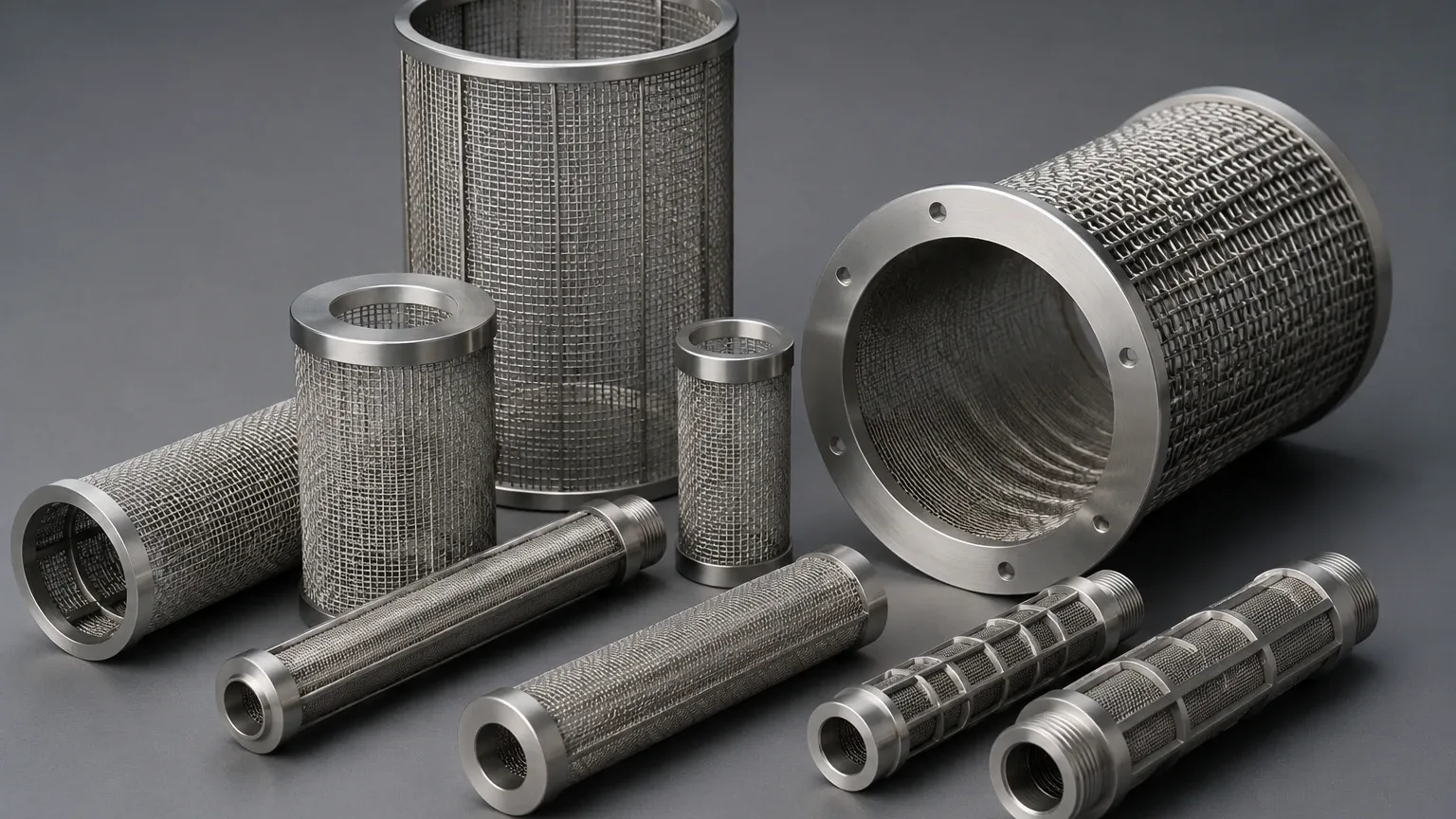
Beyond chemistry, titanium offers a high strength-to-weight ratio. While it is approximately 45% lighter than steel, its mechanical strength is comparable to many alloy steels. This allows for the design of lightweight Wire Mesh Filter Cylinders & Tubes that can still withstand significant differential pressures. Furthermore, titanium maintains its mechanical integrity across a wide temperature range, from cryogenic levels up to approximately 400°C (752°F), depending on the specific grade and environment.
Structural Design: Wire Mesh Filter Cylinders & Tubes
The physical geometry of a filter element is determined by the flow requirements and the housing constraints of the system. Titanium wire mesh is most frequently fabricated into Wire Mesh Filter Cylinders & Tubes to provide a balance of surface area and structural rigidity.
Weave Types and Filtration Characteristics
The performance of a titanium wire mesh filter is largely dictated by the weave pattern of the mesh. Common patterns include:
1. Plain Weave: The simplest configuration where wires cross over and under each other. It provides high flow rates and is easy to clean, typically used for coarse filtration (above 50 microns).
2. Twill Weave: Each warp wire passes over and under two successive weft wires. This allows for the use of heavier wires in a given mesh count, increasing the mechanical strength of the filter.
3. Dutch Weave (Plain and Twill): These weaves utilize different diameters for warp and weft wires, resulting in a dense, compact mesh with small, triangular openings. Dutch weaves are the standard for precision filtration, offering micron ratings as low as 5 to 10 microns.
Multi-Layer Sintered Structures
For applications involving high pressure or backwashing cycles, a single layer of titanium mesh may lack sufficient rigidity. In these cases, engineers often specify multi-layer structures. These may consist of a fine filtration layer bonded to one or more coarser support layers. Sintering—a process of bonding the contact points of the wires through heat and pressure without melting—creates a monolithic structure that prevents wire migration and ensures consistent pore size even under mechanical stress.
Key Engineering Selection Criteria
When specifying a titanium filter, several technical parameters must be evaluated to ensure the component meets the application's demands.
Micron Rating: Absolute vs. Nominal
* Nominal Rating: Refers to an approximate pore size where a percentage of particles (often 60% to 90%) of a specific size are retained. This is generally used for non-critical applications.
* Absolute Rating: Refers to the diameter of the largest hard spherical particle that will pass through the filter under specific test conditions. For critical pharmaceutical or chemical processes, absolute ratings are required to guarantee fluid purity.
Differential Pressure and Flow Velocity
The "clean pressure drop" (ΔP) is the resistance the filter offers to the fluid flow when it is free of contaminants. As the filter accumulates debris, the ΔP increases. Engineers must calculate the maximum allowable differential pressure before the filter element risks structural collapse or bypass. Titanium's high modulus of elasticity helps in resisting deformation, but support cores (often perforated titanium tubes) are necessary for high-pressure differentials.
Fluid Compatibility and Biocompatibility
In the pharmaceutical and food and beverage industries, titanium is prized for its biocompatibility and non-toxic nature. It does not leach metallic ions into the process stream, ensuring that the flavor, color, and chemical integrity of the product remain unaltered. This makes it a superior choice for sterile filtration and active pharmaceutical ingredient (API) processing.
Installation Constraints and Integration
Integrating a titanium wire mesh filter into an existing system requires careful attention to the interfaces between the filter and the housing.
Sealing Mechanisms
Because titanium is often used in aggressive chemical environments, the choice of gaskets or O-rings is critical. Common materials include FKM (Viton), EPDM, or PTFE-encapsulated seals. The seal must be compatible with the process fluid and the operating temperature. Furthermore, the mechanical design of the end caps (e.g., DOE – Double Open End, or SOE – Single Open End with code 7 or 222 fittings) must ensure a leak-proof bypass-free fit.
Galvanic Corrosion Risks
While titanium itself is highly resistant to corrosion, it can act as a cathode when coupled with more active metals (like aluminum or carbon steel) in an electrolyte. To prevent galvanic corrosion of the surrounding hardware, engineers should ensure that the filter housing is also made of a compatible material (such as titanium or high-nickel alloys) or that proper electrical isolation is maintained.
Application Risks and Performance Limitations
Despite its advantages, titanium filtration is not a universal solution. Engineers must be aware of specific risks:
1. Hydrogen Embrittlement: In certain high-temperature, high-pressure hydrogen environments, or in applications involving cathodic protection, titanium can absorb hydrogen, leading to embrittlement and mechanical failure.
2. Dry Chlorine: While titanium is excellent for wet chlorine, it can react violently with dry chlorine gas. The presence of at least 0.5% water is typically required to maintain the protective oxide layer.
3. Cost Considerations: Titanium is significantly more expensive than stainless steel, both in terms of raw material and fabrication (welding titanium requires an inert gas shield to prevent atmospheric contamination). Therefore, it should be specified only when the corrosion environment or purity requirements justify the investment.
Maintenance and Cleaning Protocols
The longevity of a titanium filter depends on effective cleaning. Unlike disposable polymer cartridges, metal filters are designed for reuse.
* Backwashing: For liquid systems, reversing the flow can dislodge surface-loaded contaminants. This is most effective with plain weave or sintered mesh structures.
* Ultrasonic Cleaning: High-frequency sound waves in a cleaning solvent can remove fine particles trapped deep within Dutch weave meshes.
* Chemical Cleaning: Because of titanium's chemical resistance, it can be cleaned with aggressive acids or bases that would destroy other filter types. However, the specific cleaning agent must be compatible with the contaminants being removed.
Procurement Checklist for International Buyers
When sourcing titanium filters from a manufacturer like Kaifil, providing detailed specifications ensures the final product meets the technical requirements of the project. Buyers should confirm the following:
* Material Certification: Request mill test reports (MTRs) to verify the grade of titanium used (e.g., ASTM B265 for sheet/strip or ASTM B348 for bar).
* Filtration Efficiency: Define whether the micron rating is absolute or nominal and request bubble point test data if applicable.
* Structural Integrity: Specify the maximum operating pressure and the required collapse pressure for the Wire Mesh Filter Cylinders & Tubes.
* Customization Options: Discuss specialized end-cap geometries, reinforced support layers, or specific welding standards (such as TIG welding under argon purge).
Conclusion
The titanium wire mesh filter represents a specialized engineering solution for the most challenging industrial filtration tasks. By leveraging the unique electrochemical properties of titanium and the precision of modern weaving and sintering techniques, manufacturers can provide filtration components that offer unmatched durability in corrosive environments. Whether used in desalination, chemical synthesis, or pharmaceutical production, these filters provide a reliable barrier against contaminants while maintaining the integrity of the process fluid. Proper selection, based on a rigorous evaluation of flow dynamics, chemical compatibility, and mechanical design, is the key to maximizing the performance and service life of these critical components.
