


0 Wedge
In the field of industrial separation and filtration, the geometric precision of a filter element determines its operational efficiency and longevity. Among the various technologies available, wedge wire screens stand out due to their unique V-shaped profile wire construction. A critical engineering specification often discussed in high-precision applications is the 0 wedge—or zero-degree tilt angle—of the profile wire. This configuration ensures that the flat face of the V-wire is perfectly aligned with the screen surface, providing a consistent slot width and optimized flow dynamics for demanding industrial processes.
As a specialized manufacturer of stainless steel filtration solutions, Kaifil provides engineered Wedge Wire Screens that leverage precise wire geometry to meet the rigorous standards of chemical processing, water treatment, and food production. Understanding the technical nuances of wire tilt, slot consistency, and material selection is essential for engineers tasked with optimizing filtration systems.
Engineering Fundamentals of Wedge Wire Geometry
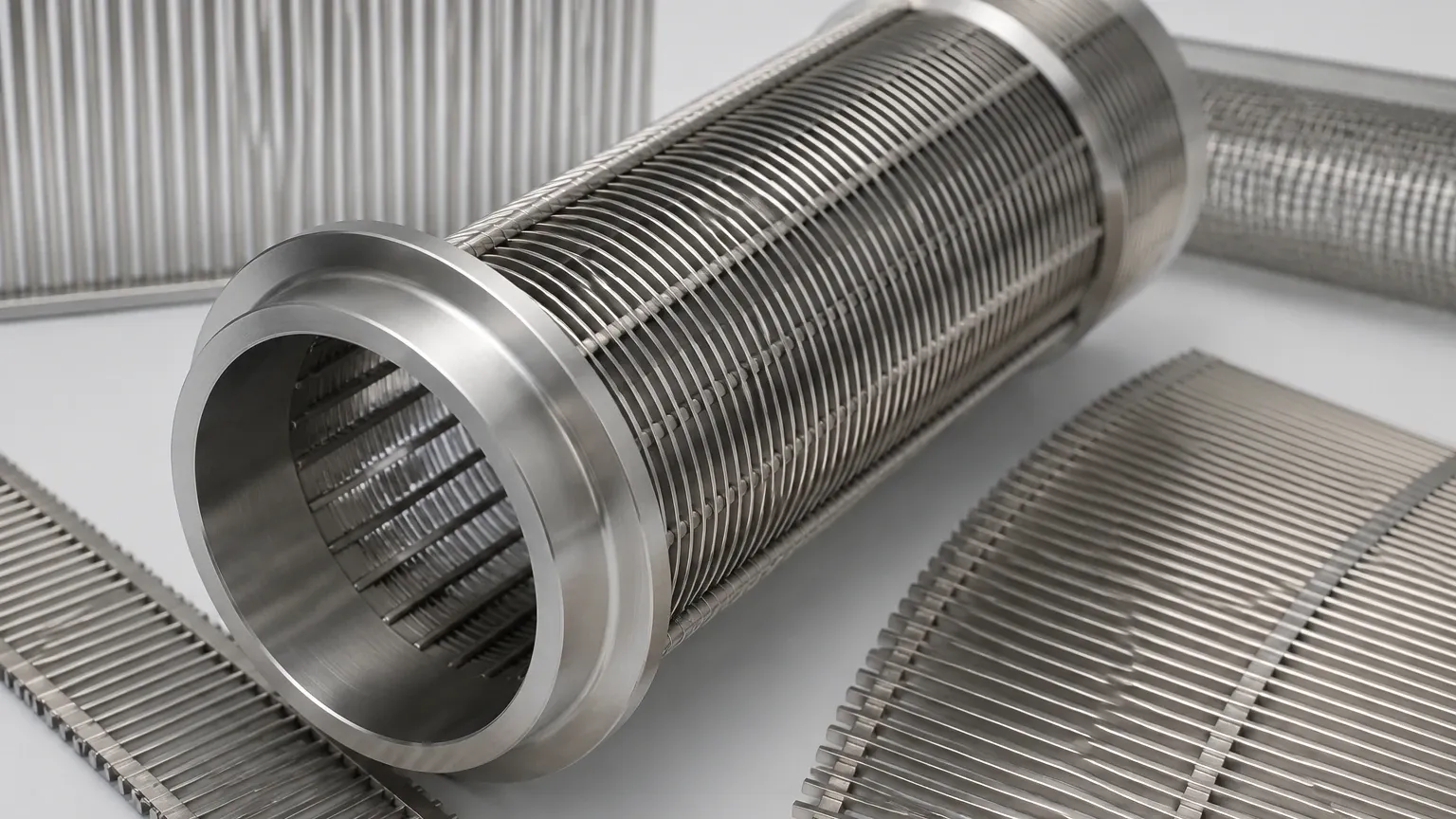
Wedge wire screens are constructed by resistance-welding V-shaped profile wires onto perpendicular support rods. The resulting structure is characterized by a continuous slot that widens inwardly. This "V" shape is the core of the technology's non-clogging characteristic; particles that pass through the narrowest point of the slot at the surface are immediately released into the larger internal area, preventing the "blinding" common in woven mesh or perforated plates.
The term 0 wedge refers specifically to the orientation of this profile wire relative to the support structure. In a zero-tilt configuration, the vertical axis of the V-wire is perpendicular to the plane of the screen. While some specialized applications require a "tilted" wire to facilitate specific shearing actions (common in mineral processing or high-velocity intake screens), a 0-degree wedge is the standard for most static and rotary filtration tasks. It ensures that the effective slot width remains uniform across the entire surface area, which is vital for maintaining a predictable pressure drop and specific particle cut-points.
The Role of the 0 Wedge Tilt Angle in Filtration Efficiency
The alignment of the profile wire directly impacts the fluid dynamics at the screen interface. When a screen is manufactured with a 0 wedge profile, several mechanical and hydraulic advantages are realized:
1. Uniform Slot Precision
In precision filtration, even a minor deviation in the wire angle can lead to variations in the slot opening. For applications requiring filtration accuracy in the range of 20 to 100 microns, any tilt can cause the "effective" opening to narrow or widen depending on the angle of approach of the process fluid. A 0-degree alignment ensures that the mechanical slot width equals the hydraulic slot width.
2. Optimized Backwashing and Cleaning
One of the primary reasons engineers select stainless steel wedge wire is for its cleanability. In automated self-cleaning filters, a scraper or backwash arm moves across the surface of the screen. If the wires are tilted (non-zero wedge), the cleaning mechanism may skip over certain areas or cause uneven wear on the wire edges. A 0 wedge surface provides a perfectly flat plane, allowing for 100% contact with cleaning blades and more efficient removal of the filter cake.
3. Reduced Turbulence and Pressure Drop
Fluid passing through a zero-tilt screen encounters a symmetrical path. This symmetry reduces localized turbulence at the entry point of the slot. Lower turbulence translates to a lower differential pressure ($ΔP$) across the screen, which reduces energy consumption for pumps and extends the time between cleaning cycles.
Material Selection and Durability in Stainless Steel Filtration
While geometry defines the performance, material selection defines the lifespan. Kaifil utilizes high-grade stainless steel alloys to ensure that the precision of the 0 wedge profile is maintained even in corrosive or high-temperature environments.
* Grade 304/304L: The standard for general industrial applications, offering excellent mechanical properties and resistance to atmospheric corrosion. It is widely used in food and beverage processing where sanitation is paramount.
* Grade 316/316L: Containing molybdenum, this grade offers superior resistance to chlorides and pitting. It is the preferred choice for chemical processing plants, pharmaceutical manufacturing, and marine environments.
* Duplex Stainless Steels: For applications involving extreme mechanical stress or highly aggressive chemical media, duplex alloys provide nearly double the yield strength of austenitic grades and exceptional resistance to stress corrosion cracking.
By maintaining a 0 wedge orientation during the welding process, the structural integrity of these materials is maximized. The weld point between the profile wire and the support rod is the strongest part of the screen; precise alignment ensures that the load-bearing capacity of the screen is distributed evenly across the support structure.
Customization and Manufacturing Precision
No two industrial filtration requirements are identical. The effectiveness of a wedge wire solution depends on the ability to customize the screen to the specific flow rates, solids loading, and mechanical constraints of the system.
Profile Wire and Support Rod Selection
Kaifil offers a variety of profile wire sizes, ranging from very fine wires for high-open-area requirements to heavy-duty profiles for high-pressure applications. The choice of support rod—whether round, rectangular, or teardrop-shaped—is also critical. For a 0 wedge screen, the support rod spacing must be calculated to prevent wire deflection under the operating pressure of the system.
Fabrication Formats
Precision wedge wire can be fabricated into various forms:
* Flat Panels: Used in vibrating screens, floor drains, and intake structures.
* Cylindrical Cartridges: Used in pressurized filter housings, often featuring an "outside-to-inside" or "inside-to-outside" flow direction.
* Sieve Bends: Curved screens used for dewatering and solids recovery where centrifugal force assists the separation.
In each of these formats, maintaining the 0 wedge alignment requires advanced CNC-controlled welding equipment. This technology ensures that the gap between each wire is held to tolerances as tight as ±0.05mm, a necessity for critical pharmaceutical and chemical separations.
Industrial Applications for Precision Wedge Wire
The technical advantages of the 0 wedge configuration make it indispensable across several sectors where reliability is non-negotiable.
Chemical and Petrochemical Processing
In catalyst recovery and resin traps, the screen must withstand high temperatures and chemical aggression without losing its slot integrity. A zero-tilt wire ensures that the catalyst particles are retained on the surface and do not become wedged in the slots, which could lead to a permanent loss of flow capacity.
Food and Beverage Production
Sanitation is the primary concern in food processing. The 0 wedge profile eliminates "dead zones" where organic matter could accumulate and breed bacteria. Whether it is used in mash tuns for brewing or juice extraction, the smooth surface of the wedge wire allows for rapid CIP (Clean-in-Place) procedures.
Water and Wastewater Treatment
From intake screens for power plants to fine screening in municipal wastewater facilities, wedge wire provides a robust barrier against debris. The 0-degree tilt is particularly effective in intake screens where it minimizes fish impingement and entrainment by providing a smooth, low-velocity surface.
Evaluating Total Cost of Ownership (TCO)
When specifying filtration components, purchasing teams must look beyond the initial acquisition cost and consider the total cost of ownership. High-precision 0 wedge screens typically offer a lower TCO compared to cheaper alternatives like woven mesh or perforated metal for several reasons:
1. Reduced Downtime: The non-clogging nature of wedge wire means fewer manual cleanings and less frequent system shutdowns.
2. Longevity: Stainless steel wedge wire is a permanent or semi-permanent media. Unlike mesh, which is prone to tearing and fatigue, a properly engineered wedge wire screen can last for years in continuous service.
3. Energy Savings: The consistent open area and reduced turbulence of a zero-tilt screen lower the energy requirements for fluid transport.
4. Product Recovery: In applications like mineral processing or pulp and paper, the precise separation provided by wedge wire increases the yield of the final product.
Conclusion: Selecting the Right Partner for Filtration Solutions
Achieving a true 0 wedge profile requires a combination of high-quality raw materials and sophisticated manufacturing capabilities. Engineers must verify that their supplier can provide documented slot tolerances and material certifications (MTRs) to ensure the screen will perform as expected in the field.
Kaifil specializes in these custom stainless steel filtration solutions, providing the technical expertise needed to design and manufacture Wedge Wire Screens that solve complex separation challenges. By focusing on precision geometry, material durability, and application-specific design, Kaifil helps industrial operators achieve efficient, reliable, and cost-effective filtration performance.
Before initiating a project, technical teams should confirm the operating temperature, chemical composition of the fluid, maximum differential pressure, and the specific particle size distribution of the solids to be removed. With this data, a 0 wedge solution can be engineered to provide optimal results for even the most demanding industrial environments.
