


Amazon Water Filter Cartridges
In the modern industrial landscape, procurement strategies for maintenance, repair, and operations (MRO) have shifted significantly. Engineers and facility managers often find themselves navigating a spectrum of sourcing options, ranging from direct manufacturer partnerships to massive e-commerce platforms. The search for amazon water filter cartridges is a common starting point for many technical professionals looking for quick replacements or cost-effective alternatives for standard water treatment systems. However, while retail platforms offer convenience and rapid shipping, the transition from consumer-grade filtration to industrial-grade performance requires a deep understanding of technical specifications, material compatibility, and long-term operational reliability.
For industrial applications—such as chemical processing, food and beverage production, and pharmaceutical manufacturing—the stakes of filtration are high. A failure in a filter cartridge can lead to downstream equipment damage, batch contamination, or costly unscheduled downtime. This article examines the technical considerations of sourcing Filter Cartridges through various channels and highlights the critical engineering factors that distinguish industrial solutions from standard retail offerings.
Understanding the Market for Water Filter Cartridges
The market for water filtration is broadly divided into residential/commercial and industrial sectors. When searching for amazon water filter cartridges, buyers typically encounter products designed for Point-of-Use (POU) or Point-of-Entry (POE) systems. These are often standardized sizes, such as 10-inch or 20-inch "Big Blue" housings, utilizing melt-blown polypropylene, string-wound fibers, or activated carbon blocks.
In contrast, industrial filtration demands a higher degree of precision. While a retail-grade cartridge might suffice for basic sediment removal in a breakroom, it often lacks the structural integrity required for high-pressure hydraulic lines or the chemical resistance needed for corrosive process fluids. Industrial procurement teams must evaluate whether a standard off-the-shelf product meets the specific ISO or FDA standards required for their facility. The primary challenge with sourcing through mass-market platforms is the potential lack of detailed technical documentation, such as Material Test Reports (MTRs) or precise Beta Ratio ratings, which are essential for process validation.
Key Engineering Specifications for Industrial Filtration
When evaluating any filtration component, engineers must look beyond the price tag and focus on the physics of the application. Whether you are considering amazon water filter cartridges or custom-engineered solutions, the following specifications are non-negotiable for industrial performance:
Micron Rating and Filtration Efficiency
Filtration accuracy is defined by the micron rating, but it is important to distinguish between nominal and absolute ratings. A nominal rating refers to a filter's ability to retain a majority of particles of a certain size, whereas an absolute rating (often expressed via a Beta Ratio) indicates a 99.9% or higher retention rate. Industrial processes often require absolute-rated cartridges to ensure that sensitive components, like spray nozzles or RO membranes, are protected from specific particle sizes.
Flow Rate and Differential Pressure (ΔP)
Every filter introduces a pressure drop into the system. As the filter captures contaminants, the differential pressure increases. Engineers must calculate the "clean pressure drop" to ensure the system pump can maintain the required flow rate. Standard retail cartridges may have higher initial resistance or lower dirt-holding capacity than high-performance pleated stainless steel versions, leading to more frequent change-outs.
Chemical and Thermal Compatibility
Water in an industrial context is rarely just H2O. It may contain solvents, high-temperature steam for sterilization (SIP), or aggressive cleaning chemicals (CIP). While a standard plastic cartridge might degrade or leach surfactants into the process stream at elevated temperatures, stainless steel Filter Cartridges maintain structural integrity and chemical neutrality across a wide temperature range.
Limitations of Retail-Grade Amazon Water Filter Cartridges in Industrial Settings
While the availability of amazon water filter cartridges is an asset for emergency repairs of non-critical systems, there are inherent risks when applying these products to heavy-duty industrial environments.
1. Material Traceability: In regulated industries like pharmaceuticals or food production, every component that contacts the product must have traceable material origins. Retail-sourced filters often lack the stringent batch-tracking and certifications (such as FDA CFR Title 21 compliance) required for audit trails.
2. Structural Integrity: Industrial systems often experience pressure surges or "water hammer." Consumer-grade cartridges, particularly those made of thin-walled plastics or bonded fibers, can collapse or undergo "bypass" where the fluid flows around the filter media rather than through it.
3. Consistency of Supply: For a manufacturing plant, consistency is key. A product purchased today from a third-party seller on a retail platform may not be identical to the one purchased six months from now. Variations in media density or gasket material can lead to unpredictable filtration results.
4. Technical Support: Sourcing directly from a manufacturer like Kaifil provides access to engineering expertise. If a filter is failing prematurely, a manufacturer can analyze the particle load and suggest a change in media or structure—a level of service generally unavailable through mass-market e-commerce.
The Advantage of Stainless Steel Filter Cartridges
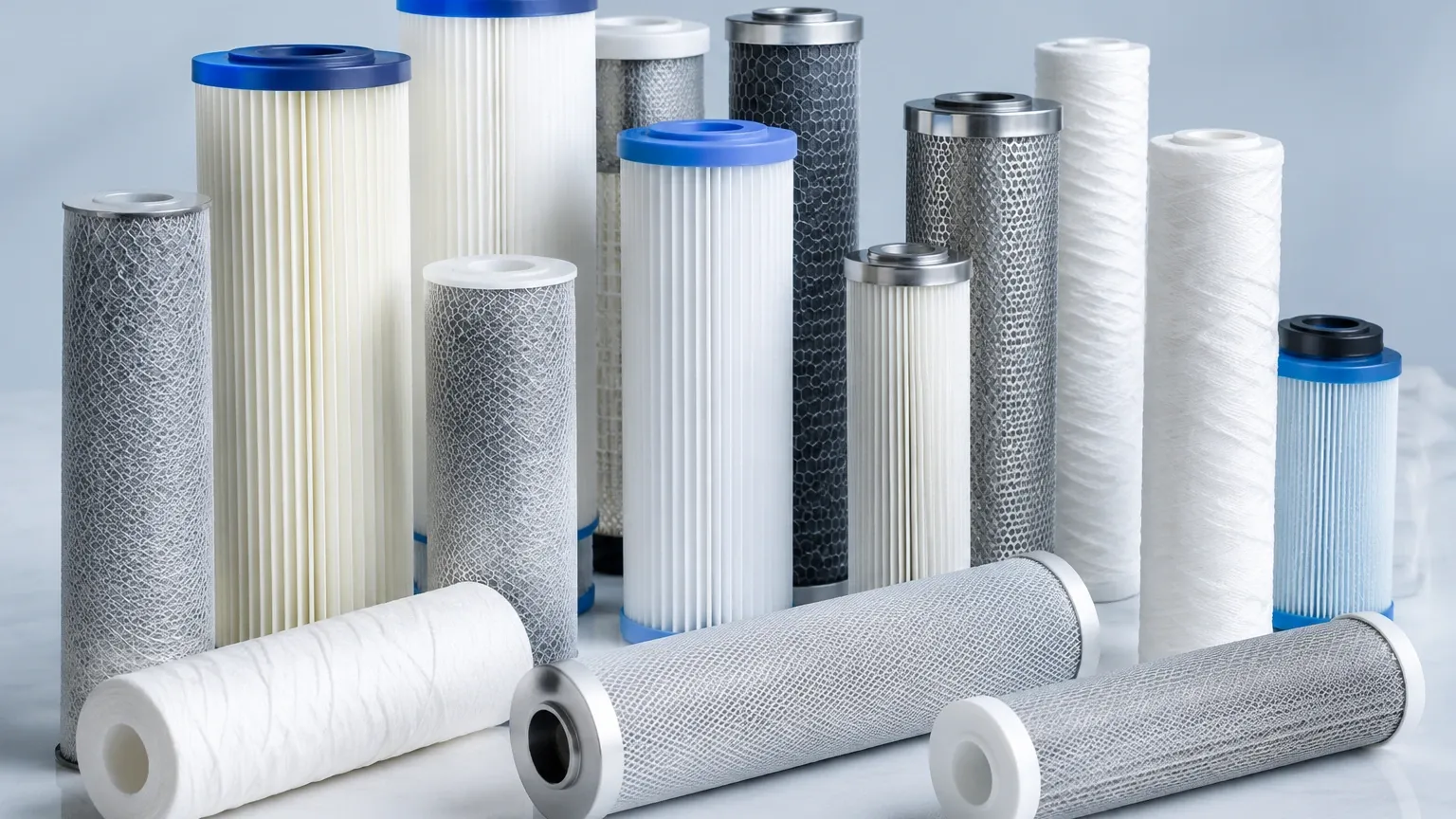
For many industrial users who initially look for amazon water filter cartridges, the eventual move toward stainless steel filtration is a matter of operational maturity. Stainless steel filter elements, including wire mesh and sintered metal designs, offer several advantages that plastic or fiber-based filters cannot match:
* Cleanability and Reusability: Unlike disposable cartridges that contribute to waste streams and recurring costs, stainless steel filters can be cleaned via backwashing, ultrasonic cleaning, or chemical baths. This makes them a more sustainable and cost-effective choice over the long term.
* High Pressure and Temperature Resistance: Stainless steel can withstand temperatures exceeding 500°F and high differential pressures that would instantly destroy a polymer-based filter.
* No Media Migration: In high-velocity flows, fiber-based filters (like string-wound or melt-blown) can shed small bits of their own material into the filtrate. Stainless steel wire mesh is mechanically woven and often sintered, ensuring that the filter itself does not become a source of contamination.
* Precision Pore Geometry: Sintered metal and precision-woven wire mesh provide highly uniform pore sizes, allowing for very specific cut-off points in filtration, which is critical for protecting high-value downstream equipment.
Custom Engineering and OEM Capabilities
One of the most significant drawbacks of relying on amazon water filter cartridges is the lack of customization. Most retail products are built to "standard" dimensions that may not perfectly suit a specialized piece of machinery. Industrial filtration often requires custom lengths, unique end-cap configurations (such as 222 or 226 O-rings, NPT threads, or flange mounts), and specific media layers.
Working with a professional manufacturer allows for the development of OEM filtration solutions. This includes:
* Layered Media: Combining a coarse outer mesh for pre-filtration with a fine inner layer for final polishing within a single cartridge.
* Reinforced Cores: Adding internal support cores to handle extreme vacuum or pressure conditions.
* Custom Gaskets: Selecting specific elastomers (Viton, EPDM, PTFE) based on the chemical profile of the process water.
By tailoring the Filter Cartridges to the specific application, engineers can optimize the balance between filtration efficiency and energy consumption (pump load).
Total Cost of Ownership and Long-Term Efficiency
When procurement departments evaluate amazon water filter cartridges, the primary driver is often the "price per unit." However, a B2B engineering perspective requires an analysis of the Total Cost of Ownership (TCO). The TCO of a filtration system includes:
1. Purchase Price: The initial cost of the cartridge.
2. Replacement Frequency: How often the system must be shut down to replace the filter.
3. Labor Costs: The man-hours required for filter changes and system bleeding.
4. Disposal Costs: The expense of disposing of contaminated, one-time-use cartridges, which may be classified as hazardous waste depending on the application.
5. Product Loss: The value of the product lost during filter change-outs or due to inadequate filtration.
In many cases, a high-quality stainless steel filter cartridge that costs ten times more than a disposable amazon water filter cartridge will actually pay for itself within the first year of operation through reduced downtime and the elimination of replacement costs. For critical industrial water lines, the reliability of a precision-engineered component far outweighs the marginal savings of a retail-sourced alternative.
Conclusion: Making Informed Sourcing Decisions
While the convenience of purchasing amazon water filter cartridges makes them an attractive option for general-purpose water filtration, industrial professionals must be diligent in assessing their specific process requirements. For non-critical, low-pressure, and low-temperature applications, retail-grade filters may provide a functional solution. However, as soon as the application involves high temperatures, aggressive chemicals, or the need for absolute particle retention, the move to industrial-grade Filter Cartridges becomes a technical necessity.
Choosing the right filtration partner involves more than just finding a part number that fits a housing. It requires a collaboration between the facility's engineering team and the manufacturer to ensure that the material, structure, and micron rating are perfectly aligned with the operational goals. By focusing on technical expertise, material quality, and custom design, companies can achieve superior filtration performance that protects their equipment, their product, and their bottom line.
For those managing complex industrial systems, the goal is not just to find a filter that works today, but to implement a filtration strategy that ensures consistent, high-performance results for years to come. Whether you are upgrading an existing system or designing a new process, prioritizing engineering specifications over retail convenience is the hallmark of a robust industrial operation.
