


Filter Cartridges for Swimming Pool
In the realm of commercial and industrial water treatment, the efficiency of a filtration system is largely determined by the quality and specification of its internal components. Filter cartridges for swimming pool applications, particularly in high-traffic aquatic centers, public facilities, and industrial-scale water features, serve as the primary defense against suspended solids and organic contaminants. Unlike residential systems that may prioritize low initial cost, commercial-grade filtration requires a focus on durability, flow rate optimization, and long-term structural integrity.
Selecting the appropriate filtration media involves understanding the fluid dynamics of the system and the chemical environment in which the filters operate. For engineers and facility managers, the objective is to maintain water clarity and safety standards while minimizing operational downtime and replacement costs.
Understanding the Role of Filter Cartridges in Large-Scale Aquatic Systems
Filter cartridges are designed to remove particles from water through mechanical straining. In a swimming pool context, this includes everything from fine silt and skin cells to larger debris. The effectiveness of this process is measured by the micron rating—the size of the smallest particle the filter can reliably capture.
In commercial settings, Filter Cartridges are often preferred over sand or DE (diatomaceous earth) filters due to their smaller footprint and lower water waste. Because cartridge systems do not require backwashing, they save significant amounts of treated and heated water, which is a critical factor in the total cost of ownership (TCO) for large facilities. However, the performance of these systems is entirely dependent on the surface area and the material properties of the cartridge media.
Material Engineering: Comparing Synthetic and Stainless Steel Components
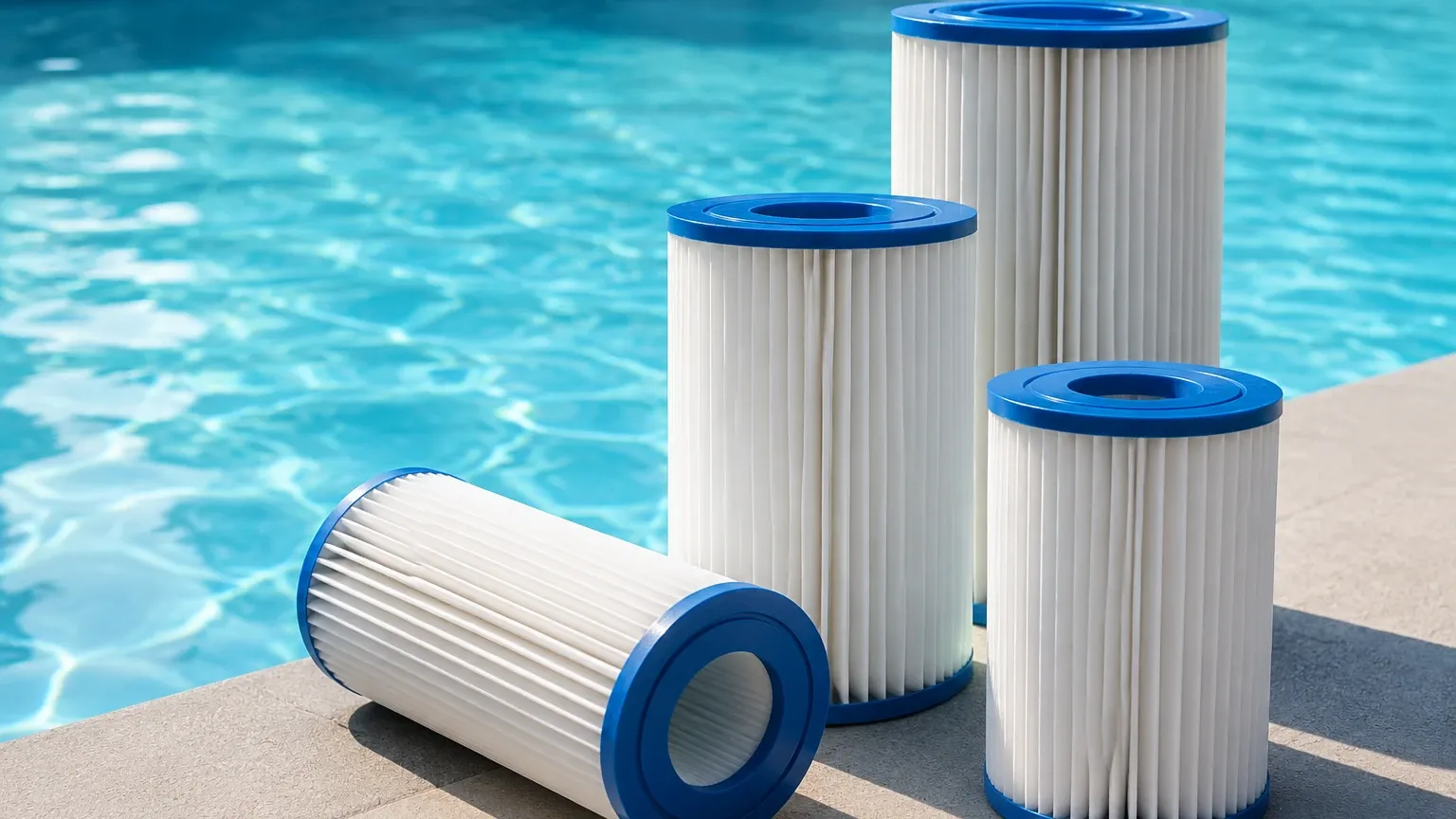
Most standard filter cartridges for swimming pool use utilize pleated polyester or non-woven synthetic fabrics. These materials provide a high surface area within a compact cylindrical volume. However, in demanding industrial or high-pressure environments, the structural components of these cartridges—such as the center core and end caps—must be engineered to withstand significant stress.
The Importance of the Support Core
In high-flow applications, the pressure differential across the filter media increases as it becomes loaded with debris. If the internal support core is insufficient, the cartridge can collapse, leading to bypass or total system failure. This is where precision metal components become essential. Stainless steel cores and support meshes provide the rigidity necessary to maintain the pleat geometry under high flux rates, ensuring that the entire surface area of the media remains active throughout the filtration cycle.
Chemical Compatibility and Corrosion Resistance
Pool water is a chemically active environment, typically containing chlorine, bromine, or ozone, along with pH adjusters. Filter components must be resistant to oxidative stress. While synthetic media handles these chemicals well, the metal reinforcements must be made from high-grade alloys, such as 304 or 316L stainless steel, to prevent localized corrosion or leaching of metal ions into the water.
Key Performance Metrics for Industrial Pool Filtration
When specifying filter cartridges for swimming pool installations at an industrial or commercial scale, engineers must evaluate several technical parameters to ensure the system meets the design intent.
1. Effective Filtration Area (EFA)
The EFA is the total surface area of the media exposed to the fluid flow. A higher EFA reduces the "face velocity" (the speed at which water passes through the media), which generally leads to higher filtration efficiency and longer intervals between cleanings. In custom-engineered solutions, the pleat count and depth are optimized to balance EFA with the physical dimensions of the filter housing.
2. Clean Pressure Drop (ΔP)
Every filter introduces resistance into the hydraulic circuit. A well-designed cartridge should have a low initial pressure drop to maximize the energy efficiency of the circulation pumps. If the initial ΔP is too high, the system will reach its terminal pressure drop (the point where cleaning is required) much faster, increasing maintenance frequency.
3. Micron Rating: Absolute vs. Nominal
* Nominal Rating: Indicates the ability of the filter to retain a majority of particles of a specific size (e.g., 80% of 10-micron particles).
* Absolute Rating: Refers to the diameter of the largest hard spherical particle that will pass through the filter under specified test conditions. For critical applications where water clarity is paramount, understanding these ratings is vital for achieving the desired turbidity levels.
Operational Challenges and Maintenance Cycles
The longevity of filter cartridges for swimming pool use is dictated by the loading of the media and the cleaning protocols employed. Unlike disposable industrial filters, many commercial pool cartridges are designed to be cleaned and reused several times before replacement.
Monitoring Pressure Differential
Maintenance teams should monitor the pressure gauges at the inlet and outlet of the filter vessel. A common rule of thumb is to clean the cartridges when the pressure differential increases by 8 to 10 PSI over the clean starting pressure. Delaying this maintenance can cause contaminants to be driven deeper into the media fibers, a phenomenon known as "depth loading," which makes the cartridge much harder to clean effectively.
Cleaning Procedures
Effective cleaning involves more than just rinsing with a hose. In commercial environments, organic oils and mineral scales can bind to the media. Chemical soaking in specialized degreasers or descaling solutions is often required to restore the permeability of the cartridge. It is essential that the materials used in the cartridge construction—including the adhesives and gaskets—are compatible with these cleaning agents.
Customization and OEM Solutions for Large-Scale Projects
Standard off-the-shelf cartridges often fall short in specialized industrial aquatic applications, such as high-temperature mineral baths, salt-water recovery systems, or high-pressure water features. In these instances, custom-manufactured filtration components are required.
Customization options include:
* Dimensional Adjustments: Tailoring the height and diameter to fit existing non-standard housings.
* End Cap Configurations: Designing specific gaskets or O-ring interfaces (such as Code 7 or 222/226 fittings) to ensure a bypass-free seal.
* Reinforced Structures: Utilizing stainless steel outer cages or inner cores for high-viscosity or high-pressure applications.
By working with a manufacturer that understands both the textile and metalworking aspects of filtration, engineers can develop solutions that are specifically tuned to the unique demands of their facility.
Procurement and Selection Checklist for Engineers
Before finalizing a purchase or specifying a filter for a new project, purchasing teams and engineers should confirm the following technical details with their supplier:
1. Housing Compatibility: Does the cartridge interface correctly with the internal manifold of the filter vessel to prevent untreated water bypass?
2. Flow Rate Requirements: Is the cartridge rated for the maximum GPM (gallons per minute) of the system without exceeding the recommended flux rate for the media?
3. Temperature Limits: In the case of heated pools or spas, can the media and structural adhesives withstand continuous exposure to elevated temperatures?
4. Structural Integrity: For systems with frequent pump cycling, is the center core robust enough to handle the resulting pressure surges?
5. Total Cost of Ownership: Beyond the initial purchase price, what is the expected lifespan, and how many cleaning cycles can the media withstand before the filtration efficiency significantly degrades?
For those managing complex water treatment systems, selecting high-quality Filter Cartridges is a strategic decision that impacts water quality, energy consumption, and labor costs. By prioritizing engineering specifications over generic marketing claims, facilities can ensure reliable, long-term performance in their swimming pool and aquatic filtration systems.
