


Steel Mesh for Filter: An Engineering Guide to Industrial Selection and Application
In industrial process engineering, the selection of filtration media is a critical decision that impacts equipment longevity, product purity, and operational efficiency. Among the various materials available, steel mesh for filter applications remains the industry standard for demanding environments. This is due to its mechanical strength, thermal stability, and precise pore geometry.
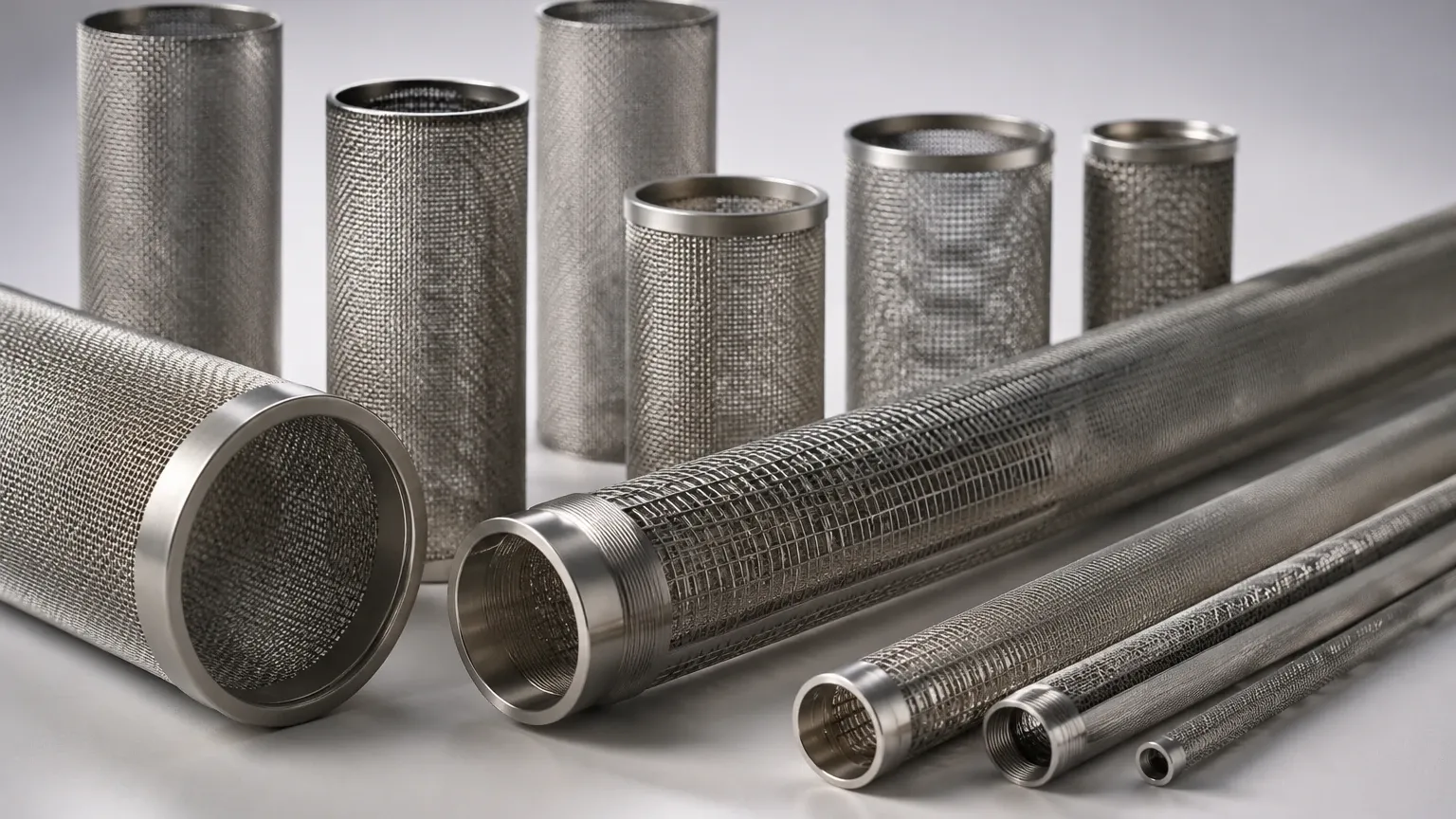
For engineers and procurement specialists, understanding the technical nuances of stainless steel filtration is essential for optimizing system performance. This guide examines the engineering principles, material science, and structural configurations—specifically Wire Mesh Filter Cylinders & Tubes—that define high-performance industrial filtration.
1. Fundamentals of Steel Mesh for Filter Applications
The primary function of steel mesh for filter systems is the mechanical separation of solids from fluids (liquids or gases). Unlike synthetic fiber or paper filters, which often rely on depth filtration where particles are trapped within a thick matrix, stainless steel wire mesh primarily facilitates surface filtration.
Mechanical Sieving and Particle Retention
In surface filtration, the aperture size of the weave determines the "cutoff" point for particle retention. This provides a high degree of predictability. Engineers can specify exact micron ratings, ensuring that any particle larger than the mesh opening is effectively blocked. This predictability is vital in industries like pharmaceutical manufacturing and food processing, where batch consistency is non-negotiable.
Durability and Reusability
One of the most significant advantages of using steel mesh for filter components is its ability to withstand high differential pressures without deforming. Furthermore, stainless steel is non-shedding; unlike polymer filters, there is no risk of media migration—where bits of the filter itself break off and contaminate the filtrate. This structural integrity allows for repeated cleaning cycles, significantly lowering the total cost of ownership compared to disposable alternatives.
2. Material Selection: Navigating Stainless Steel Grades
Selecting the correct alloy is as important as the mesh count. The chemical environment, operating temperature, and cleaning protocols dictate which grade of steel mesh for filter production should be utilized.
* AISI 304 Stainless Steel: The most common grade, offering excellent mechanical properties and basic corrosion resistance. It is suitable for water treatment, hydraulic oils, and general industrial applications where highly corrosive chemicals are not present.
* AISI 316L Stainless Steel: Containing molybdenum, 316L provides superior resistance to chlorides and organic acids. The "L" denotes low carbon content, which is crucial for components that require welding, as it prevents intergranular corrosion in the heat-affected zone. This is the preferred material for chemical processing and marine environments.
* Specialty Alloys: For extreme conditions involving high-temperature oxidation or highly acidic environments, alloys such as 904L, Inconel, or Monel may be used. These materials ensure that the filter mesh does not undergo stress-corrosion cracking or pitting during extended service.
3. Structural Design: Wire Mesh Filter Cylinders & Tubes
While flat mesh sheets are used in simple strainers, most industrial applications require the structural rigidity and increased surface area provided by Wire Mesh Filter Cylinders & Tubes. These geometries are engineered to handle flow from the inside-out or outside-in, depending on the housing design.
Support Structures and Reinforcement
In high-pressure applications, a single layer of fine mesh may lack the necessary hoop strength to resist collapse or bursting. To address this, engineers often design multi-layer structures. A typical configuration includes:
1. The Filtration Layer: A fine-weave mesh that determines the micron rating.
2. The Support Layer: A coarser, heavier-gauge steel mesh for filter reinforcement.
3. The Drainage Layer: Provides a path for the filtrate to exit efficiently, reducing pressure drop.
In some cases, the mesh is pleated before being formed into a cylinder. Pleating significantly increases the effective filtration area within the same footprint, allowing for higher flow rates and longer intervals between cleaning.
4. Weave Patterns and Their Impact on Performance
The way the steel wires are interlaced—the weave pattern—directly affects the flow resistance and the shape of the pores. Understanding these patterns is key to selecting the right steel mesh for filter tasks.
* Plain Weave: Each warp wire crosses over and under each shute wire. This creates square openings and is ideal for high-flow, low-pressure applications where simple sieving is required.
* Twill Weave: The wires are woven over two and under two, allowing for a heavier wire diameter for a given mesh count. This results in greater strength and is often used for finer filtration tasks.
* Dutch Weave (Plain and Twill): These weaves use a larger diameter for the warp wires and a smaller diameter for the shute wires, which are driven close together. This creates a "zero-aperture" mesh where the fluid must follow a tortuous path. Dutch weaves are essential for high-pressure filtration and can achieve micron ratings as low as 5-10 microns.
5. Engineering Metrics: Flow Rate, Pressure Drop, and Blinding
When integrating Wire Mesh Filter Cylinders & Tubes into a system, engineers must calculate the Clean Pressure Drop ($ΔP$). A high initial pressure drop limits the "dirt-holding capacity" of the filter, leading to frequent maintenance.
The Concept of Blinding
Blinding occurs when particles that are approximately the same size as the mesh apertures become wedged in the openings. This is common with spherical particles. To mitigate blinding, engineers may select a Dutch weave or a different mesh geometry that provides a non-linear path, or they may implement automated backwashing systems.
Calculating Effective Filtration Area (EFA)
For a cylindrical filter, the EFA is calculated based on the diameter and length, but it must also account for the "open area" percentage of the mesh. A mesh with 30% open area will naturally have a higher flow resistance than one with 50% open area, even if the micron rating is the same. Balancing structural strength (thicker wires) with flow efficiency (higher open area) is a core challenge in filter design.
6. Manufacturing and Customization for OEM Applications
Standard off-the-shelf filters rarely meet the specific needs of complex industrial machinery. Customization is often required to ensure a perfect fit within existing housings and to meet specific process parameters.
Welding and Joining Techniques
Because these filters operate in high-stress environments, the method of joining the mesh is critical. TIG (Tungsten Inert Gas) welding and plasma welding are preferred because they create a clean, strong bond without introducing contaminants. For Wire Mesh Filter Cylinders & Tubes, the longitudinal seam must be as strong as the parent mesh to prevent bypass—the unintended passage of unfiltered fluid through a structural failure.
End Fittings and Sealing
Custom filters can be manufactured with various end-cap configurations, including NPT threads, flanges, or O-ring grooves (such as 222 or 226 connectors). Proper sealing is paramount; even a 1% bypass can compromise the entire downstream process, leading to pump damage or product contamination.
7. Maintenance: Cleaning and Lifespan Optimization
Unlike disposable cartridges, steel mesh for filter components is an investment intended for long-term use. Proper maintenance protocols can extend the life of a stainless steel filter for several years.
* Ultrasonic Cleaning: This is the most effective method for removing deeply embedded particles from fine Dutch weaves. High-frequency sound waves create cavitation bubbles that dislodge contaminants without damaging the wire structure.
* Backwashing: For automated systems, reversing the flow of the fluid can flush accumulated solids off the surface of the mesh. This is particularly effective for cylinders with outside-in flow patterns.
* Chemical Cleaning: In industries like food and beverage, CIP (Clean-In-Place) systems use caustic or acidic solutions to dissolve organic buildup. The corrosion resistance of 316L stainless steel is essential here to prevent degradation during these cycles.
8. Purchasing Considerations for Engineers
When sourcing Wire Mesh Filter Cylinders & Tubes, international buyers should confirm several technical specifications to ensure the product is fit for purpose:
1. Micron Rating: Specify whether the requirement is "nominal" (approximate) or "absolute" (guaranteed retention of 99.9% of particles at that size).
2. Operating Temperature and Pressure: Define the maximum spikes the filter will encounter, not just the steady-state averages.
3. Fluid Compatibility: Provide the chemical composition of the filtrate, including pH levels and any abrasive solids present.
4. Certification Requirements: For pharmaceutical or food applications, ensure the materials are FDA-compliant or meet specific industry standards like 3-A Sanitary Standards.
By focusing on these factual engineering boundaries, technical professionals can select filtration solutions that provide the best balance of performance, durability, and cost-effectiveness. Whether for chemical processing, hydraulic systems, or water treatment, the right steel mesh for filter applications is a cornerstone of industrial reliability.
