


Filter Cartridge Lube Oil
In industrial machinery, the lubrication system is often referred to as the lifeblood of the equipment. Whether in high-speed turbines, heavy-duty hydraulic presses, or large-scale reciprocating compressors, the quality and cleanliness of the lubricant directly dictate the service life of bearings, gears, and seals. A critical component in maintaining this quality is the filter cartridge lube oil system. By removing particulate matter, varnish, and other contaminants, these filtration components prevent abrasive wear and chemical degradation of the oil.
For engineers and maintenance professionals, selecting the appropriate filter cartridge is not merely a matter of finding a component that fits a housing. It requires a deep understanding of fluid dynamics, material compatibility, and the specific contamination profile of the application. This guide explores the technical nuances of lube oil filtration, focusing on the engineering considerations that ensure optimal performance in demanding industrial environments.
Understanding the Role of the Filter Cartridge in Lube Oil Systems
Lube oil systems are closed loops designed to provide a hydrodynamic film between moving parts. However, these loops are susceptible to various forms of contamination. Ingressed contaminants from the environment, such as dust and moisture, combine with internally generated wear debris (metal shavings) and chemical byproducts of oil oxidation.
The primary function of a filter cartridge lube oil assembly is to intercept these particles before they reach critical clearances. In many industrial applications, these clearances are measured in microns. If a particle larger than the lubricant film thickness enters a bearing, it causes three-body abrasion, leading to surface fatigue and eventual component failure.
Beyond simple particle removal, modern industrial filtration must account for the increasing complexity of synthetic lubricants and the high flow rates required by modern machinery. A well-engineered filter cartridge must balance high dirt-holding capacity with low resistance to flow, ensuring that the system remains lubricated even during cold starts or high-load conditions.
Engineering Considerations for Lube Oil Filter Cartridges
When specifying Filter Cartridges for lubrication systems, several technical parameters must be evaluated to ensure the component can withstand the operational stresses of the environment.
Material Selection and Structural Integrity
Industrial lube oils can operate at elevated temperatures, often exceeding 80°C (176°F), and may contain aggressive chemical additives. While cellulose or synthetic fiber media are common in light-duty applications, heavy industrial processes often require stainless steel wire mesh or sintered metal fiber media.
Stainless steel (typically Grade 304 or 316L) offers several advantages in lube oil filtration:
- Thermal Stability: Unlike polymer-based media, stainless steel does not soften or degrade at high temperatures.
- Chemical Compatibility: It is inert to most oil additives and oxidation products, preventing media migration into the system.
- Mechanical Strength: Metal cartridges can withstand higher differential pressures without collapsing, a critical factor during cold starts when oil viscosity is at its peak.
Pressure Drop and Flow Dynamics
The differential pressure ($ΔP$) across a filter is a function of the oil's viscosity, the flow rate, and the resistance of the filter media. In lube oil systems, maintaining a low $ΔP$ is essential to prevent the system's bypass valve from opening. If the bypass valve opens, unfiltered oil circulates through the machinery, defeating the purpose of the filtration system.
To optimize flow, manufacturers often use pleated designs. Pleating significantly increases the effective filtration surface area within the same footprint, which reduces the flux (flow per unit area) and lowers the initial pressure drop. For high-viscosity lubricants, the spacing and height of these pleats must be carefully engineered to prevent "pleat bunching," which can restrict flow and cause premature filter failure.
Performance Metrics and Filtration Accuracy
Evaluating the effectiveness of a filter cartridge lube oil solution requires looking beyond simple micron ratings. Engineers typically rely on the Beta Ratio (β), derived from the Multi-Pass Test (ISO 16889).
Absolute vs. Nominal Ratings
A "nominal" rating is an arbitrary value provided by some manufacturers, often indicating the filter can stop a certain percentage of particles of a given size. In contrast, an "absolute" rating (typically $β_x ≥ 75$ or $1000$) provides a statistically verified efficiency. For critical lubrication points, such as high-speed turbine bearings, absolute-rated cartridges are mandatory to ensure that the ISO 4406 cleanliness codes are met consistently.
Surface vs. Depth Filtration
- Surface Filtration: Utilizes a single layer of media, such as stainless steel wire mesh. Contaminants are trapped on the surface. This type is highly predictable and often cleanable, making it ideal for removing large volumes of metallic wear debris.
- Depth Filtration: Uses a thick layer of media where particles are trapped throughout the structure. This is effective for capturing smaller, "silt-sized" particles and soft contaminants like varnish.
In many advanced lube oil systems, a combination of these methods is used, or specialized multi-layered stainless steel mesh is employed to provide both fine filtration and high structural strength.
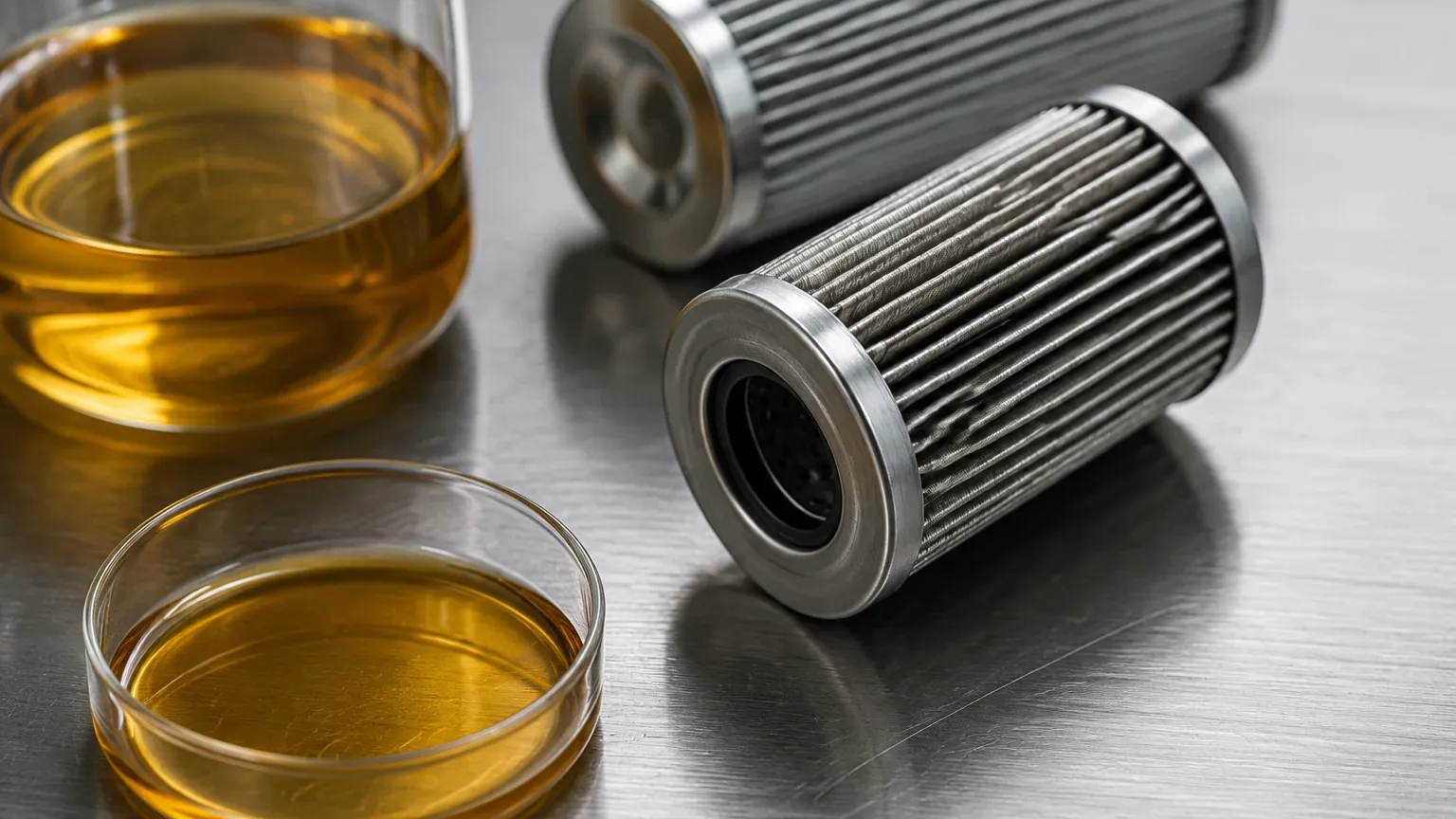
Selecting the Right Filter Cartridge for Industrial Lubrication
The selection process should begin with a thorough analysis of the system's operating parameters. Purchasing teams and engineers should confirm the following before finalizing a specification:
1. Fluid Type and Viscosity: Is the oil mineral-based or synthetic? What is the viscosity at the minimum and maximum operating temperatures? High-viscosity oils require larger filter surface areas to maintain acceptable pressure drops.
2. Target Cleanliness Level: What is the required ISO 4406 code for the downstream components? This determines the necessary micron rating and Beta ratio.
3. Flow Conditions: Is the flow steady or pulsating? Pulsating flow, common in systems with reciprocating pumps, can cause "particle unloading" in inferior filters. Robust stainless steel cartridges are better suited for these environments.
4. Environmental Factors: Is the filter housing located in a corrosive environment (e.g., offshore or chemical processing)? This may dictate the use of 316L stainless steel for all wetted parts, including end caps and support cores.
Customization is often required when replacing filters in older OEM equipment or when upgrading a system for higher efficiency. Working with a manufacturer capable of producing custom dimensions and specialized media configurations ensures that the new filter cartridge lube oil component integrates seamlessly with existing hardware while meeting modern performance standards.
Maintenance and Replacement Strategies
Effective filtration is not a "set and forget" process. The total cost of ownership (TCO) of a filtration system is heavily influenced by maintenance practices and the durability of the cartridges used.
Monitoring Differential Pressure
The most reliable indicator of a filter's condition is the differential pressure gauge. As the filter captures contaminants, the $ΔP$ will rise. It is standard practice to replace or clean cartridges when the $ΔP$ reaches a pre-determined limit, usually well before the bypass valve setting.
Oil Analysis as a Diagnostic Tool
Regular oil analysis provides insight into both the condition of the lubricant and the effectiveness of the filter. If an analysis shows an increase in particle counts despite a low $ΔP$, it may indicate media rupture or that the filter's micron rating is insufficient for the application.
The Case for Reusable Stainless Steel Cartridges
In many heavy industrial applications, the volume of waste generated by disposable cartridges is a significant concern. Stainless steel wire mesh filters offer the advantage of being cleanable. Through ultrasonic cleaning or backwashing, these cartridges can be restored to near-original condition multiple times. While the initial investment is higher than disposable alternatives, the long-term savings in replacement costs and waste disposal fees often result in a much lower TCO.
Custom Stainless Steel Solutions for Demanding Lube Oil Applications
For specialized industrial sectors, off-the-shelf filtration products often fall short of specific performance or durability requirements. This is where custom-engineered stainless steel solutions become essential. Manufacturers like Kaifil specialize in developing bespoke filtration components that address unique challenges such as extreme pressures, highly corrosive additives, or non-standard housing geometries.
Customization allows for the optimization of the support structure (inner cores and outer cages) to handle specific mechanical loads, ensuring the filter does not deform under vacuum or surge conditions. Furthermore, the ability to select specific weave patterns in the wire mesh allows for precise control over filtration accuracy and flow resistance.
In conclusion, the performance of a lube oil system is fundamentally linked to the quality of its filtration. By prioritizing technical specifications—such as absolute micron ratings, material compatibility, and structural integrity—engineers can ensure their machinery remains protected against the hidden costs of contamination. Investing in high-quality, engineered filter cartridges is a proactive strategy that pays dividends in reduced downtime, lower maintenance costs, and extended equipment life.
