


Filter Cartridge Meaning
In the context of industrial engineering and fluid management, understanding the comprehensive filter cartridge meaning is essential for maintaining process integrity and equipment longevity. A filter cartridge is a modular, replaceable piece of filtration equipment designed to remove solid contaminants or chemical impurities from liquids or gases. Unlike permanent filtration structures, cartridges are engineered for ease of maintenance, allowing operators to swap or clean elements without dismantling the entire housing system.
For procurement managers and process engineers, the meaning of a filter cartridge extends beyond a simple definition; it represents a critical boundary between raw process fluids and the required purity of the final output. Whether used in chemical processing, food and beverage production, or hydraulic systems, these components are the primary defense against particulate-induced damage and product contamination.
Defining the Industrial Filter Cartridge
At its most basic level, the filter cartridge meaning refers to a self-contained filtration element that fits into a pressurized vessel or housing. The fluid enters the housing, passes through the cartridge media, and exits through the core, leaving the contaminants trapped on or within the media.
In industrial settings, the "meaning" of these components is defined by their specific application. For example, in a high-temperature chemical reactor, a filter cartridge is a precision-engineered stainless steel component capable of withstanding thermal expansion and corrosive attack. In a water treatment facility, it may be a high-surface-area pleated element designed for high flow rates and low pressure drops.
Choosing the right Filter Cartridges requires a deep dive into the mechanical and chemical requirements of the specific process. The cartridge is not a standalone product but a functional part of a larger engineering solution that balances flow velocity, pressure retention, and particle capture efficiency.
Core Components and Structural Design
To understand the functional filter cartridge meaning, one must examine the individual components that make up the assembly. Each part serves a specific engineering purpose:
1. Filter Media
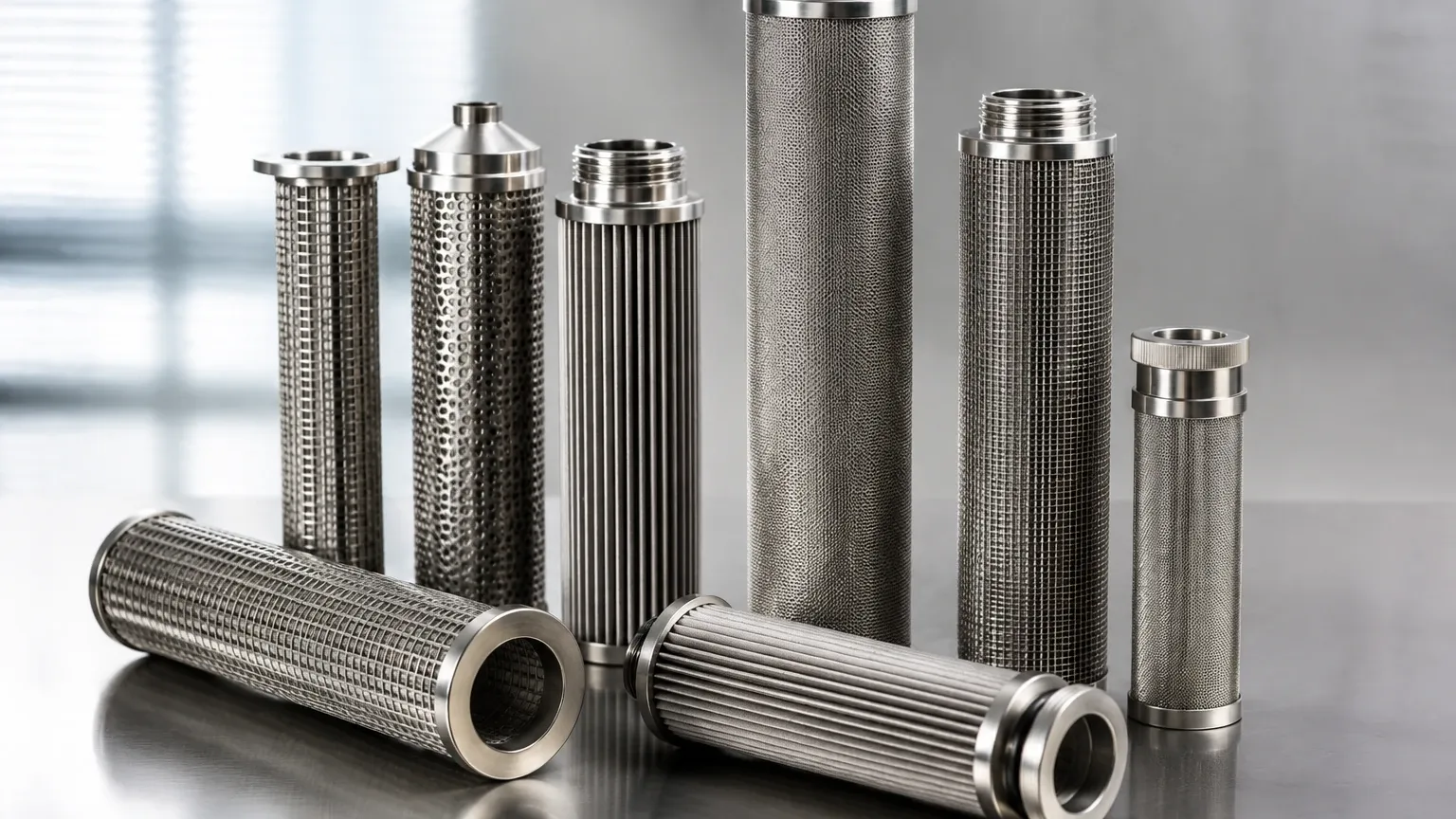
This is the heart of the cartridge. In industrial metal filters, the media typically consists of stainless steel wire mesh, sintered metal powder, or sintered fiber felt. The choice of media determines the filtration accuracy (micron rating) and the cartridge's ability to be cleaned and reused.
2. Inner Core and Outer Cage
Industrial cartridges often operate under significant pressure. An inner support core—usually a perforated or spiral-welded stainless steel tube—prevents the media from collapsing under inward pressure. In high-flow or backwash applications, an outer cage may also be used to protect the media from outward pressure or mechanical damage during handling.
3. End Caps and Seals
End caps define how the cartridge interfaces with the filter housing. Common configurations include Double Open End (DOE), where both ends are open and rely on flat gaskets for sealing, and Single Open End (SOE), which often features specialized O-ring configurations (such as 222 or 226 styles) to ensure a bypass-free seal. The material of the seals (EPDM, Viton, PTFE) must be compatible with the process fluid to prevent leaks or chemical degradation.
Understanding Filtration Mechanisms: Surface vs. Depth
A critical part of the filter cartridge meaning involves the mechanism of particle capture. Industrial cartridges generally fall into two categories: surface filtration and depth filtration.
Surface Filtration
Surface filters, such as those made from a single layer of stainless steel wire mesh, trap particles on the upstream side of the media. The openings are uniform, providing a very precise "absolute" micron rating. These are ideal for removing large quantities of hard, non-deformable particles. Because the contaminants stay on the surface, these cartridges are often easier to clean via backpulsing or ultrasonic baths.
Depth Filtration
Depth filters utilize a thicker media structure, such as sintered metal fibers or multi-layered mesh. Contaminants are trapped throughout the entire thickness of the material. This provides a higher dirt-holding capacity for gelatinous or irregularly shaped particles. While depth filters offer excellent protection for downstream equipment, they can be more challenging to clean than simple surface filters, often requiring specialized chemical cleaning or high-pressure thermal processing.
Critical Performance Metrics: Micron Ratings and Efficiency
When engineers discuss filter cartridge meaning, they often focus on the micron rating. This metric defines the size of particles the filter is capable of removing. However, the rating itself can be misleading without context:
* Nominal Micron Rating: This is an indicative value, suggesting that the filter will trap a large percentage of particles at that size (e.g., 90% of 10-micron particles). It does not guarantee total removal.
* Absolute Micron Rating: This refers to the diameter of the largest hard spherical particle that will pass through the filter under specified test conditions. For critical applications like pharmaceutical processing or fine chemical production, absolute-rated cartridges are mandatory to ensure process consistency.
Efficiency is also tied to the "Beta Ratio," a mathematical expression of filtration performance. A higher Beta ratio indicates a more efficient filter. For instance, a Beta 1000 rating means that for every 1000 particles of a specific size entering the filter, only one passes through.
Material Engineering and Environmental Compatibility
The material of construction is perhaps the most significant factor in the industrial filter cartridge meaning. While plastic or cellulose cartridges are common in light-duty applications, industrial processes often demand stainless steel (typically 304 or 316L) or exotic alloys like Hastelloy.
Temperature Resistance
Metal filter cartridges can operate at temperatures exceeding 500°F (260°C), where polymer-based filters would melt or lose structural integrity. This is vital in steam filtration and hot gas applications.
Chemical Compatibility
Stainless steel provides excellent resistance to a wide range of acids, bases, and solvents. In the chemical industry, the "meaning" of a high-quality cartridge is its ability to maintain its pore structure and mechanical strength even when exposed to aggressive fluids that would degrade standard synthetic materials.
Pressure and Durability
Industrial cartridges must withstand high differential pressures (Delta P). As a filter becomes loaded with contaminants, the pressure required to push fluid through it increases. A robust stainless steel cartridge can handle high differential pressures without tearing or bypassing, protecting expensive downstream components like high-pressure pumps or spray nozzles.
Integration and Customization in Industrial Systems
In many B2B environments, the standard filter cartridge meaning is insufficient for unique process requirements. This is where OEM (Original Equipment Manufacturer) and custom filtration solutions become necessary. Customization allows engineers to specify the exact dimensions, end cap styles, and media combinations required for their specific housing or flow conditions.
Customized filter cartridges allow for:
* Retrofitting: Designing a high-performance metal element to fit into an existing housing originally designed for disposable filters.
* Optimized Flow: Adjusting the pleat density or media thickness to achieve the lowest possible initial pressure drop, which reduces energy costs for pumps.
* Application-Specific Seals: Selecting specialized gasket materials for cryogenic or ultra-high-temperature applications.
By working with a specialized manufacturer, companies can ensure that the cartridge is not just a commodity part, but a precision tool tailored to the nuances of their production line.
Lifecycle Management: Cleaning and Replacement Strategies
Finally, the filter cartridge meaning encompasses the total cost of ownership (TCO). While disposable cartridges have a lower upfront cost, industrial stainless steel cartridges offer a long-term economic advantage through reusability.
Cleaning Procedures
Unlike disposable melt-blown or pleated paper filters, stainless steel cartridges can be cleaned multiple times. Methods include:
* Backwashing: Reversing the flow of fluid to dislodge surface contaminants.
* Ultrasonic Cleaning: Using high-frequency sound waves in a cleaning solution to remove particles from deep within the media.
* Chemical Soaking: Using solvents or acids to dissolve organic or mineral scale.
When to Replace
Despite their durability, even metal cartridges have a finite lifespan. Replacement is typically indicated when the "clean" pressure drop (the pressure measured immediately after a cleaning cycle) begins to rise significantly. This suggests that fine particulates have become permanently embedded in the media or that the media has suffered mechanical fatigue. Regular inspection of the seals and end caps is also necessary to ensure that fluid bypass does not occur.
Conclusion
Understanding the professional filter cartridge meaning is a prerequisite for any engineer or purchasing agent involved in industrial fluid processing. It is more than just a tube of mesh; it is a sophisticated engineering component that dictates the efficiency, safety, and cost-effectiveness of a manufacturing process. By focusing on material compatibility, micron accuracy, and structural integrity, industrial facilities can select filtration solutions that provide consistent performance in the most demanding environments.
For those seeking reliable, high-performance filtration components, choosing a partner with deep technical expertise in metal fabrication and filtration science is essential. High-quality stainless steel cartridges represent an investment in process stability, ensuring that downstream equipment remains protected and final products meet the highest quality standards.
