


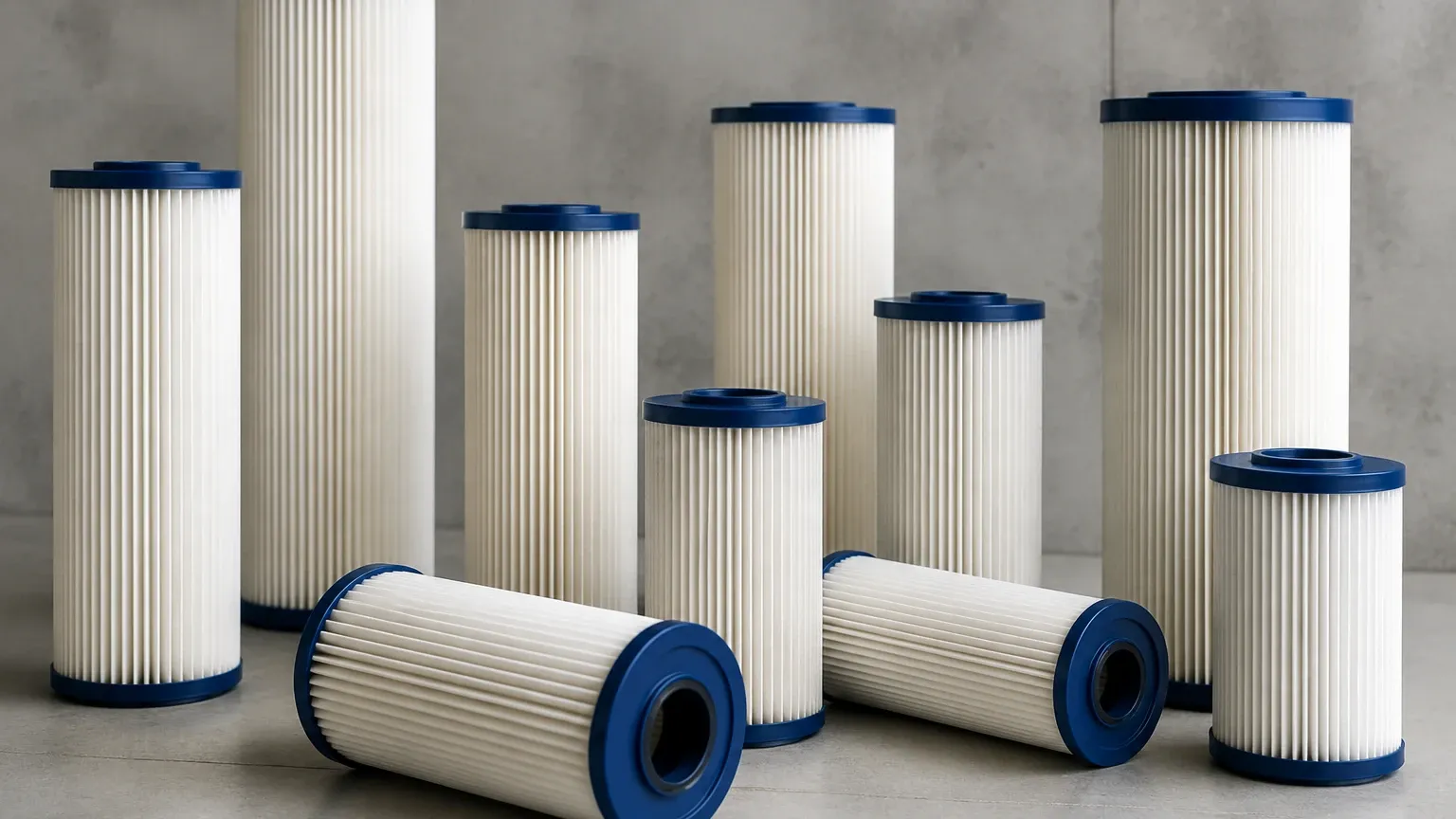
Pool Filter Cartridges By Size
In industrial and high-capacity commercial water treatment, the selection of filtration components is a critical engineering decision that impacts both operational efficiency and long-term maintenance costs. While residential applications often rely on standard off-the-shelf solutions, commercial aquatic facilities, industrial cooling towers, and large-scale water features require a more rigorous approach to selecting pool filter cartridges by size. Precise sizing is not merely a matter of physical fit within a housing; it is a fundamental factor in determining flow rates, pressure differentials, and the overall structural integrity of the filtration system.
For engineers and procurement professionals, understanding the technical nuances of cartridge dimensions and material performance is essential. When standard synthetic media fails to meet the demands of high-pressure or chemically aggressive environments, specialized Filter Cartridges—particularly those constructed from stainless steel—offer a robust alternative that ensures consistent performance over an extended service life.
Understanding the Dimensions of Filter Cartridges
When evaluating pool filter cartridges by size, three primary physical dimensions must be verified with high precision: the outer diameter (OD), the inner diameter (ID), and the overall length (OAL). In the B2B sector, where filtration systems are often custom-engineered or legacy-built, relying on "nominal" sizes can lead to significant bypass issues or mechanical failure.
Outer Diameter (OD)
The outer diameter determines the total surface area available for filtration within the constraints of the filter vessel. In high-flow environments, a larger OD allows for more pleats or a greater volume of filter media, which reduces the flux (flow per unit area). Engineers must ensure that the OD provides sufficient clearance from the vessel walls to allow for uniform flow distribution while maximizing the available space.
Inner Diameter (ID)
The inner diameter is critical for ensuring a proper seal with the internal standpipe or manifold of the filter housing. A mismatch in ID, even by a few millimeters, can result in unfiltered water bypassing the media entirely. In industrial applications, the ID must also accommodate the structural core of the cartridge, which prevents collapse under high differential pressure.
Overall Length (OAL)
The length of the cartridge is often the most variable dimension. Many commercial systems utilize stacked configurations where multiple cartridges are placed end-to-end. In these scenarios, the precision of the OAL and the quality of the end-cap seals are paramount to preventing leaks between the stacked units.
The Engineering Impact of Surface Area and Sizing
The primary objective of selecting the correct pool filter cartridges by size is to optimize the effective filtration area (EFA). The relationship between the physical size of the cartridge and its performance is governed by fluid dynamics and the specific requirements of the water being treated.
Flow Rate and Velocity
Every filter medium has a maximum recommended face velocity—the speed at which water passes through the media. If a cartridge is undersized for the required flow rate, the velocity increases, which can force contaminants deeper into the media or even through it. By selecting a larger cartridge size or increasing the number of cartridges, engineers can lower the face velocity, thereby improving filtration efficiency and extending the time between cleaning cycles.
Pressure Drop (Delta P)
As water passes through a filter, a natural drop in pressure occurs. This is known as the clean pressure drop. As the filter captures debris, the pressure drop increases. Sizing a cartridge correctly ensures that the initial pressure drop is kept within the system’s design parameters. An undersized cartridge will reach its terminal pressure drop much faster, necessitating frequent shutdowns for maintenance and increasing the strain on circulation pumps.
Material Selection: Stainless Steel vs. Synthetic Media
While traditional pool filtration often utilizes polyester or cellulose media, industrial-grade applications frequently demand the durability of metal. Stainless steel Filter Cartridges provide distinct advantages in commercial and industrial pool environments where high temperatures, chemical exposure, or high solids loading are present.
Chemical Compatibility
Commercial pools and industrial water systems often utilize aggressive sanitizers or pH adjusters. Over time, these chemicals can degrade synthetic fibers, leading to media migration—where bits of the filter material enter the water stream. Stainless steel (typically Grade 304 or 316L) is inert to most common water treatment chemicals, ensuring that the structural integrity of the filter remains uncompromised.
Thermal Stability
In applications such as large-scale spas, hydrotherapy pools, or industrial process water, temperatures can fluctuate significantly. Synthetic cartridges may soften or deform under thermal stress, especially when combined with high pressure. Metal cartridges maintain their physical dimensions and filtration accuracy across a much wider temperature range.
Cleanability and Longevity
One of the most significant B2B considerations is the total cost of ownership. While synthetic cartridges are often viewed as consumables, stainless steel cartridges are cleanable and reusable. In high-load environments, the ability to backwash or ultrasonically clean a metal cartridge can result in substantial long-term savings compared to the repeated purchase and disposal of synthetic alternatives.
Critical Evaluation Criteria for Industrial Filtration
Beyond the physical dimensions of pool filter cartridges by size, technical professionals must evaluate several performance metrics to ensure the selected component is fit for purpose.
1. Micron Rating: It is vital to distinguish between nominal and absolute micron ratings. A nominal rating indicates the ability to trap a percentage of particles of a certain size, while an absolute rating (common in precision metal mesh) indicates the size of the largest particle that can pass through the media.
2. Structural Integrity: For cartridges used in high-pressure systems, the strength of the center core and the attachment of the end caps are vital. In stainless steel designs, TIG welding or plasma welding is preferred over adhesives to ensure a permanent, leak-proof bond.
3. End Cap Configuration: Cartridges come with various end cap styles, including Double Open End (DOE), Single Open End (SOE) with O-rings, or threaded connections. The choice depends entirely on the housing design and the required seal integrity.
Custom Sizing and OEM Solutions for Specialized Systems
Many industrial facilities operate legacy filtration systems or specialized equipment that does not conform to standard residential sizing. In these instances, sourcing custom-manufactured filter cartridges is the most effective path forward. Customization allows for the optimization of the filter to the specific contaminants and flow conditions of the site.
When requesting custom pool filter cartridges by size, engineers should provide the following data to the manufacturer:
* Exact Housing Dimensions: To ensure proper fit and flow clearance.
* Operating Pressure and Temperature: To determine the required material thickness and reinforcement.
* Contaminant Type: To select the appropriate mesh weave or pore size.
* Flow Rate Requirements: To calculate the necessary surface area.
Manufacturers like Kaifil specialize in bridging the gap between standard requirements and specialized industrial needs, providing precision-engineered metal filtration components that outperform standard synthetic options in demanding environments.
Maintenance and Replacement Cycles
The lifespan of a filter cartridge is directly related to its size and the volume of contaminants it is expected to handle. In a B2B context, unplanned downtime is costly. Therefore, establishing a predictable maintenance schedule based on pressure differential (Delta P) is essential.
Monitoring Performance
Industrial systems should be equipped with pressure gauges on both the influent and effluent sides of the filter housing. A common rule of thumb is to clean or replace the cartridge when the pressure differential reaches 8-10 PSI above the clean starting pressure. If the time between these intervals is too short, it is a clear indicator that the current pool filter cartridges by size are insufficient for the system's solids loading.
Cleaning Protocols for Metal Cartridges
Unlike synthetic cartridges that are typically hosed off or replaced, stainless steel cartridges can undergo more rigorous cleaning. This may include chemical soaking to remove scale or organic buildup, or ultrasonic cleaning to dislodge fine particulates trapped within the mesh. Proper cleaning restores the cartridge to near-original flow conditions, significantly extending its service life.
Conclusion: Selecting the Right Filtration Partner
Selecting pool filter cartridges by size is a technical process that requires a thorough understanding of system requirements, fluid dynamics, and material science. For industrial and commercial applications, the transition from disposable synthetic media to high-performance stainless steel Filter Cartridges can provide the durability and precision necessary to maintain water quality while reducing operational overhead.
By focusing on accurate measurements, material compatibility, and structural integrity, procurement teams can ensure they are investing in filtration solutions that provide consistent performance. Whether retrofitting an existing system or designing a new water treatment process, partnering with a manufacturer capable of providing custom dimensions and technical guidance is the most effective way to achieve long-term filtration success.
