


Types of Water Filter Cartridges
In industrial water treatment and process fluid management, selecting the appropriate filtration media is a critical engineering decision. The efficiency of a filtration system depends not only on the housing design but fundamentally on the physical and chemical properties of the filter cartridges employed. For engineers and procurement teams, understanding the various types of water filter cartridges is essential for optimizing flow rates, ensuring product purity, and managing the total cost of ownership.
Industrial water filtration encompasses a wide range of applications, from pre-filtration in reverse osmosis (RO) systems to high-purity processing in the pharmaceutical and food and beverage sectors. Each application presents unique challenges, such as high temperatures, aggressive chemical environments, or the need for specific micron ratings. This guide examines the technical classifications, material compositions, and performance characteristics of the most common Filter Cartridges used in modern industry.
Classification by Filtration Mechanism: Depth vs. Surface
Before selecting a specific material, engineers must determine whether the application requires depth or surface filtration. These two mechanisms handle particulate matter differently and are suited to different types of contaminant loads.
Depth Filtration
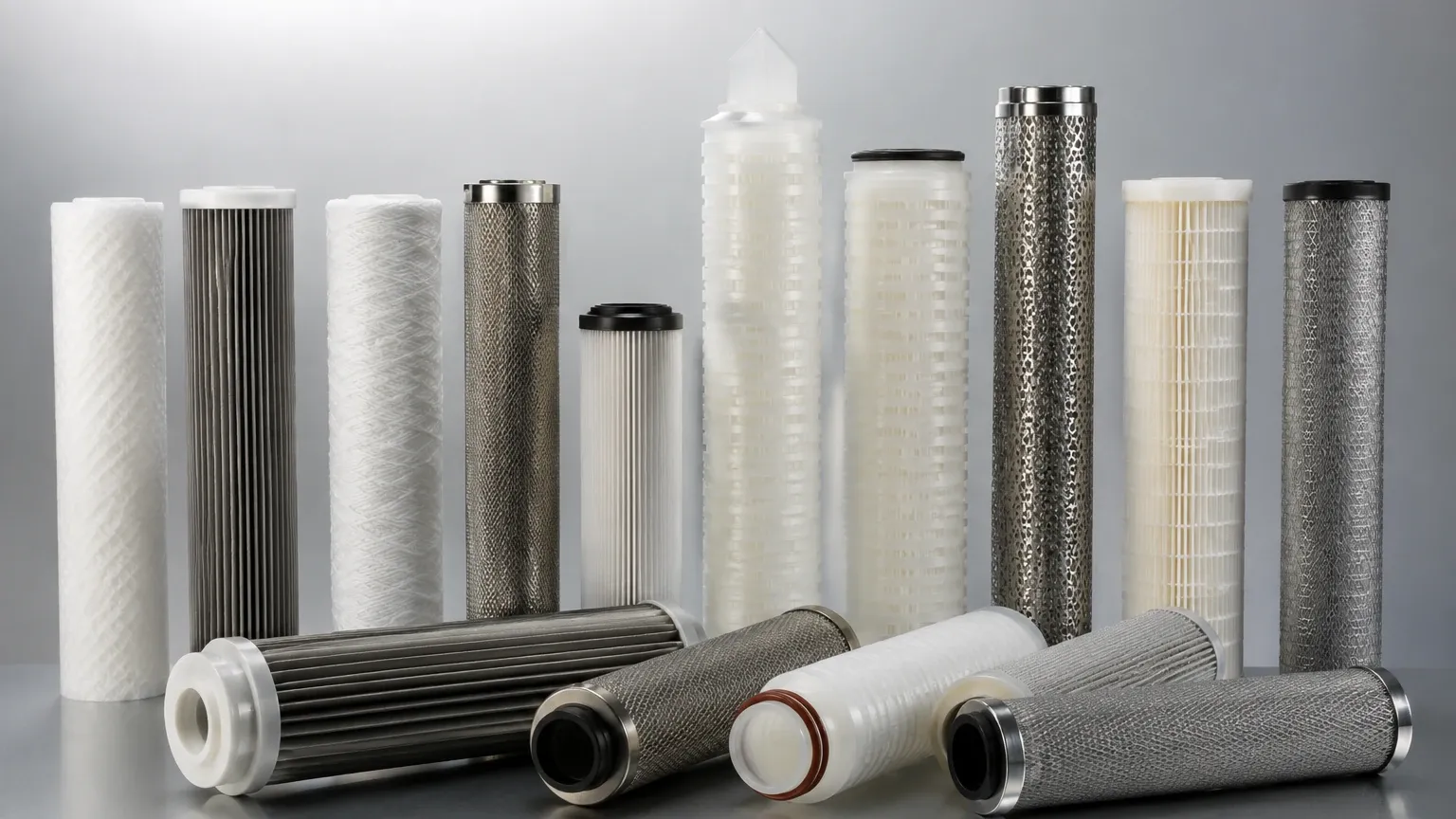
Depth filter cartridges work by trapping particles throughout the entire thickness of the filter media. The media typically features a tortuous path or a gradient density structure, where the outer layers capture larger particles and the inner layers capture smaller ones. This design provides a high dirt-holding capacity, making it ideal for water sources with a broad distribution of particle sizes. Common examples include string-wound, melt-blown, and certain resin-bonded cartridges.
Surface Filtration
Surface filtration occurs on a thin, often pleated, layer of material. Particles larger than the pore size are trapped on the upstream side of the media. Because the filtration happens on a single plane, surface filters can be manufactured with very precise, "absolute" micron ratings. Pleated cartridges are the most common form of surface filtration, offering a significantly higher surface area than cylindrical depth filters, which allows for higher flow rates and lower initial pressure drops.
Material Selection and Chemical Compatibility
The choice of material for types of water filter cartridges is dictated by the temperature of the fluid, the chemical nature of the contaminants, and the required level of purity.
Synthetic Polymers
Polypropylene (PP) is the most widely used material due to its broad chemical compatibility and low cost. It is resistant to most acids, bases, and salts. For higher temperature applications or specific chemical resistances, materials such as Polyethersulfone (PES), Polytetrafluoroethylene (PTFE), and Nylon are utilized. PES is frequently used in sterile filtration for the pharmaceutical industry due to its high flux and hydrophilic nature.
Stainless Steel and Metal Alloys
In demanding industrial environments where synthetic polymers fail due to extreme heat, high pressure, or aggressive solvents, stainless steel filter cartridges are the standard. Typically manufactured from 304 or 316L stainless steel, these filters offer exceptional structural integrity. They are available in several forms, including:
* Sintered Wire Mesh: Multiple layers of stainless steel wire cloth bonded through a heat-treatment process to create a robust, fixed-pore structure.
* Sintered Metal Fiber: Non-woven stainless steel fibers that provide high porosity and low resistance to flow.
* Wedge Wire: Ideal for heavy-duty applications requiring high mechanical strength and easy cleaning.
Common Types of Water Filter Cartridges
Identifying the right cartridge type requires matching the physical structure of the media to the process requirements.
1. Melt-Blown Cartridges
Melt-blown cartridges are produced by extruding polymer (usually polypropylene) through high-velocity air to create fine fibers that are thermally bonded. These are classic depth filters. Their primary advantage is the lack of binders or surfactants, which minimizes extractables. They are commonly used as pre-filters to protect more expensive downstream components.
2. String-Wound Cartridges
These are among the oldest types of depth filters, created by winding yarn (cotton, polypropylene, or glass fiber) around a central core. The winding pattern creates diamond-shaped openings that become progressively smaller toward the center. While economical, they can sometimes suffer from "media migration," where fibers from the yarn break off into the filtrate, or "unloading," where trapped particles are pushed through the media as pressure increases.
3. Pleated Filter Cartridges
Pleated designs maximize the available surface area within a standard cartridge footprint. This high surface area results in a lower face velocity, which improves filtration efficiency and extends the service life before the terminal pressure drop is reached. Pleated cartridges are available in both nominal and absolute ratings, making them suitable for critical clarification and sterilization tasks.
4. Sintered Metal Cartridges
For applications involving steam, high-viscosity fluids, or aggressive chemicals, sintered metal cartridges provide a permanent or semi-permanent solution. Unlike disposable polymer cartridges, stainless steel sintered filters can often be cleaned through backwashing, ultrasonic cleaning, or chemical baths, significantly reducing long-term waste and replacement costs.
Engineering Considerations: Micron Ratings and Efficiency
When evaluating types of water filter cartridges, engineers must distinguish between nominal and absolute micron ratings. This distinction is often the source of performance failures in industrial systems.
* Nominal Rating: This is an arbitrary value assigned by the manufacturer, indicating that the filter will trap a certain percentage (often 60% to 90%) of particles of a given size. It does not guarantee total removal.
* Absolute Rating: This refers to the diameter of the largest hard spherical particle that will pass through the filter under specified test conditions. An absolute rating implies a filtration efficiency of 99.9% (Beta 1000) or higher for that particle size.
Additionally, the Beta Ratio is a critical metric. It is the ratio of the number of particles of a specific size in the upstream fluid to the number of particles of the same size in the downstream fluid. A higher Beta ratio indicates higher filtration efficiency.
Customization and OEM Requirements
Industrial systems often require non-standard configurations to fit existing housings or to meet specific process parameters. Customization options for filter cartridges typically include:
* End-Cap Configurations: Common designs include Double Open End (DOE), Code 7 (226 O-rings with bayonet lock), and Code 3 (222 O-rings with flat cap). Proper sealing is vital to prevent bypass.
* Length Variations: While 10, 20, 30, and 40-inch lengths are standard, custom lengths are often required for specialized machinery.
* Core Reinforcement: In high-pressure or high-viscosity applications, a stainless steel or reinforced polypropylene core is necessary to prevent the cartridge from collapsing.
As a professional manufacturer, Kaifil specializes in these custom stainless steel filtration solutions, providing precision-engineered components that meet the rigorous standards of chemical processing and hydraulic systems.
Maintenance, Pressure Drop, and Replacement Cycles
The performance of a filter cartridge is monitored primarily through differential pressure ($ΔP$). This is the difference in pressure between the inlet and the outlet of the filter housing.
1. Initial Clean Pressure Drop: The resistance to flow when the filter is new. A high initial $ΔP$ suggests that the filter is undersized for the flow rate or that the media is too dense.
2. Terminal Pressure Drop: The point at which the filter is considered fouled and must be replaced or cleaned. For many polymer cartridges, this is typically between 20 and 35 psi (1.4 to 2.4 bar). Operating beyond this point risks media rupture or contaminant bypass.
In water treatment, replacement cycles are also influenced by biological fouling. Even if the $ΔP$ has not reached the terminal limit, cartridges may need to be replaced periodically to prevent the growth of bacteria or biofilm within the media, particularly in food-grade or pharmaceutical applications.
Conclusion
Selecting from the various types of water filter cartridges requires a balanced assessment of fluid characteristics, required effluent quality, and operational constraints. While disposable polymer depth filters offer low upfront costs for general pre-filtration, pleated surface filters provide the precision needed for critical applications. For the most demanding environments, stainless steel and sintered metal options provide the durability and cleanability required for continuous industrial processes. By confirming chemical compatibility, micron efficiency, and mechanical requirements, engineers can ensure reliable filtration performance and protect downstream equipment from costly damage.
