


Technical Guide to Brass Woven Wire Mesh for Industrial Applications in Australia
In the complex landscape of industrial filtration and material separation, the selection of the correct alloy and weave pattern is critical to operational efficiency and equipment longevity. While stainless steel is often the default choice for high-corrosion environments, brass woven wire mesh remains a vital component in specific sectors across the Australian industrial market. From precision electrical shielding and specialized industrial filtration to heavy-duty mining screens, the unique physical properties of brass offer advantages that other metals cannot replicate.
For engineers and procurement teams sourcing brass woven wire mesh australia, understanding the technical nuances of the material, its mechanical limits, and its chemical compatibility is essential. As a professional manufacturer, Kaifil provides high-performance Woven Wire Mesh solutions tailored to these demanding requirements, ensuring that every component meets the rigorous standards of modern industrial processes.
1. Material Science: The Properties of Brass in Industrial Filtration
Brass is a non-ferrous alloy primarily composed of copper and zinc. In the context of industrial mesh production, the most common variations are "Yellow Brass" (approximately 65% copper and 35% zinc) and "Red Brass" (approximately 80% copper and 20% zinc). Each variation offers a different balance of ductility, strength, and corrosion resistance.
Conductivity and Thermal Properties
One of the primary reasons engineers specify brass is its superior electrical and thermal conductivity compared to stainless steel. In applications involving electromagnetic interference (EMI) or radio frequency interference (RFI) shielding, brass mesh acts as a highly effective barrier. This is particularly relevant in the Australian telecommunications and defense sectors, where sensitive electronic equipment requires protection from external signals.
Non-Sparking Characteristics
In hazardous environments—such as the Australian oil and gas industry or underground mining—the risk of ignition from mechanical sparks is a constant safety concern. Brass is a non-sparking material. Unlike ferrous metals, brass mesh will not produce a spark when struck by other tools or debris, making it the mandatory choice for filtration and screening in volatile atmospheres.
Antimicrobial and Biofouling Resistance
Due to its high copper content, brass exhibits natural antimicrobial properties. In water treatment and marine applications, this characteristic helps prevent the growth of algae, barnacles, and bacteria on the mesh surface. This "biofouling" resistance ensures that the open area of the mesh remains clear for longer periods, reducing the frequency of maintenance and cleaning cycles.
2. Engineering Specifications: Weave Patterns and Performance
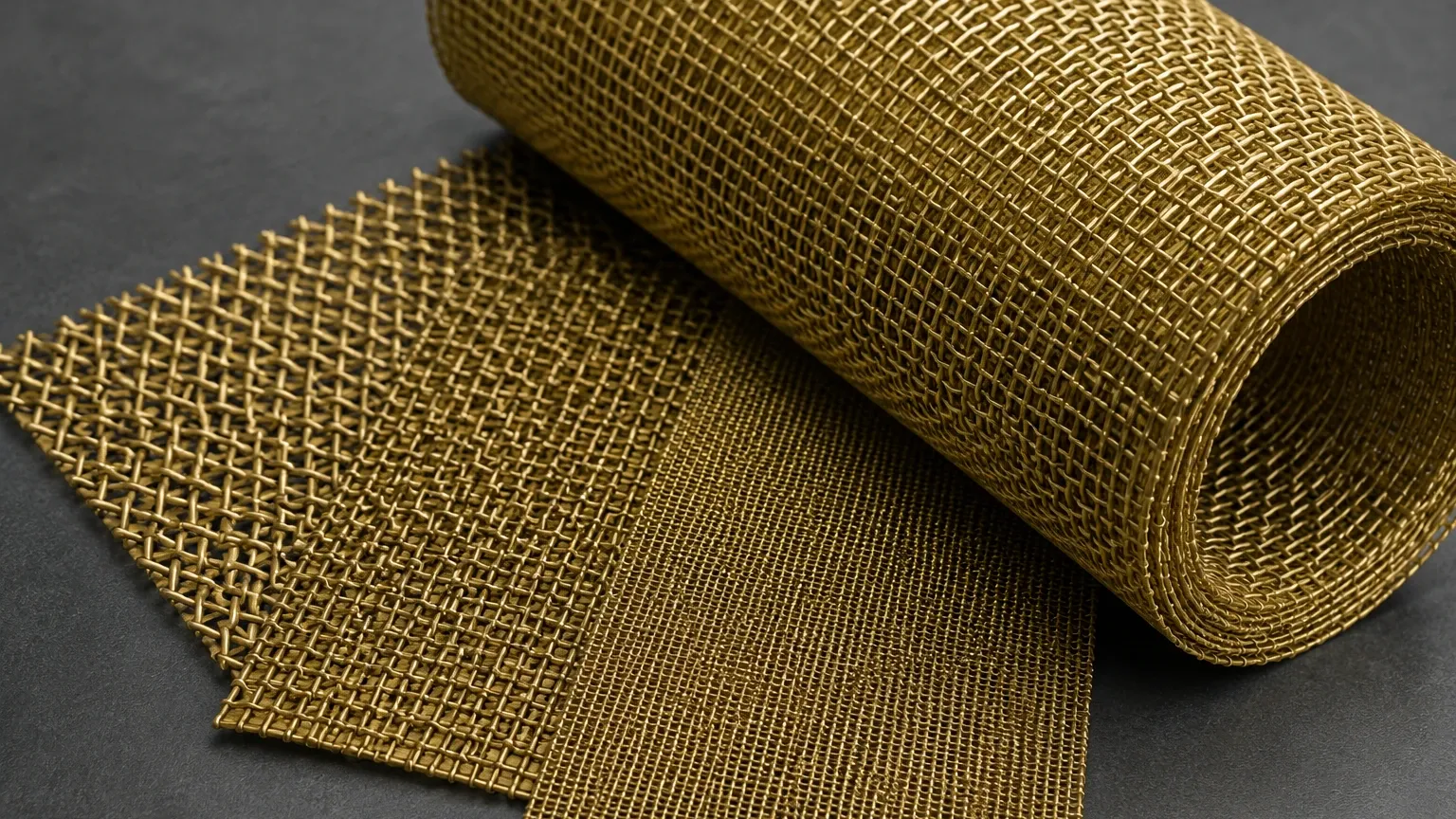
The performance of a filter or screen is determined by how the wires are interlaced. When evaluating brass woven wire mesh australia, it is important to distinguish between the three primary weave types used in industrial settings.
Plain Weave
The plain weave is the most straightforward configuration, where each warp wire (running lengthwise) passes alternately over and under each shute or weft wire (running crosswise). This weave provides a high degree of transparency and a consistent aperture size. It is typically used for general-purpose screening, laboratory sieves, and low-pressure filtration where high flow rates are prioritized over extreme mechanical strength.
Twill Weave
In a twill weave, each shute wire passes over and under two warp wires in a staggered pattern. This configuration allows for the use of heavier wire diameters for a given mesh count. The result is a mesh with greater durability and resistance to mechanical deformation. Twill weave brass mesh is often found in heavy-duty industrial sifters and filtration systems that must withstand high-pressure differentials or abrasive materials.
Dutch Weave (Plain and Twill)
Dutch weaves utilize different wire diameters for the warp and shute. Typically, a larger diameter warp wire is combined with a smaller diameter, tightly packed shute wire. This creates a dense, strong mesh with no visible openings when viewed directly. Instead, the fluid must follow a "tortuous path" through the mesh. Dutch weave brass mesh is the gold standard for high-precision liquid filtration, capable of capturing particles down to the low micron range while maintaining structural integrity under pressure.
3. Key Industrial Applications in the Australian Market
Australia’s unique industrial geography—characterized by extensive mining operations, a growing food and beverage sector, and significant marine infrastructure—dictates specific use cases for brass mesh.
Mining and Mineral Processing
In the Australian mining sector, brass mesh is frequently utilized in laboratory testing and mineral sifting. Because it is non-magnetic, it does not interfere with the separation of magnetic ores. Furthermore, its resistance to the abrasive nature of certain mineral dusts, combined with its non-sparking safety profile, makes it indispensable in processing plants where combustible dust is present.
Food and Beverage Production
In the food industry, brass mesh is often used in the filtration of oils, syrups, and spirits. The antimicrobial properties of the copper alloy provide an additional layer of hygiene, preventing the colonization of the filter media by microbes. However, engineers must ensure that the specific brass alloy used is compliant with local food safety standards regarding lead content, as some commercial brasses contain trace amounts of lead for machinability.
Marine and Coastal Infrastructure
Australia’s vast coastline necessitates materials that can withstand salt-laden air and seawater. While brass will develop a patina (a protective oxidation layer) over time, it remains highly resistant to the structural degradation caused by salt. It is commonly used in seawater intake screens and marine ventilation systems where stainless steel might suffer from localized pitting corrosion in stagnant water conditions.
4. Selection Criteria: Evaluating Mesh for Your Project
When specifying brass woven wire mesh australia, engineers must look beyond the basic mesh count. A comprehensive evaluation involves several technical variables that impact the total cost of ownership (TCO).
Aperture Size and Micron Rating
The aperture size is the clear distance between two adjacent wires. For filtration, the "micron rating" defines the size of the smallest particle the mesh is expected to retain. It is critical to distinguish between "nominal" micron ratings (the average pore size) and "absolute" micron ratings (the maximum pore size). In precision B2B applications, absolute ratings are usually required to guarantee process consistency.
Open Area Percentage
The open area is the ratio of the total area of the holes to the total area of the mesh. A higher open area results in a lower pressure drop and higher flow rates, but it also means the mesh is constructed from thinner wires, making it more fragile. Engineers must strike a balance between the required flow capacity and the mechanical strength needed to survive the operating environment.
Chemical Compatibility and Dezincification
While brass is generally corrosion-resistant, it is susceptible to a process called dezincification in certain environments—particularly in soft water or acidic conditions. During dezincification, the zinc is leached out of the alloy, leaving behind a brittle, porous copper structure that eventually fails. If the application involves acidic fluids or specific water chemistries, a high-copper brass or a specialized stainless steel mesh from Kaifil may be a more durable alternative.
5. Maintenance, Cleaning, and Lifecycle Management
To maximize the ROI of industrial filtration components, a structured maintenance program is essential. Brass mesh, being softer than stainless steel, requires specific handling to avoid damage during cleaning.
Cleaning Protocols
1. Ultrasonic Cleaning: This is the most effective method for fine Dutch weave meshes. High-frequency sound waves create cavitation bubbles that dislodge particles from deep within the weave without the need for abrasive scrubbing.
2. Chemical Cleaning: Mild alkaline cleaners can be used to remove organic buildup. However, strong acids should be avoided as they can accelerate the dezincification process.
3. Backwashing: In automated filtration systems, backwashing (reversing the flow) is a common method for clearing the mesh. For brass mesh, the backwash pressure must be carefully regulated to prevent "wire migration" or mechanical deformation of the weave.
Replacement Cycles
The lifecycle of a brass mesh component depends on the abrasiveness of the media and the frequency of cleaning. Engineers should monitor the pressure drop across the filter; a permanent increase in the baseline pressure drop usually indicates that the mesh is "blinded" (clogged beyond cleaning) or that the wire structure has begun to collapse. Regular inspection for thinning wires or broken strands is necessary to prevent downstream contamination.
6. Customization and OEM Solutions with Kaifil
As a specialized manufacturer, Kaifil understands that off-the-shelf solutions rarely meet the exacting needs of high-stakes industrial processes. We offer comprehensive customization for brass woven wire mesh australia, ensuring that the final product aligns perfectly with the engineering requirements of the site.
Tailored Fabrication
Beyond providing mesh in rolls or cut pieces, Kaifil specializes in the fabrication of complete filter components. This includes:
* Cylindrical and Conical Filters: Multi-layered brass mesh structures welded or crimped for high-strength applications.
* Framed Panels: Mesh panels tensioned and secured within stainless steel or brass frames for use in vibrating screens or architectural partitions.
* Custom Micron Ratings: We can adjust wire diameters and weave densities to achieve specific filtration targets that are not available in standard catalogs.
Quality Assurance and Material Certification
For B2B procurement, traceability is paramount. Kaifil provides material certificates and technical data sheets for all our Woven Wire Mesh products. This ensures that the alloy composition, wire diameter, and mesh count meet the specified tolerances, providing peace of mind for engineers working in regulated industries like pharmaceuticals or aerospace.
Conclusion: Making an Informed Procurement Decision
Selecting the right brass woven wire mesh for an Australian industrial application requires a deep understanding of both the material's strengths and its limitations. Whether the priority is non-sparking safety in a mine, antimicrobial performance in a food plant, or high-conductivity shielding in a data center, brass remains an indispensable engineering material.
By focusing on technical specifications—such as weave type, aperture size, and chemical compatibility—and partnering with a manufacturer like Kaifil that offers custom OEM capabilities, purchasing teams can ensure they receive a product that optimizes performance and minimizes long-term costs. When sourcing brass woven wire mesh australia, always prioritize verified technical data and manufacturing precision to achieve the most reliable filtration results.
