


7 Carbon Filter
In industrial process engineering, the removal of organic contaminants, chlorine, and volatile organic compounds (VOCs) is a critical step in maintaining fluid purity and protecting downstream equipment. The term "7 carbon filter" typically refers to specific configurations in high-demand environments, whether it describes a 7-inch cartridge length for compact OEM systems or, more commonly, a 7-round housing configuration designed to hold multiple Filter Cartridges for increased flow capacity.
For engineers and procurement specialists, selecting the correct carbon filtration setup requires a technical understanding of adsorption kinetics, housing compatibility, and the structural integrity of the filter media. This guide examines the engineering principles behind carbon filtration, the specifics of multi-round configurations, and the critical selection criteria for industrial applications.
Technical Principles of Carbon Adsorption in Industrial Systems
Unlike mechanical filtration, which relies on physical straining to remove particles, carbon filtration operates primarily through adsorption. Activated carbon possesses an incredibly high surface-area-to-volume ratio, often exceeding 1,000 square meters per gram. This surface is covered with a network of submicroscopic pores categorized as micropores, mesopores, and macropores.
The Adsorption Process
When fluids pass through a carbon medium, intermolecular forces (Van der Waals forces) attract contaminant molecules to the surface of the carbon. In industrial settings, this is used to remove:
* Residual Chlorine: Essential in food and beverage production and reverse osmosis (RO) pretreatment to prevent membrane oxidation.
* Organic Compounds: Including tannins, phenols, and various solvents that affect the color, taste, or chemical stability of the process fluid.
* Volatile Organic Compounds (VOCs): Critical in wastewater treatment and chemical processing.
Material Science: GAC vs. Block Carbon
Industrial carbon filters are generally available in two formats: Granular Activated Carbon (GAC) and Carbon Blocks. GAC filters allow for higher flow rates with lower pressure drops but may be prone to "channeling," where the fluid finds the path of least resistance, bypassing much of the media. Carbon blocks, formed by compressing fine carbon powder with a binder, provide a more uniform pore structure and prevent channeling, though they typically result in a higher initial pressure drop ($\Delta P$).
Engineering the "7" Configuration: Size and Scale
In the context of professional filtration, the "7" designation often dictates the physical footprint or the throughput capacity of the system. Understanding these dimensions is vital for system integration.
7-Inch Cartridges in OEM Applications
While 10-inch and 20-inch cartridges are industry standards, the 7-inch carbon filter is a specialized size often found in compact industrial machinery, laboratory equipment, or specific chemical dosing skids. These require precise end-cap configurations—such as Double Open End (DOE) or Code 7 (226 O-ring with bayonet)—to ensure a bypass-free seal within the housing.
7-Round Housing Systems
In high-flow industrial environments, a single cartridge is rarely sufficient. A 7-round housing is a stainless steel vessel designed to hold seven individual Filter Cartridges in parallel. This configuration is a staple in medium-scale industrial plants because it balances high flow capacity with a manageable maintenance footprint.
By utilizing seven cartridges, the system increases the total surface area and the "Empty Bed Contact Time" (EBCT). EBCT is a critical calculation for engineers; it represents the time the fluid stays in contact with the carbon media. If the flow velocity is too high (and EBCT too low), the adsorption process will be incomplete, allowing contaminants to pass through the system.
Selection Criteria for Industrial Carbon Filtration
When specifying a carbon filtration system, engineers must look beyond the basic dimensions and evaluate the technical specifications that impact long-term performance and total cost of ownership.
1. Iodine Number and Pore Distribution
The Iodine Number is a standard measure of the carbon's activity level, representing the micropore content. For industrial applications involving small molecule removal (like chlorine), a higher iodine number (typically 900–1100 mg/g) is preferred. If the goal is removing larger organic molecules or color bodies, the mesopore distribution becomes more significant.
2. Housing Metallurgy and Construction
Since carbon filters are often used with corrosive chemicals or in high-purity water systems, the housing material is paramount. Stainless steel 304 is suitable for general industrial water, while 316L stainless steel is required for pharmaceutical, food and beverage, or mildly corrosive chemical applications. The housing must be rated for the system's maximum operating pressure, typically 100 to 150 PSI, and should include a high-quality interior finish to prevent bacterial adhesion in sanitary applications.
3. Micron Rating and Pre-filtration
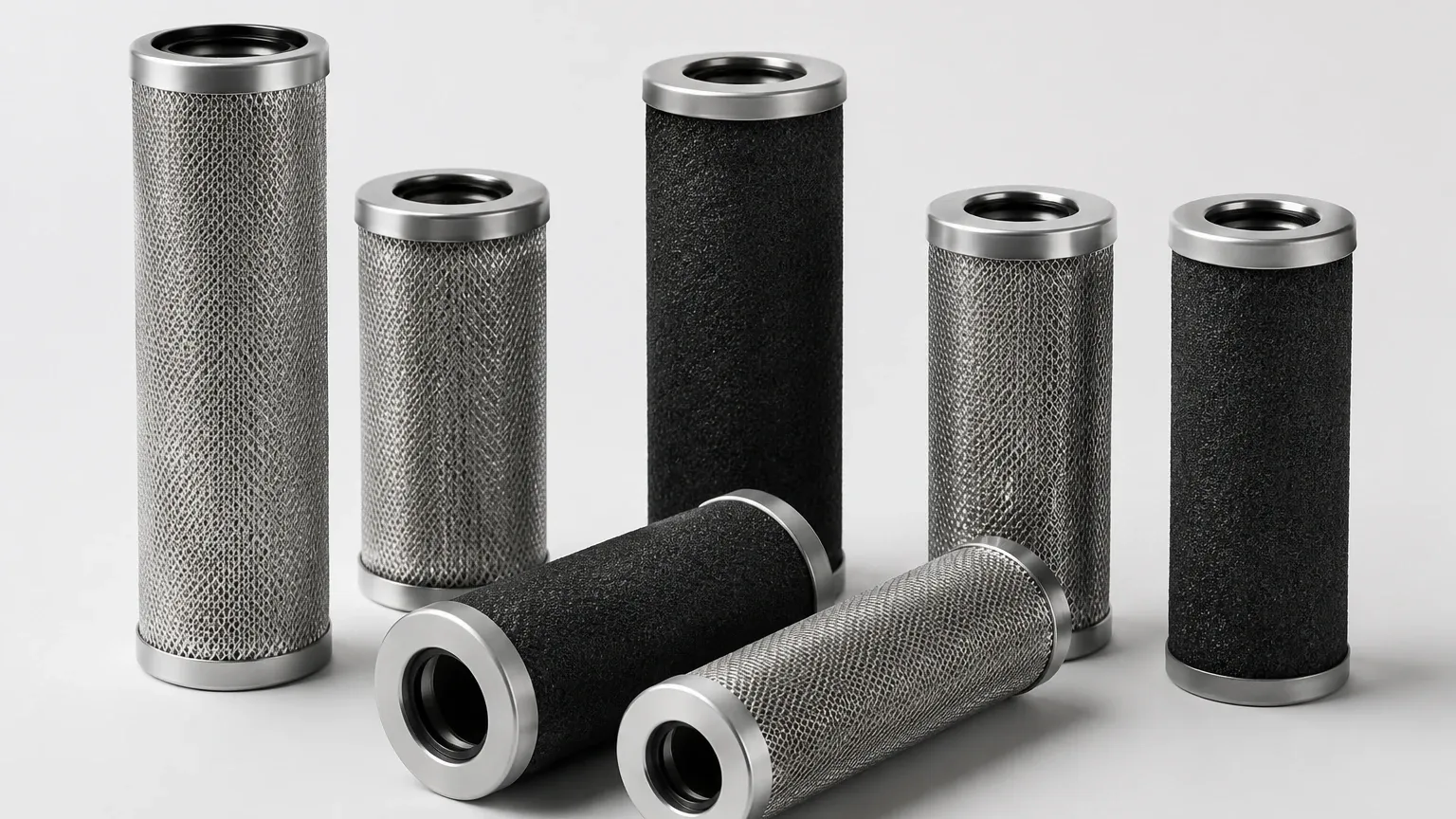
Carbon cartridges often include a mechanical filtration rating (e.g., 5-micron or 10-micron). However, carbon media is inherently friable. Over time, carbon "fines" (tiny particles of carbon) can slough off and enter the downstream flow. To mitigate this, a high-quality carbon filter should be followed by a stainless steel mesh or pleated sediment filter. Conversely, to prevent the carbon pores from clogging with suspended solids, a pre-filter should be installed upstream. This extends the life of the carbon media, which is generally more expensive to replace than sediment filters.
Operational Challenges and Maintenance
Unlike mechanical filters that show a clear increase in pressure drop when they are full, carbon filters can become "exhausted" without a significant change in flow resistance. This makes monitoring more complex.
Breakthrough and Saturation
Breakthrough occurs when the carbon's adsorption sites are fully occupied, and the contaminant concentration in the effluent begins to rise. In a 7 carbon filter system, this is usually monitored via periodic sampling and chemical analysis (e.g., testing for free chlorine). Once breakthrough is detected, the cartridges must be replaced immediately.
Pressure Drop (Delta P) Monitoring
While adsorption doesn't always increase $\Delta P$, the mechanical trapping of particles within the carbon block will. Industrial systems should be equipped with differential pressure gauges. A common rule of thumb is to replace the cartridges when the pressure drop reaches 20–25 PSI, even if the carbon is not yet chemically exhausted, to prevent structural failure of the cartridge core.
Sterilization and Sanitization
In pharmaceutical and food/beverage sectors, the carbon filter housing must be periodically sanitized. It is important to note that while the stainless steel housing can withstand steam-in-place (SIP) or hot water sanitization, the carbon cartridges themselves may have temperature limits depending on the binders used in their construction. Engineers must verify the thermal stability of the cartridge before designing a sanitization protocol.
Applications Across Key Industries
The versatility of the 7-round or 7-inch carbon configuration makes it applicable across a wide range of industrial sectors:
* Chemical Processing: Removing organic impurities from acids, alkalis, and solvents to ensure reagent purity.
* Food and Beverage: De-chlorination of ingredient water and removal of off-flavors or odors from process liquids.
* Pharmaceuticals: Pre-treatment for deionized (DI) water systems and the removal of pyrogens and organic contaminants from process streams.
* Hydraulics and Power Generation: Removing oxidation products and organic acids from oils to prevent component wear and maintain fluid dielectric properties.
* Wastewater Treatment: Tertiary treatment to remove trace organics and VOCs before discharge or reuse.
Customization and Engineering Support
In many industrial scenarios, off-the-shelf solutions do not meet specific environmental or chemical requirements. Customization of Filter Cartridges allows engineers to optimize the filtration process for their unique parameters. This includes:
* Custom Lengths: Adapting to non-standard OEM housing dimensions.
* Specific End-Caps: Ensuring compatibility with existing housing hardware to prevent bypass.
* Media Blending: Combining different types of activated carbon or adding specialty resins to target specific contaminants like heavy metals or chloramines.
* Reinforced Cores: Utilizing stainless steel inner cores for high-pressure or high-viscosity applications where standard plastic cores might collapse.
When evaluating a 7 carbon filter solution, it is essential to work with a manufacturer that understands the intersection of material science and mechanical engineering. Precise manufacturing ensures that each cartridge in a multi-round housing performs uniformly, preventing uneven flow distribution and premature exhaustion of the media. By focusing on durability, filtration accuracy, and application-specific design, facilities can achieve reliable performance and lower their total operational costs.
