


Respirator Filter Cartridge Color Codes
In industrial environments where hazardous vapors, gases, and particulates are present, the correct identification of filtration equipment is a critical safety requirement. The standardized system of respirator filter cartridge color codes serves as a visual shorthand for engineers, safety officers, and technicians to ensure that personnel are protected against specific atmospheric contaminants. While these color codes are primarily associated with personal protective equipment (PPE), the underlying principles of chemical compatibility and filtration efficiency are equally vital when selecting industrial-grade Filter Cartridges for process applications.
Understanding these codes requires a technical look at how different media interact with contaminants and how regulatory bodies like NIOSH (National Institute for Occupational Safety and Health) and OSHA (Occupational Safety and Health Administration) categorize filtration capabilities.
The Technical Basis of Respirator Filter Cartridge Color Codes
Respirator cartridges are designed to remove specific contaminants through mechanical filtration, chemical absorption, or adsorption. The color-coding system is governed by NIOSH in the United States (under 42 CFR Part 84) and similar standards globally, such as EN 14387 in Europe. Each color represents a specific class of protection, ensuring that a worker does not mistakenly use an organic vapor cartridge in an environment filled with ammonia or acid gases.
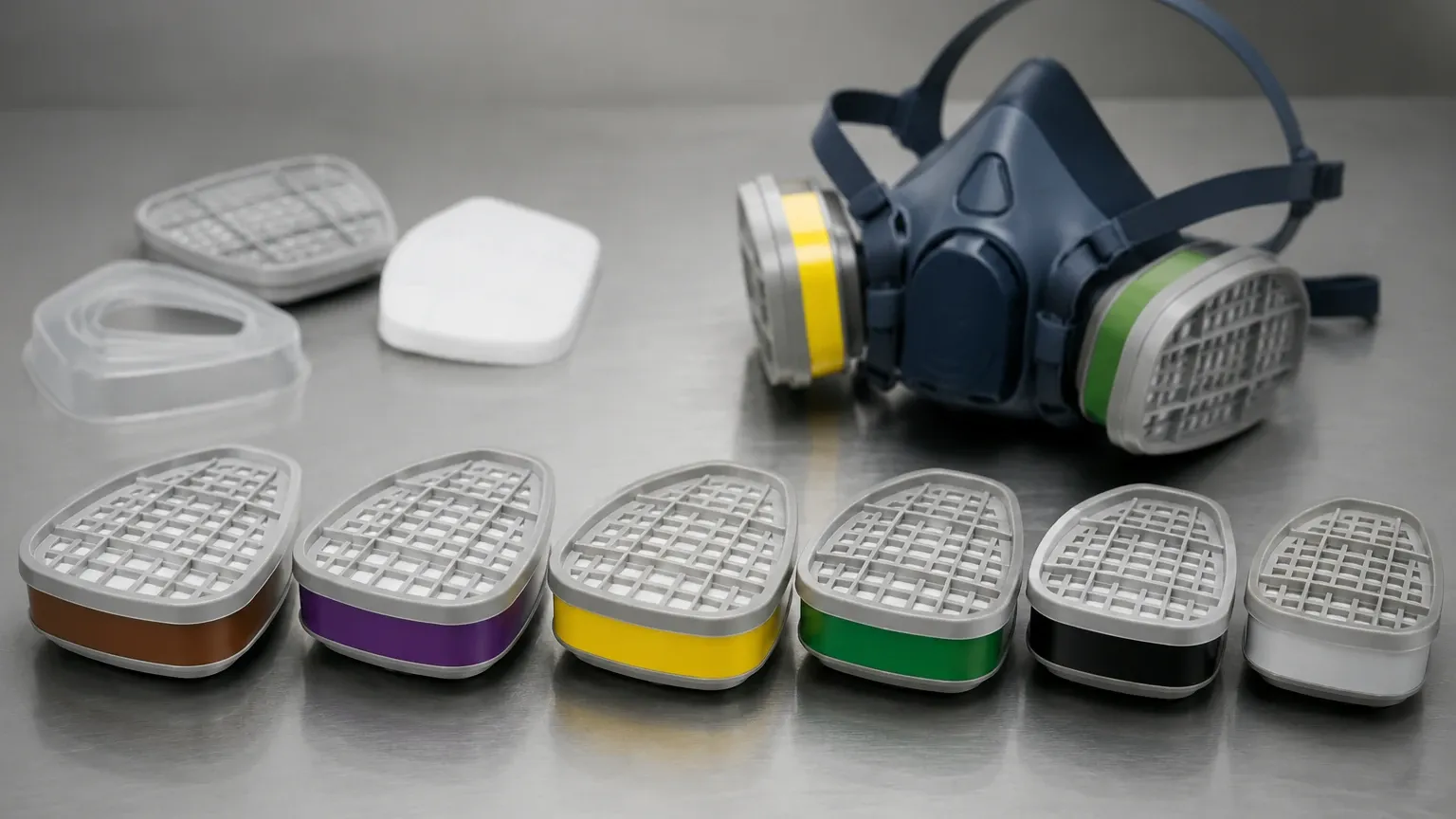
Standard Color Designations
* White: Designed for Acid Gases. This includes contaminants such as chlorine, hydrogen chloride, and sulfur dioxide. The media typically involves treated sorbents that chemically neutralize acidic molecules.
* Black: Designed for Organic Vapors. These are the most common cartridges in industrial painting, degreasing, and solvent handling. They typically contain activated carbon with a high surface area to adsorb hydrocarbons.
* Green: Designed for Ammonia and Methylamine. These cartridges use specially treated carbon to capture basic (alkaline) gases.
* Yellow: Designed for Acid Gases and Organic Vapors. This is a combination cartridge used in environments where multiple chemical hazards coexist, such as in certain chemical processing plants.
* Olive or Multi-Gas: These are designed for a broad spectrum of gases and vapors, often including organic vapors, ammonia, acid gases, and formaldehyde. They are frequently used when the exact concentration or variety of contaminants is variable.
* Purple (Magenta): This color indicates a P100 rating, meaning the cartridge is a high-efficiency particulate air (HEPA) filter capable of removing 99.97% of airborne particles, including oil-based aerosols.
* Orange: Typically used for specialized gases like Mercury Vapor or Chlorine Dioxide.
By following the respirator filter cartridge color codes, facility managers can implement a fail-safe visual inspection protocol. However, for engineers managing large-scale industrial filtration, these color codes are just the beginning of understanding media selection and chemical resistance.
Chemical Compatibility and Media Selection
The effectiveness of any filtration system—whether a small respirator or a large-scale industrial housing—depends on the compatibility between the filter media and the process fluid or gas. In the context of respirator cartridges, the "media" is often a bed of granulated activated carbon or a pleated synthetic fiber. In industrial process filtration, particularly in high-temperature or corrosive environments, these materials are often replaced by stainless steel wire mesh or sintered metal components.
Adsorption vs. Absorption
Most gas-phase respirator cartridges work through *adsorption*, where gas molecules adhere to the surface of internal pores in the activated carbon. The capacity of these cartridges is finite; once the adsorption sites are filled, "breakthrough" occurs, and the contaminant passes through the filter.
In contrast, industrial Filter Cartridges used in chemical processing often rely on mechanical separation or specialized coatings. For example, when filtering aggressive solvents that would degrade synthetic respirator housings, engineers turn to 316L stainless steel cartridges. These offer the structural integrity and chemical inertness required for continuous operation in environments that would compromise standard PPE materials.
Engineering Considerations: From PPE to Industrial Filtration
While the respirator filter cartridge color codes help protect the individual, the same engineering logic applies to protecting industrial machinery and maintaining product purity. When selecting filtration solutions for a facility, engineers must evaluate several technical parameters that mirror the NIOSH testing standards for respirators.
1. Micron Rating and Efficiency
Just as a P100 respirator filter is rated for 0.3-micron particles, industrial filters are categorized by their micron rating. This can be "absolute" (capturing 99.9% of particles at that size) or "nominal" (capturing a major percentage). In pharmaceutical or food and beverage applications, absolute-rated stainless steel mesh filters are preferred because they provide a verifiable barrier against contaminants without the risk of media migration.
2. Pressure Drop (Delta P)
In a respirator, high resistance to airflow (pressure drop) causes user fatigue. In an industrial system, a high pressure drop increases energy consumption and can lead to pump failure or housing deformation. Engineers must balance the need for fine filtration with the requirement for high flow rates. Using pleated stainless steel cartridges can increase the effective surface area, thereby reducing the initial pressure drop while maintaining high dirt-holding capacity.
3. Service Life and Saturation
Respirator cartridges have a limited service life based on the concentration of the contaminant and the breathing rate of the user. Similarly, industrial filter elements must be monitored for saturation. In stainless steel filtration systems, the advantage is the ability to clean and reuse the media. Unlike disposable respirator cartridges that must be discarded once the color-coded label reaches its expiration or the media is saturated, metal cartridges can be backwashed or ultrasonically cleaned, significantly reducing the total cost of ownership in high-volume applications.
Common Risks in Filtration Mismanagement
Misinterpreting respirator filter cartridge color codes can lead to immediate health hazards, such as acute chemical exposure or asphyxiation. In the industrial process sector, the risks of incorrect filter selection are equally severe but often manifest differently:
* Chemical Degradation: Using a filter housing or media that is not compatible with the process fluid can lead to corrosion, leaching of heavy metals, and downstream contamination.
* Bypass: If a filter is not properly seated or if the seals fail due to chemical incompatibility, the fluid will take the path of least resistance, bypassing the filtration media entirely.
* Structural Failure: In high-pressure hydraulic systems, using a low-strength filter element can lead to a collapse of the cartridge, sending shards of filter media into sensitive components like valves and actuators.
To mitigate these risks, engineers often specify custom-engineered stainless steel filtration components that are designed to withstand the specific thermal and chemical stresses of their unique environment.
The Role of Customization in Industrial Filtration
Standardized systems like the respirator filter cartridge color codes work because they are universal. However, many industrial processes fall outside the "standard" parameters. This is where custom manufacturing becomes essential. For instance, a chemical plant may require a filtration system that can handle a mixture of organic solvents and highly acidic vapors at temperatures exceeding 200°C—conditions that would destroy any standard NIOSH-certified respirator cartridge.
Customized stainless steel Filter Cartridges allow for:
* Tailored Metallurgy: Selecting specific alloys like Hastelloy, Monel, or 316L Stainless Steel based on the corrosive profile of the application.
* Variable Geometry: Designing cartridges that fit into existing legacy housings while providing upgraded filtration performance.
* Reinforced Structures: Adding internal support cores or external shrouds to handle high-pressure differentials or turbulent flow conditions.
Maintenance and Replacement Protocols
For personal safety, OSHA requires a formal respirator cartridge change-out schedule based on objective data. In the B2B industrial sector, maintenance protocols are driven by differential pressure monitoring and scheduled inspections.
When to Replace or Clean
1. Pressure Thresholds: Most systems are designed with a maximum allowable pressure drop. Once this is reached, the cartridge is either replaced (if disposable) or cleaned (if stainless steel).
2. Visual Inspection: For wire mesh filters, checking for signs of "blinding" (permanent clogging) or physical damage to the mesh weave is critical.
3. Time-Based Intervals: In sterile environments, such as pharmaceutical manufacturing, filters may be replaced after a certain number of batches or sterilization cycles, regardless of the pressure drop, to ensure absolute purity.
Conclusion: Integrating Safety and Performance
Whether you are identifying the correct PPE using respirator filter cartridge color codes or selecting high-performance metal filtration components for a refinery, the goal remains the same: the reliable separation of contaminants from a medium. For engineers and purchasing teams, understanding the technical specifications—from chemical adsorption in carbon beds to the precision pore structures of sintered stainless steel—is the key to operational safety and efficiency.
By applying the rigorous standards of safety identification to the broader scope of industrial process filtration, companies can protect both their personnel and their infrastructure. When standard off-the-shelf solutions are insufficient for the demands of heavy industry, specialized stainless steel Filter Cartridges provide the durability and precision required to maintain peak performance in the most challenging environments.
