


Sand Screens
In industrial filtration and well completion, sand screens serve as the primary defense mechanism against the migration of solids into production streams or downstream equipment. These specialized filtration components are engineered to allow the passage of fluids—such as water, oil, or chemical process liquids—while effectively retaining sand, silt, and other particulate matter. For engineers and procurement professionals, selecting the correct sand screen is not merely a matter of choosing a part; it is a critical decision that impacts the longevity of pumps, the purity of the final product, and the overall efficiency of the industrial system.
As a professional manufacturer of stainless steel filtration solutions, Kaifil provides a range of precision-engineered components designed to meet the rigorous demands of industrial sand control. Understanding the technical nuances of sand screens, from material selection to aperture design, is essential for optimizing performance in challenging environments. For more information on customized filtration components, you can visit the Main Page.
The Role of Sand Screens in Industrial Filtration
Sand screens are utilized across various sectors, including water treatment, chemical processing, and the oil and gas industry. Their primary function is to provide a physical barrier that prevents formation solids or process-generated particulates from entering the flow path. Failure to manage sand production can lead to catastrophic consequences, such as:
* Erosion of Equipment: High-velocity sand particles act as abrasives, quickly wearing down valves, piping, and pump impellers.
* System Plugging: Accumulation of sand in separators, heat exchangers, or storage tanks reduces capacity and necessitates frequent, costly cleaning.
* Reduced Flow Rates: Inefficient sand control can lead to the formation of a low-permeability "skin" around the filter, significantly dropping the production rate.
To mitigate these risks, engineers must evaluate the particle size distribution (PSD) of the target environment and select a screen configuration that balances filtration accuracy with flow capacity.
Primary Types of Sand Screens
Industrial sand screens are categorized based on their construction and the specific filtration mechanism they employ. Each type offers distinct advantages depending on the pressure, temperature, and chemical composition of the fluid.
1. Wire-Wrapped Screens (V-Wire)
Wire-wrapped screens are among the most common solutions for sand control. They consist of a keystone-shaped or V-shaped wire wrapped around a series of longitudinal support rods. This design creates a continuous slot opening that widens inwardly, which is a critical feature for preventing clogging. If a particle manages to pass through the initial narrow opening, the widening interior ensures it will continue through the screen rather than getting lodged in the aperture.
2. Metal Mesh Screens
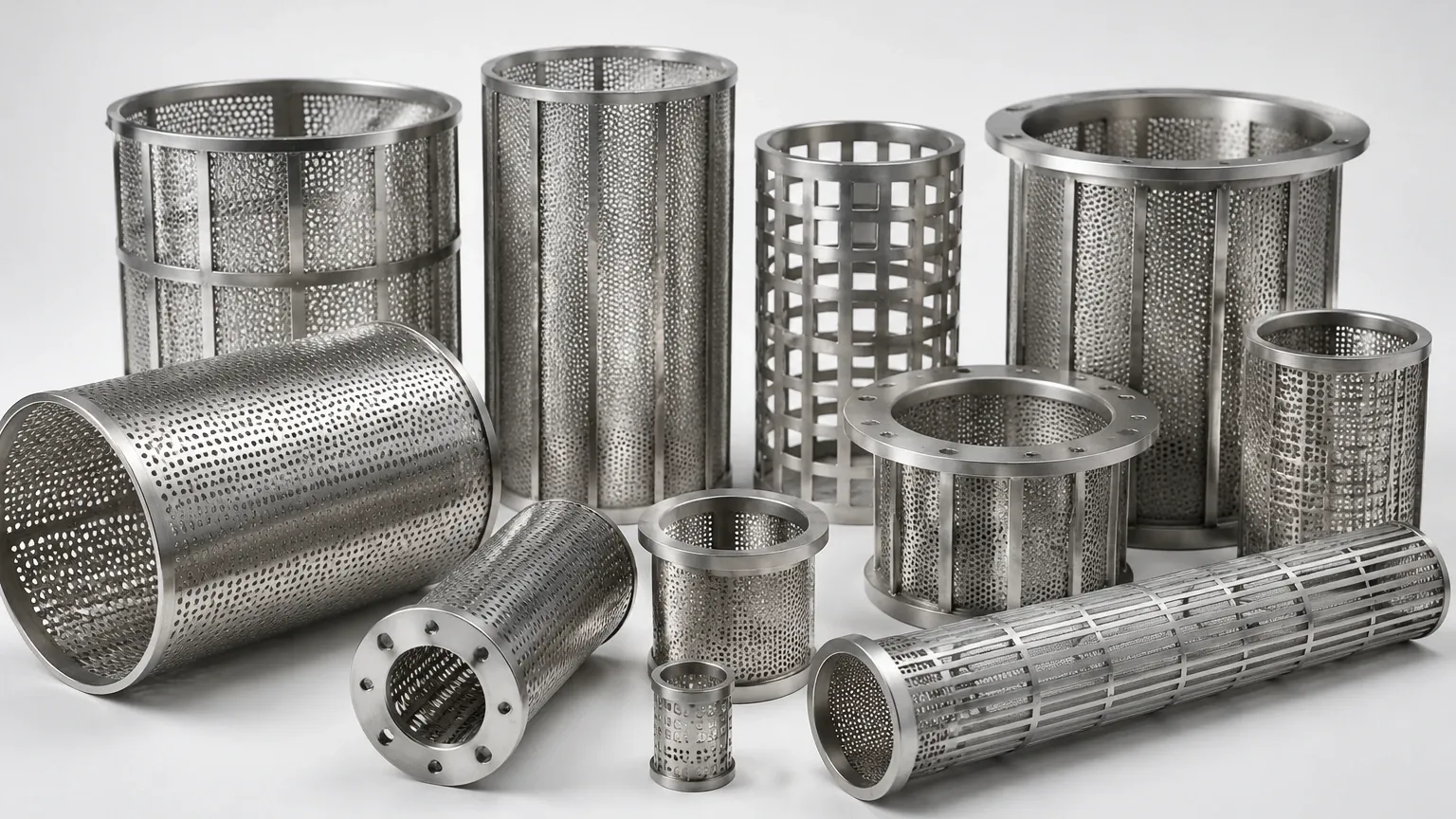
Metal mesh screens utilize multiple layers of stainless steel wire mesh, often sintered or bonded together to provide mechanical stability. These screens are capable of much finer filtration than standard wire-wrapped designs, often reaching micron-level accuracy. They are frequently used in applications where the sand particles are exceptionally fine or where high-strength filtration is required under high-pressure conditions.
3. Slotted Liners
Slotted liners are the most basic form of sand control, involving a pipe with longitudinal or transverse slots machined into the surface. While cost-effective, they generally offer lower open area and are more prone to plugging compared to wire-wrapped or mesh-based systems. They are typically reserved for applications where sand control requirements are less stringent.
4. Pre-Packed Screens
In environments where traditional gravel packing is difficult to implement, pre-packed screens provide an integrated solution. These consist of an inner and outer screen with a layer of resin-coated or ceramic proppant sandwiched between them. This "pre-packed" layer acts as a secondary filter, providing enhanced sand retention in highly unconsolidated formations.
Engineering Considerations for Material Selection
The durability of sand screens is heavily dependent on the materials used in their construction. Because these components are often installed in corrosive or high-temperature environments, stainless steel is the industry standard. At Kaifil, the focus is on high-grade alloys that ensure long-term structural integrity.
* 304/304L Stainless Steel: Suitable for general industrial applications and freshwater environments where corrosion risks are moderate.
* 316/316L Stainless Steel: The preferred choice for chemical processing and marine environments. The addition of molybdenum provides superior resistance to pitting and crevice corrosion, particularly in chloride-rich fluids.
* Duplex and Super Duplex Stainless Steel: Used in highly aggressive environments, these alloys offer high mechanical strength and exceptional resistance to stress corrosion cracking.
* 904L and Nickel-Based Alloys: Reserved for extreme chemical exposure where standard stainless steels would fail prematurely.
When selecting a material, engineers must consider the pH levels, chloride concentration, and the presence of hydrogen sulfide (H2S) or carbon dioxide (CO2) in the process stream.
Technical Evaluation Criteria: Pore Size and Flow Capacity
Effective sand control requires a precise balance between the aperture size (slot width or micron rating) and the total open area. If the openings are too large, sand will pass through; if they are too small, the screen will plug rapidly, causing a significant pressure drop.
Sieve Analysis and Particle Size Distribution (PSD)
Before selecting a sand screen, a sieve analysis of the formation or process solids is mandatory. Engineers look at the D10, D50, and D90 values—representing the particle sizes at which 10%, 50%, and 90% of the sample passes through a sieve. A common rule of thumb for sand control is to size the screen aperture based on the D10 or D50 of the sand pack to encourage the formation of a stable "bridge" of larger particles across the screen openings. This bridge then acts as a natural filter medium.
Collapse and Burst Pressure
Sand screens are structural components that must withstand significant differential pressures. Collapse pressure is the external pressure at which the screen will deform inwardly, while burst pressure is the internal pressure the screen can withstand. In deep-well or high-pressure industrial applications, the support rods and base pipes must be engineered to handle these mechanical loads without compromising the filtration surface.
Flow Velocity and Pressure Drop
The "open area" of a screen—the percentage of the total surface area that is open for fluid flow—directly affects the pressure drop across the filter. High open areas allow for lower fluid velocities, which reduces the risk of erosion and extends the service life of the screen. Wire-wrapped screens typically offer higher open areas than slotted liners or thick-walled mesh filters.
Maintenance, Cleaning, and Replacement Cycles
While sand screens are designed for durability, they are not immune to fouling. Over time, fines, scale, or biological growth can accumulate on the screen surface or within the apertures. Understanding the maintenance requirements is essential for maintaining system performance.
* Backwashing: Many industrial sand screens are designed for automated backwashing. By reversing the flow of fluid, accumulated solids are pushed off the screen surface and flushed out of the system. This is most effective with V-wire designs due to their non-clogging geometry.
* Chemical Cleaning: In cases where scale or organic fouling has occurred, chemical treatments (such as acid washes) may be necessary to restore the open area. Material compatibility is paramount here; the screen material must be able to withstand the cleaning agents without degrading.
* Replacement Indicators: A steady increase in differential pressure that cannot be resolved through backwashing is the primary indicator that a screen has reached the end of its functional life. Monitoring these trends helps in planning scheduled downtime rather than reacting to unexpected system failures.
Customization and OEM Solutions
Every industrial application presents unique challenges, from specific flow rates to unconventional installation spaces. Standard off-the-shelf sand screens often fail to meet the precise needs of complex chemical or water treatment systems. This is where customization becomes a value-add for engineering teams.
Customized sand screens can be tailored in terms of:
* Diameter and Length: To fit specific housing or wellbore dimensions.
* End Fittings: Including NPT threads, flanges, or custom weld rings for seamless integration into existing piping.
* Reinforcement: Adding internal or external shrouds to protect the filtration media during installation or high-velocity flow.
By working with a manufacturer like Kaifil, engineers can specify exact micron ratings and material grades to ensure the filtration solution is optimized for their specific particulate profile and chemical environment. Review product options and application support on the Main Page to explore how custom metal filtration components can be integrated into your project.
Conclusion
Sand screens are foundational to the reliability of industrial fluid systems. Whether protecting a high-value pump in a water treatment plant or ensuring the purity of a chemical batch, the technical specifications of these components cannot be overlooked. By focusing on high-quality stainless steel construction, precise aperture sizing based on sieve analysis, and robust mechanical design, facilities can achieve efficient sand control with minimal maintenance overhead.
When evaluating sand screens, engineers should prioritize manufacturers who provide transparent technical data regarding collapse strength, material certifications, and flow performance. A well-chosen sand screen not only prevents contamination but also reduces the total cost of ownership by extending the life of the entire industrial infrastructure.
