


Maple Syrup Filter Press for Sale
In the production of high-quality maple syrup, the transition from a raw, boiled concentrate to a crystal-clear consumer product depends heavily on the efficiency of the final filtration stage. For producers scaling from hobbyist levels to commercial operations, identifying a reliable maple syrup filter press for sale is a critical step in ensuring product consistency and marketability. This article examines the technical engineering behind filter presses, the importance of material selection, and the specific criteria that purchasing teams must evaluate to optimize their filtration performance.
The Role of Filtration in Maple Syrup Production
Maple syrup is produced by evaporating water from maple sap. As the sugar concentration increases, minerals naturally present in the sap—primarily calcium malate—precipitate out of the solution. These precipitates are known in the industry as "sugar sand" or niter. If not removed, niter results in a cloudy appearance, a gritty texture, and can even affect the flavor profile and shelf stability of the syrup.
While gravity-fed felt bags are common in small-scale setups, they are often insufficient for larger volumes due to slow flow rates and inconsistent clarity. A maple syrup filter press utilizes mechanical pressure to force the hot syrup through a series of filter media, effectively capturing niter and other impurities. This process not only accelerates production but also ensures that the syrup meets the rigorous clarity standards required for commercial grading.
Technical Mechanics of the Filter Press
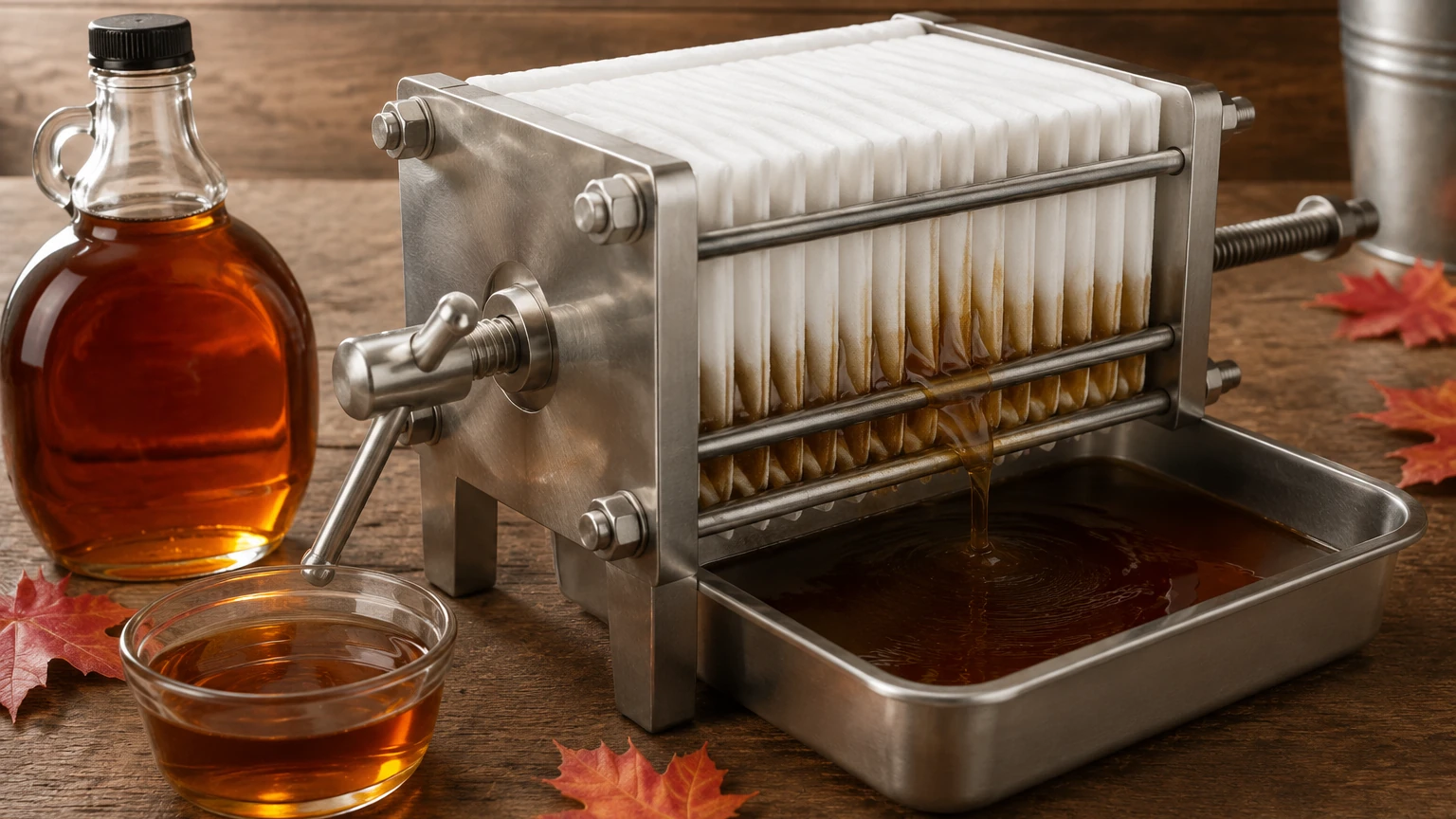
A maple syrup filter press typically operates on a plate-and-frame principle. The system consists of a series of plates with recessed chambers, between which filter media (usually specialized filter paper or cloth) are sandwiched.
Pressure-Driven Flow
To overcome the resistance of the filter media and the accumulating cake of sugar sand, a pump—commonly a diaphragm or gear pump—is used to move the syrup into the press. The syrup enters the chambers, passes through the filter media, and exits through a manifold, leaving the solids trapped inside the press.
Filtration Aids
In many commercial applications, the use of Diatomaceous Earth (DE) as a filter aid is standard. DE is mixed into the syrup before it enters the press to form a "pre-coat" on the filter media. This creates a porous lattice that prevents the niter from blinding the filter paper prematurely, allowing for longer filtration cycles and higher throughput before the press needs to be cleaned.
Material Integrity and Engineering Standards
When evaluating a maple syrup filter press for sale, the materials used in construction are paramount. Given that maple syrup is a food product processed at high temperatures (typically between 180°F and 200°F), the equipment must be both heat-resistant and food-grade.
Stainless Steel Construction
Stainless steel is the industry standard for maple syrup filtration equipment. Specifically, 304 or 316L grade stainless steel offers the necessary corrosion resistance to withstand the slightly acidic nature of maple syrup and the rigorous cleaning chemicals used in food processing. Unlike aluminum or plated steels, high-quality stainless steel components manufactured by specialists like Kaifil ensure that there is no metallic leaching into the product.
Precision Components
The integrity of the seals and the flatness of the plates are critical engineering considerations. Any misalignment or imperfection in the plate surface can lead to "blowouts," where pressurized syrup bypasses the filter media, resulting in contaminated batches and significant product loss. Precision-machined metal filter components are essential for maintaining a tight seal under the high pressures required for efficient operation.
Key Evaluation Criteria for Purchasing Teams
Selecting the right filtration system requires a balance between current production volume and projected growth. Engineers and purchasing managers should confirm the following specifications before finalizing a purchase:
1. Surface Area and Capacity
The capacity of a filter press is determined by the total surface area of the plates. Common sizes for maple syrup production include 7-inch and 10-inch square plates. A higher number of plates increases the surface area, which directly correlates to the volume of syrup that can be filtered before the sugar sand fills the chambers and flow rate drops.
2. Pump Compatibility
The pump must be capable of maintaining consistent pressure without shearing the syrup or failing at high temperatures. Air-operated double diaphragm (AODD) pumps are frequently preferred for their ability to handle solids and their self-priming capabilities, though electric gear pumps are also used in specific configurations.
3. Ease of Maintenance
In a seasonal industry like maple syrup production, downtime is costly. A filter press should be designed for rapid disassembly and cleaning. Features such as quick-release handles and accessible manifolds significantly reduce the labor required between batches.
4. Customization Options
Every production facility has a unique layout. The ability to customize the inlet/outlet configurations, mounting brackets, and integrated bypass valves allows the filter press to be seamlessly integrated into existing evaporation and bottling lines. For specialized requirements, consulting with a manufacturer on the Main Page can provide insights into tailored OEM solutions that meet specific spatial or throughput constraints.
Common Risks and Operational Challenges
Even with a high-quality maple syrup filter press for sale, operational errors can compromise filtration performance. Understanding these risks is essential for technical teams.
* Temperature Fluctuations: If the syrup cools below 180°F during filtration, its viscosity increases, making it significantly harder to push through the media. This can lead to stalled pumps or ruptured filter paper.
* Improper Pre-coating: Failing to establish a uniform layer of DE can result in immediate clogging of the filter paper. The pre-coating process must be monitored to ensure the syrup is circulating until it runs clear before the final output is directed to the bottling tank.
* Over-pressurization: Exceeding the rated PSI of the filter press can cause structural damage to the plates or seals. Integrated pressure gauges are a mandatory safety and performance feature for any commercial press.
Total Cost of Ownership (TCO)
While the initial purchase price of a filter press is a significant factor, the total cost of ownership includes consumables (filter paper, DE), labor for cleaning, and the longevity of the components. Investing in a press with precision-engineered stainless steel plates may have a higher upfront cost but reduces the frequency of part replacements and prevents product waste due to equipment failure.
Durability is particularly important for the internal filtration components. Wire mesh supports and stainless steel cartridges used within some press designs must be manufactured to exacting tolerances to ensure they do not warp under thermal stress. High-performance filtration components are the foundation of a reliable system that can perform consistently season after season.
Conclusion
For maple syrup producers, the transition to a professional filter press is an investment in product quality and operational efficiency. By focusing on technical specifications such as material grade, plate surface area, and pump compatibility, purchasing teams can select a system that provides clear, high-grade syrup with minimal waste.
When searching for a maple syrup filter press for sale, it is vital to partner with manufacturers who understand the nuances of industrial filtration. Precision engineering and high-quality materials are non-negotiable for equipment that must operate under the demanding conditions of a sugarhouse. For more information on custom stainless steel filtration solutions and technical support, visit the Main Page to explore how advanced manufacturing can optimize your production process.
