


Sparger for Bioreactor
In aerobic bioprocessing, the efficiency of gas-liquid mass transfer is often the limiting factor for cellular growth and product yield. The sparger for bioreactor serves as the critical interface where process gases—typically air, oxygen, or carbon dioxide—are introduced into the liquid medium. Achieving the optimal dissolved oxygen (DO) levels requires a sophisticated understanding of bubble dynamics, gas holdup, and the mechanical design of the sparging system.
For engineers and system integrators, selecting the right sparging component is not merely a matter of gas delivery; it is a complex balancing act between maximizing the mass transfer coefficient ($k_La$) and minimizing the mechanical shear stress that can damage sensitive cell lines. As a manufacturer specializing in precision metal components, Kaifil provides high-performance sintered stainless steel solutions designed to meet these rigorous industrial requirements.
The Role of Gas Distribution in Bioprocessing
The primary function of a sparger for bioreactor is to facilitate the transfer of oxygen from the gas phase to the liquid phase, where it becomes available for microbial or mammalian cells. This process is governed by the oxygen transfer rate (OTR), which must meet or exceed the oxygen uptake rate (OUR) of the culture to prevent growth limitation.
Understanding the Mass Transfer Coefficient ($k_La$)
The efficiency of this transfer is represented by the formula:
*OTR = k_La (C* – C_L)*
Where *k_La* is the volumetric mass transfer coefficient, *C** is the saturated dissolved oxygen concentration, and *C_L* is the actual dissolved oxygen concentration in the broth.
The "a" in $k_La$ represents the specific interfacial area. By using a sparger that produces smaller bubbles, the total surface area for gas exchange increases significantly for the same volume of gas. Sintered metal spargers are particularly effective here, as they can generate micro-bubbles that stay in suspension longer, increasing the gas residence time and enhancing the overall $k_La$.
Gas Holdup and Residence Time
Gas holdup refers to the volume fraction of the gas phase within the liquid medium. A well-designed sparger ensures that bubbles are distributed uniformly across the vessel's cross-section. If bubbles are too large, they rise rapidly due to buoyancy, escaping the liquid before efficient transfer occurs. Conversely, micro-bubbles produced by precision-engineered spargers exhibit lower rise velocities, which increases the gas holdup and provides more time for oxygen to dissolve into the medium.
Comparative Analysis of Sparger Types
Bioreactors utilize several types of spargers, each with distinct advantages and limitations depending on the scale of operation and the sensitivity of the biological agent.
Orifice and Ring Spargers
Orifice spargers, often configured as a simple tube or a ring with drilled holes, are common in large-scale industrial fermenters. They are robust and less prone to clogging. However, the bubbles produced are relatively large (typically 3–10 mm). While these are suitable for robust microbial fermentations where high agitation speeds can break down the bubbles, they are often insufficient for high-density cell cultures or shear-sensitive processes.
Sintered Metal Spargers
Sintered metal spargers, a core specialty in the Kaifil product line, are manufactured by compacting and sintering stainless steel powder to create a porous structure. These spargers can produce bubbles in the micrometer range (often 10–100 μm). The high density of pores allows for a massive increase in the interfacial area "a," making them the preferred choice for applications requiring high oxygen transfer rates at low gas flow velocities. This is particularly beneficial in mammalian cell culture, where high agitation speeds must be avoided to prevent cell lysis.
Nozzle and Venturi Spargers
Nozzle spargers use high-velocity gas streams to shear bubbles into smaller sizes. While effective, they require higher inlet pressures and can create localized zones of high shear stress. Venturi systems integrate the gas into a recirculating liquid loop, which is often used in specialized loop reactors rather than traditional stirred-tank bioreactors (STRs).
Engineering Design Parameters for Bioreactor Spargers
When specifying a sparger for bioreactor applications, several technical parameters must be evaluated to ensure compatibility with the process and the vessel geometry.
Pore Size and Bubble Dynamics
The pore size of a sintered sparger directly influences the initial bubble diameter. Common pore ratings range from 0.5 μm to 100 μm. However, the actual bubble size is also a function of the liquid's surface tension, viscosity, and the gas exit velocity. Engineers must calculate the "bubble point"—the minimum pressure required to force gas through the wetted pores—to ensure the gas delivery system can overcome the hydrostatic head of the bioreactor and the resistance of the porous media.
Gas Exit Velocity and Shear Stress
High gas exit velocities at the sparger surface can lead to bubble coalescence (where small bubbles merge into larger ones) or excessive shear. For shear-sensitive cells, such as CHO (Chinese Hamster Ovary) cells used in monoclonal antibody production, the sparger must be designed to provide sufficient oxygen at a low "superficial gas velocity." This is achieved by increasing the surface area of the sparger element itself, allowing for a higher total volume of gas to be introduced through more pores at lower individual velocities.
Placement and Impeller Interaction
The sparger is typically located beneath the bottom impeller in a stirred-tank bioreactor. The interaction between the rising gas and the impeller blades is critical. The impeller's job is to disperse the gas bubbles throughout the tank. If the sparger is too small or poorly positioned, "gas flooding" can occur, where the gas accumulates around the impeller hub, reducing its pumping efficiency and causing a drop in power consumption and mass transfer.
Material Selection and Biocompatibility
In the pharmaceutical and food industries, the materials used in a sparger for bioreactor must meet stringent regulatory and functional standards.
316L Stainless Steel
316L stainless steel is the industry standard for bioreactor internals. The "L" denotes low carbon content, which minimizes carbide precipitation during welding, ensuring superior corrosion resistance. This material is highly resistant to the organic acids produced during fermentation and the aggressive chemicals used in cleaning. Furthermore, 316L is capable of withstanding repeated Sterilization-In-Place (SIP) cycles using high-pressure saturated steam (typically at 121°C or 134°C).
Surface Finish and Passivation
The surface finish of the sparger and its support hardware is vital for preventing microbial attachment and biofilm formation. Kaifil ensures that components meet specific Ra (roughness average) requirements. Electropolishing is often employed to create a smooth, passive chromium-oxide layer, which enhances corrosion resistance and cleanability. For more information on our manufacturing standards and the range of precision components available, please visit our Main Page.
Exotic Alloys
For specialized applications involving highly corrosive media or extreme temperatures, other materials such as Hastelloy® C-276 or Titanium may be used. These alloys provide enhanced protection against chloride-induced pitting and stress corrosion cracking, which can be a concern in certain chemical-heavy bioprocesses.
Operational Challenges: Fouling, Cleaning, and Maintenance
One of the primary concerns with porous spargers is the risk of fouling. Over time, media components, proteins, and cellular debris can accumulate within the porous structure, leading to increased pressure drop and uneven gas distribution.
Cleaning-In-Place (CIP) Protocols
Effective CIP protocols are essential for maintaining sparger performance. This typically involves circulating alkaline cleaners (like sodium hydroxide) to dissolve organic buildup, followed by acid rinses (like phosphoric or citric acid) to remove mineral scale. Because sintered metal spargers have a complex internal geometry, the CIP flow must be sufficient to penetrate the pores. In some cases, ultrasonic cleaning or back-pulsing with clean fluid is required during maintenance shutdowns to restore the original permeability.
Integrity Testing
Engineers should periodically perform integrity tests on spargers, especially in validated pharmaceutical processes. This includes pressure decay tests or bubble point tests to ensure that the porous element has not been breached or excessively clogged. A significant change in the pressure required to maintain a specific gas flow rate is a primary indicator that the sparger requires cleaning or replacement.
Replacement Cycles
While stainless steel spargers are highly durable, they are considered semi-consumable components in many high-value processes. The total cost of ownership should account for the labor involved in cleaning versus the cost of periodic replacement. Standardizing sparger dimensions across different reactor scales can help simplify inventory management and reduce downtime.
Customization and Integration in Industrial Fermenters
Every bioprocess has unique requirements, and off-the-shelf sparging components may not always provide the necessary performance. Customization is often required in the following areas:
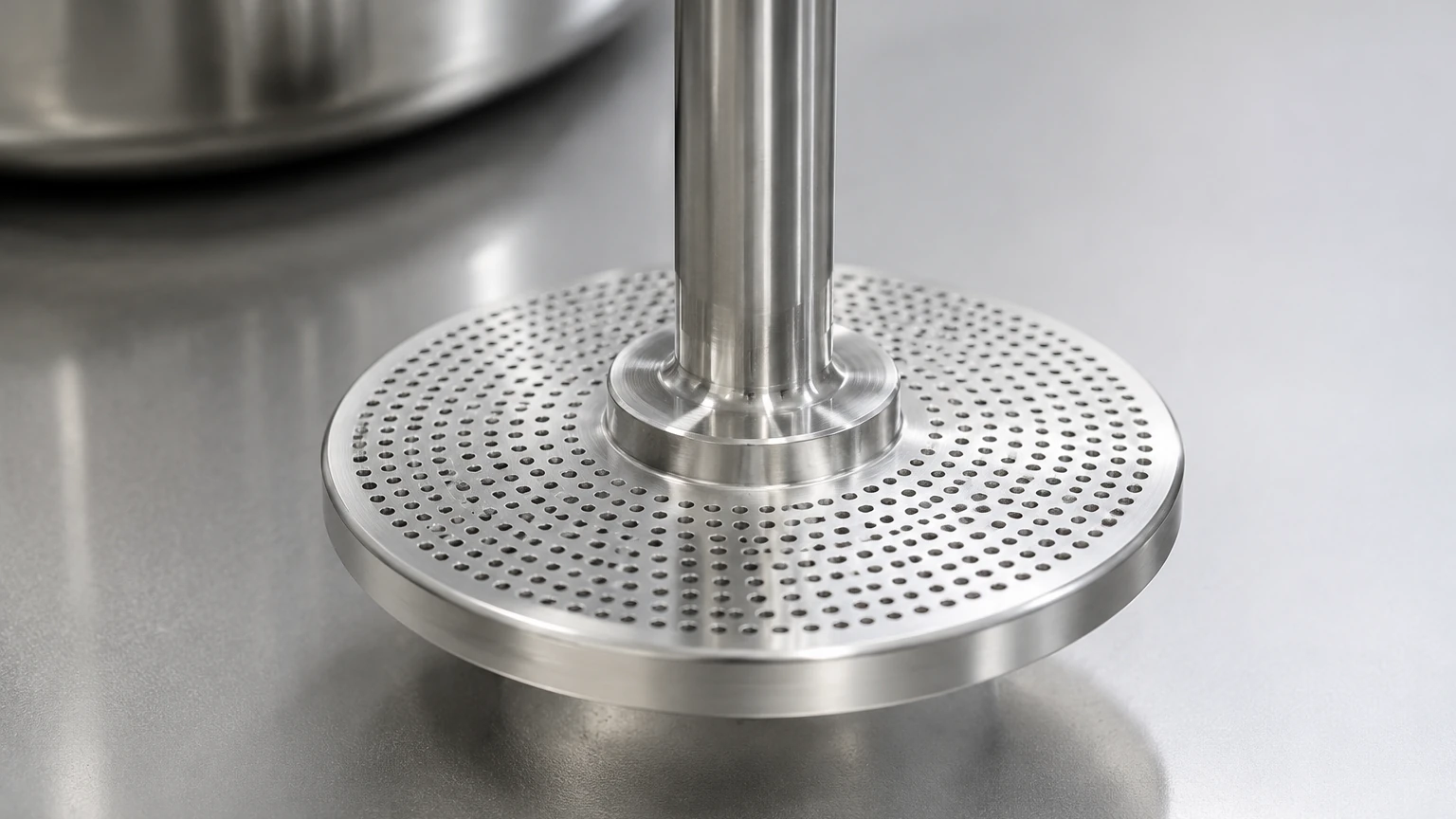
1. Geometry and Mounting: Spargers can be designed as flat discs, cylindrical cartridges, or complex manifold arrays. The mounting interface (e.g., Tri-Clamp, NPT, or flanged connections) must match the bioreactor's ports to ensure a leak-proof seal.
2. Specific Pore Distributions: In some large-scale vessels, a gradient of pore sizes may be used to compensate for hydrostatic pressure differences or to optimize the bubble plume shape.
3. OEM Integration: For bioreactor manufacturers, sourcing custom-designed spargers that fit proprietary vessel geometries is essential for maintaining brand-specific performance benchmarks.
Kaifil works closely with engineering teams to develop customized filtration and gas distribution components. By controlling the powder metallurgy process, we can fine-tune the permeability and mechanical strength of the sparger to match specific OTR targets. Whether you are scaling up a pilot plant or optimizing a production-scale fermenter, the selection of a high-quality sparger for bioreactor is a fundamental step in ensuring process stability.
Conclusion: Key Considerations for Purchasing
Before finalizing the specification for a bioreactor sparger, purchasing teams and engineers should confirm the following:
* Required Oxygen Transfer Rate (OTR): Does the sparger provide enough interfacial area to meet the peak demand of the culture?
* Gas Compatibility: Are the materials and seals compatible with all process gases and cleaning chemicals?
* Vessel Geometry: Does the sparger placement avoid interference with the agitator while maximizing gas-liquid contact time?
* Sterilization Requirements: Can the component withstand the specific SIP/CIP cycles of the facility?
* Customization Needs: Does the application require a non-standard pore size or a specific mounting configuration to fit an existing OEM vessel?
By addressing these technical factors, organizations can ensure they invest in a gas distribution system that enhances yield, reduces operational risks, and provides a long service life in demanding industrial environments. For a comprehensive look at our technical capabilities in stainless steel filtration and gas diffusion, explore the resources available on the Kaifil Main Page.
