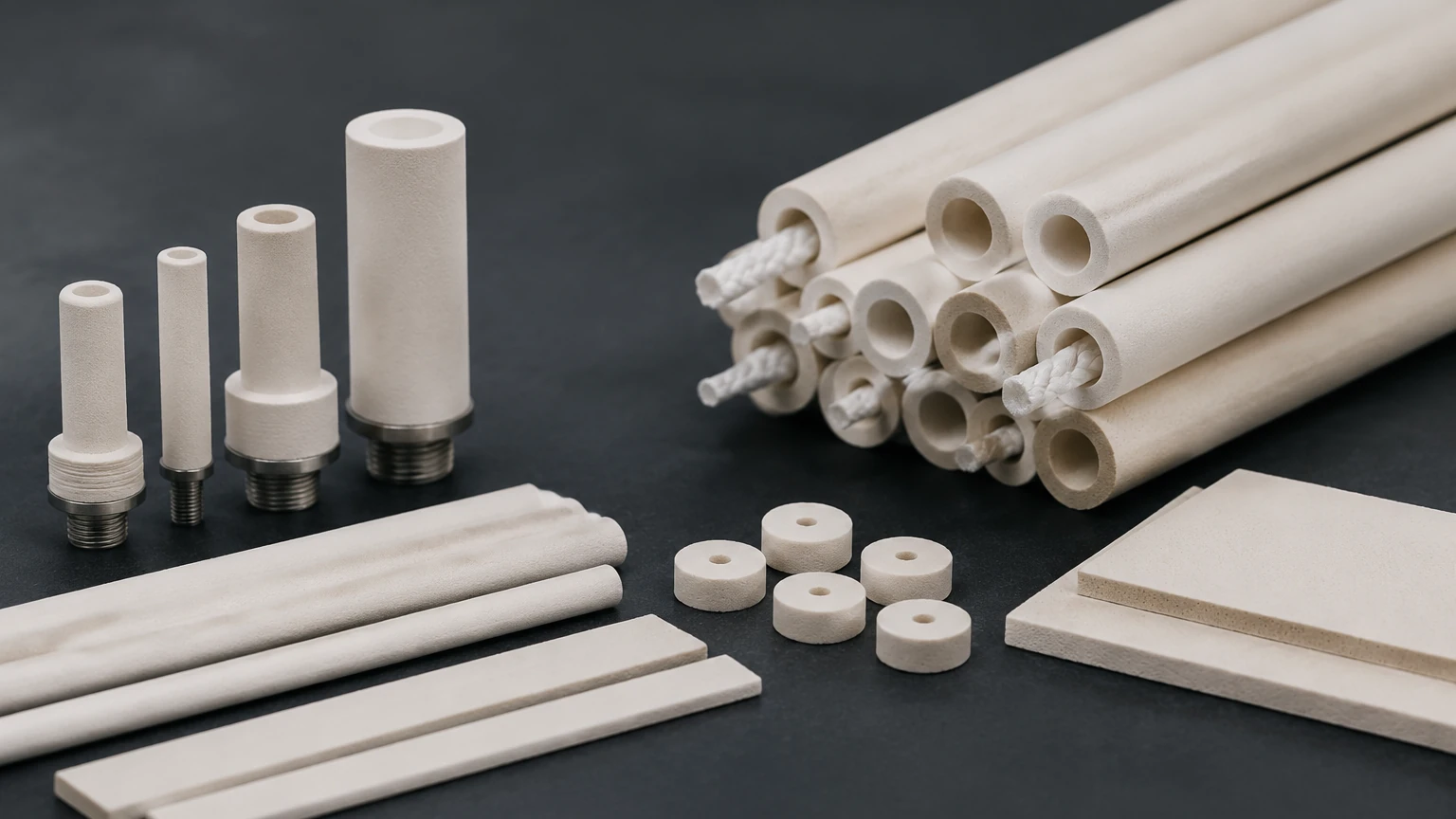
Ceramic Wick
In the landscape of industrial fluid management and precision delivery systems, the ceramic wick stands as a critical component for applications requiring high thermal stability, chemical inertness, and controlled capillary action. Unlike organic or polymer-based wicking materials, porous ceramics offer a rigid, durable structure capable of operating in environments that would compromise other materials. For engineers and procurement specialists, understanding the technical nuances of ceramic wicking media is essential for optimizing system performance, whether in specialized heating elements, chemical transport systems, or high-performance filtration assemblies.
The Engineering Principles of Porous Ceramics
A ceramic wick is essentially a porous ceramic body engineered with a specific network of interconnected voids. These voids, or pores, facilitate the movement of liquids through capillary pressure—the same physical principle that allows plants to draw water from their roots. In an industrial context, the efficiency of a ceramic wick is determined by its porosity, pore size distribution, and the surface energy of the ceramic material relative to the fluid being transported.
Capillary Action and the Young-Laplace Equation
The performance of a ceramic wick is governed by the Young-Laplace equation, which relates the capillary pressure to the surface tension of the liquid and the pore radius. For an engineer, this means that a smaller pore size generates higher capillary suction, allowing for fluid transport against gravity or over longer distances. However, smaller pores also increase the hydraulic resistance, potentially slowing the overall flow rate. Balancing these factors is the primary challenge in custom wick design.
Porosity and Tortuosity
Porosity refers to the percentage of the total volume that is occupied by voids. Industrial ceramic wicks typically feature porosity levels ranging from 30% to 65%. High porosity increases the fluid holding capacity and reduces the weight of the component. Tortuosity, on the other hand, describes the complexity of the path a fluid must take through the wick. A lower tortuosity generally leads to faster fluid delivery, which is critical in high-demand applications like industrial atomization or rapid-response cooling systems.
Material Selection for Industrial Wicks
The choice of ceramic material significantly impacts the wick’s mechanical strength, thermal conductivity, and chemical resistance. Common materials used in the manufacture of these components include:
1. Alumina (Aluminum Oxide): Perhaps the most common material for industrial wicks due to its excellent mechanical strength and resistance to wear. Alumina wicks are often used in high-temperature applications where structural integrity must be maintained up to 1,600°C.
2. Zirconia (Zirconium Dioxide): Known for its extremely low thermal conductivity and high fracture toughness. Zirconia wicks are ideal for applications where thermal insulation is required alongside fluid transport.
3. Silicon Carbide: Chosen for its exceptional thermal shock resistance and high thermal conductivity. These are frequently found in specialized heat pipes and high-power electronic cooling systems.
4. Cordierite: Often selected for its low coefficient of thermal expansion, making it resistant to cracking during rapid temperature fluctuations.
Technical Advantages Over Alternative Wicking Media
When comparing a ceramic wick to stainless steel mesh or polymer fibers, several technical advantages emerge that make ceramics the preferred choice for demanding B2B applications:
* Thermal Stability: Ceramics do not soften or lose their capillary properties at temperatures where polymers would melt and metals might undergo creep or oxidation.
* Chemical Inertness: In the presence of aggressive solvents, acids, or bases, ceramic wicks remain non-reactive. This prevents contamination of the fluid and ensures the long-term stability of the wicking structure.
* Dimensional Rigidity: Unlike fiber-based wicks, ceramic components do not compress or deform under pressure. This ensures that the pore structure remains constant throughout the life of the component, providing predictable and repeatable fluid delivery.
* Customizable Pore Architecture: Through advanced manufacturing techniques such as freeze-casting or sacrificial template methods, manufacturers can tailor the pore size and distribution to meet specific flow requirements.
Manufacturing and Customization Capabilities
Producing a ceramic wick that meets precise industrial specifications requires sophisticated manufacturing processes. At the OEM level, customization is often necessary to ensure the component fits the specific geometry and performance needs of the end-use equipment.
Forming Techniques
* Extrusion: Used for creating long, uniform rods or tubes with consistent internal pore structures.
* Dry Pressing: Ideal for high-volume production of simple shapes with high dimensional accuracy.
* Injection Molding (CIM): Allows for the creation of complex, three-dimensional geometries that would be impossible to achieve through traditional machining.
Sintering and Pore Control
The sintering process—heating the green ceramic body to high temperatures—is where the final properties of the wick are established. By controlling the sintering temperature and duration, as well as the inclusion of pore-forming agents (porogens), manufacturers can precisely dial in the required porosity levels. For engineers, this means the ability to specify a wick that performs exactly as needed under specific pressure and temperature conditions.
Key Evaluation Criteria for Purchasing Teams
When sourcing ceramic wicks for industrial projects, purchasing teams and engineers should evaluate suppliers based on several technical benchmarks:
* Pore Size Consistency: Inconsistent pore sizes can lead to "channeling," where fluid takes the path of least resistance, resulting in uneven delivery or premature drying of certain sections of the wick.
* Mechanical Strength: While ceramics are hard, they are also brittle. The wick must have sufficient flexural strength to withstand installation and any vibration present in the operating environment.
* Surface Finish: For wicks that must interface with other components, the surface roughness (Ra) must be tightly controlled to ensure a proper seal or thermal contact.
* Cleanliness and Outgassing: In pharmaceutical or semiconductor applications, the ceramic wick must be free of residual binders and must not outgas volatile organic compounds (VOCs) when heated.
Common Risks and Mitigation Strategies
Despite their durability, ceramic wicks are subject to specific failure modes that must be addressed during the design phase:
1. Clogging (Fouling): If the fluid being transported contains dissolved solids or particulates, these can accumulate within the pore structure. To mitigate this, engineers often integrate a primary filtration stage. For high-performance metal filtration solutions that protect sensitive ceramic components, professionals often consult the Main Page of specialist manufacturers to select appropriate pre-filters.
2. Thermal Shock: Rapid heating or cooling can induce internal stresses that lead to micro-cracking. Selecting materials with low thermal expansion coefficients, like cordierite or silicon carbide, can reduce this risk.
3. Brittle Fracture: Ceramic wicks should be designed with rounded edges and robust cross-sections to minimize stress concentrators that could lead to breakage during handling.
Applications in Industrial Filtration and Fluid Management
Ceramic wicks are frequently integrated into broader filtration and fluid management systems. Their role often complements that of stainless steel filters and wire mesh components. For instance, in a chemical processing plant, a ceramic wick might be used for the controlled release of a catalyst, while a stainless steel filter cartridge ensures the purity of the surrounding fluid stream.
In the food and beverage industry, ceramic wicking elements are used in precision dosing systems where they must withstand rigorous Clean-in-Place (CIP) cycles involving caustic chemicals and high-pressure steam. The ability of the ceramic to maintain its structural integrity through thousands of these cycles is a primary reason for its selection over cheaper, less durable alternatives.
The Role of Customization in OEM Partnerships
For B2B customers, the "off-the-shelf" ceramic wick is rarely sufficient. Most industrial applications require a partner capable of providing OEM services, from material formulation to final precision machining. A successful partnership involves:
* Prototyping: Validating the wicking rate and capillary rise height with the actual fluid used in the application.
* Scalability: Ensuring that the manufacturing process used for the prototype can be scaled to thousands of units without losing pore size consistency.
* Integration Support: Advising on how to house the ceramic wick within a metal or polymer assembly to prevent leaks and ensure mechanical stability.
Conclusion
The ceramic wick is a sophisticated engineering component that offers unparalleled performance in high-temperature, chemically aggressive, and precision-dependent environments. By understanding the relationship between material science, pore architecture, and fluid dynamics, engineers can leverage these components to solve complex fluid delivery challenges.
When designing a complete filtration or fluid management system, it is important to look at the assembly holistically. While ceramic wicks handle the delivery, the surrounding filtration infrastructure—often composed of stainless steel wire mesh or precision metal cartridges—ensures the longevity and reliability of the entire process. For more information on high-performance industrial filtration components and custom engineering support, visit the Main Page to explore professional solutions tailored to demanding industrial requirements.