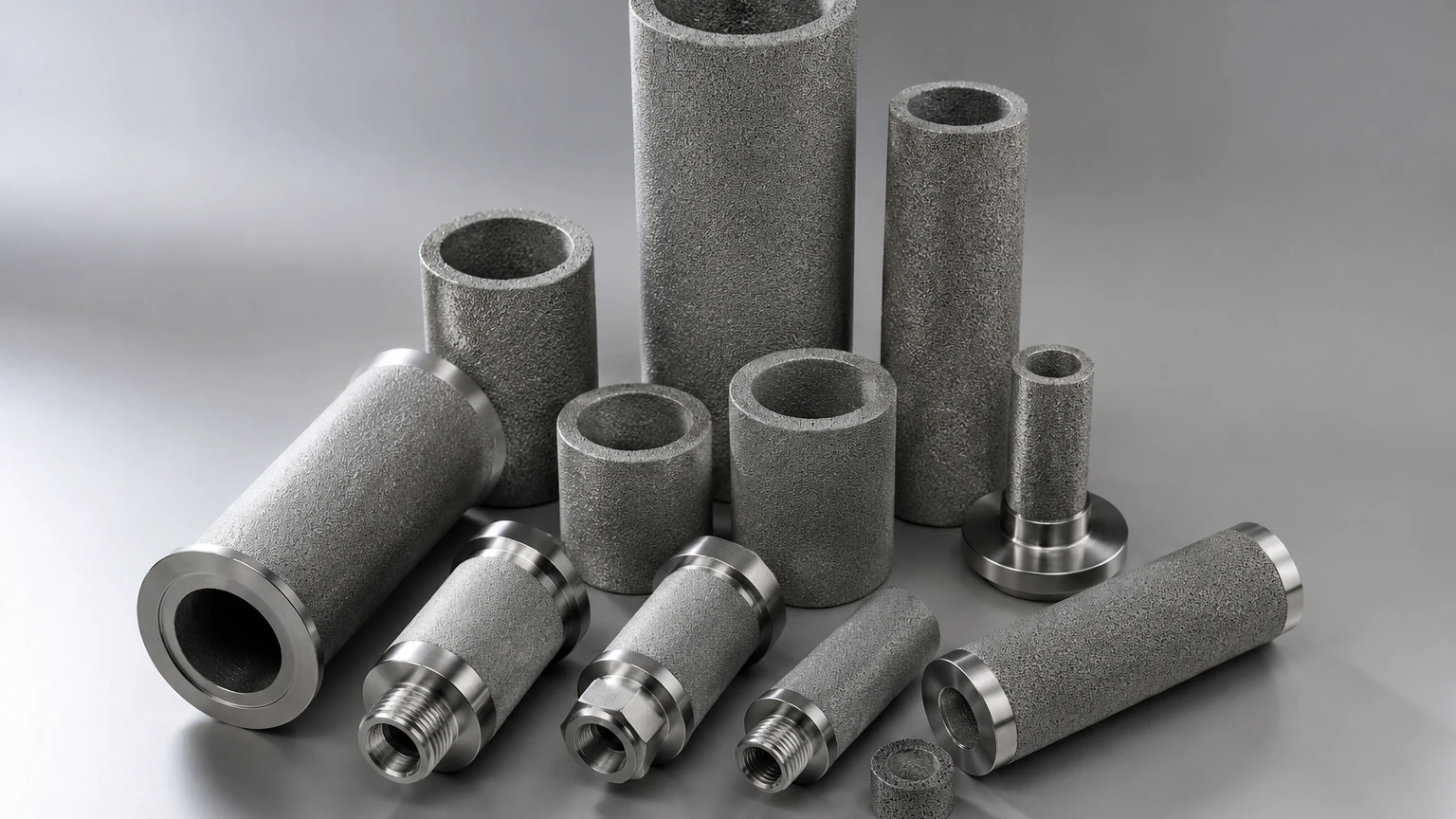
Sintered Tube
In the realm of industrial filtration, the sintered tube stands as a critical component for processes requiring high mechanical strength, thermal stability, and precise filtration accuracy. Unlike traditional fabric or polymer filters, these porous metal structures are engineered through a specialized powder metallurgy process that fuses metal particles together without melting them. This results in a robust, self-supporting filter element capable of withstanding extreme pressures and temperatures while maintaining a consistent pore structure. For engineers and procurement specialists, understanding the technical nuances of sintered tubes is essential for optimizing system performance and ensuring long-term operational reliability.
Understanding the Sintering Process and Material Selection
The production of a sintered tube begins with the selection of high-purity metal powders, most commonly 316L stainless steel, though alloys like Monel, Inconel, and Hastelloy are utilized for specific corrosive or high-temperature environments. 316L is favored in the majority of industrial applications due to its excellent corrosion resistance and mechanical properties.
The manufacturing process involves several precise steps. First, the metal powder is graded by particle size to ensure the desired porosity and filtration rating. This powder is then compacted into a cylindrical shape using specialized tooling. The "green" compact is then placed in a high-temperature sintering furnace with a controlled atmosphere. During sintering, temperatures are raised to just below the melting point of the metal. Atomic diffusion occurs at the contact points between particles, creating strong metallic bonds (necks) that form a rigid, porous matrix.
This process allows for the creation of a sintered tube with a highly uniform pore distribution. Unlike woven wire mesh, which can shift under pressure, the sintered structure is fixed. This stability ensures that the filtration rating—whether it be 0.5 microns or 100 microns—remains constant throughout the service life of the component. For technical teams evaluating suppliers, it is vital to confirm that the manufacturer employs rigorous atmospheric controls during sintering to prevent oxidation, which can compromise the structural integrity and corrosion resistance of the finished tube.
Mechanical and Filtration Performance Metrics
When specifying a sintered tube for an industrial system, engineers must look beyond simple dimensions and focus on performance metrics that define the component's efficiency and durability. The two most critical factors are porosity and permeability.
1. Porosity and Pore Size Distribution: Porosity refers to the percentage of void space within the metal matrix, typically ranging from 30% to 50% for sintered tubes. Higher porosity allows for greater flow rates but may reduce the overall mechanical strength. The pore size distribution determines the filtration efficiency. A narrow distribution ensures that the filter captures particles of a specific size with high consistency, preventing "breakthrough" where oversized contaminants pass through larger-than-average pores.
2. Permeability and Pressure Drop: Permeability is a measure of how easily a fluid (liquid or gas) can pass through the porous medium. In any filtration system, there is an inherent pressure drop (differential pressure) across the filter. A well-engineered sintered tube minimizes this pressure drop while maximizing contaminant retention. This balance is crucial for reducing energy consumption in pumps and compressors. Engineers should request Darcy’s Law calculations or empirical flow-rate-versus-pressure-drop data from the manufacturer during the design phase.
3. Mechanical Strength: One of the primary advantages of the sintered tube is its ability to operate as a stand-alone structural element. These tubes can often withstand high differential pressures (up to several hundred bar in certain configurations) without the need for internal or external support cores. This simplifies the filter housing design and reduces the number of potential failure points in the system.
Engineering Considerations for Sintered Tube Integration
Integrating a sintered tube into an existing or new industrial process requires careful consideration of the operating environment. Because these components are often used in mission-critical applications, such as catalyst recovery or high-pressure hydraulic systems, the following engineering factors must be addressed:
* Thermal Expansion: In high-temperature applications, the thermal expansion coefficient of the sintered tube must be compatible with the housing and connection fittings. Stainless steel tubes can typically operate at temperatures up to 450°C (842°F) in oxidizing environments and even higher in reducing atmospheres. However, rapid temperature cycling can lead to thermal fatigue, so gradual heating and cooling protocols are recommended.
* Chemical Compatibility: While 316L stainless steel is resistant to many organic and inorganic chemicals, certain acids or high-chloride environments may require higher-grade alloys. It is essential to provide a full chemical profile of the process fluid to the manufacturer to ensure the material selection prevents pitting or stress corrosion cracking.
* Connection Types: Sintered tubes are rarely used in isolation; they must be securely mounted within a filter vessel. Common connection methods include threaded ends (NPT, BSP), flanged connections, or specialized sanitary fittings (Tri-Clamp) for the food and pharmaceutical industries. The method of joining the porous tube to the solid end-fitting—usually via TIG welding—must be performed with precision to ensure a leak-proof seal that does not compromise the pore structure near the heat-affected zone.
For organizations looking to explore the full range of standard and custom filtration components, the Kaifil Main Page provides comprehensive technical specifications and application support to assist in the selection process.
Customization Options for Specialized Industrial Needs
No two industrial processes are identical, which is why customization is a hallmark of high-quality sintered tube manufacturing. Beyond standard diameters and lengths, several advanced customization options are available to meet specific engineering challenges.
Multi-Layer Structures: In some cases, a single-layer sintered powder tube may not provide the optimal balance of filtration fineness and flow capacity. Manufacturers can create multi-layer tubes, where a fine filtration layer is sintered onto a coarser, high-strength support layer. This "graded density" approach allows for high-efficiency filtration with a lower initial pressure drop and increased dirt-holding capacity.
Surface Treatments: To enhance the performance of a sintered tube, various surface treatments can be applied. For example, electro-polishing can be used to smooth the surface of the metal particles, reducing the adhesion of sticky contaminants and making the tube easier to clean. Hydrophobic or hydrophilic coatings can also be applied to assist in liquid-gas separation processes.
Geometric Variations: While the standard form is a cylindrical tube, sintering technology allows for the production of conical shapes, blind-end tubes (caps), and complex manifolds. These custom geometries are often required in aerospace or specialized chemical reactors where space is at a premium and flow patterns must be precisely controlled.
Operational Maintenance and Cleaning Protocols
One of the most significant cost-saving benefits of the sintered tube is its cleanability. Unlike disposable cartridges, a sintered metal tube can be cleaned and reused multiple times, significantly reducing the total cost of ownership and environmental impact. However, the effectiveness of the cleaning process depends on the nature of the contaminant and the filtration depth.
* Backwashing and Backpulsing: For surface filtration applications, where contaminants accumulate on the exterior of the tube, backwashing (using a reverse flow of liquid) or backpulsing (using a high-pressure burst of gas) is highly effective. This can often be performed in-situ, allowing for continuous operation without dismantling the system.
* Ultrasonic Cleaning: For deep-seated particulates that have lodged within the porous matrix, ultrasonic cleaning is the gold standard. By placing the sintered tube in an ultrasonic bath with an appropriate cleaning agent, high-frequency sound waves create cavitation bubbles that dislodge contaminants from the smallest pores.
* Chemical and Thermal Cleaning: In industries like polymer processing, where the filter may be clogged with hardened resins, chemical solvents or thermal burn-off cycles (controlled pyrolysis) may be necessary. It is crucial to ensure that the cleaning temperature does not exceed the sintering temperature of the metal to avoid altering the pore structure.
Regular monitoring of the differential pressure is the best way to determine the cleaning cycle. A significant increase in pressure drop indicates that the tube has reached its dirt-holding capacity and requires maintenance to prevent potential deformation or media migration.
Application Landscapes Across High-Requirement Industries
The versatility of the sintered tube makes it indispensable across a wide array of sectors. In the Chemical and Petrochemical industry, these tubes are used for catalyst recovery, where expensive precious metal catalysts must be captured from process streams with near 100% efficiency. The ability to handle corrosive fluids at high temperatures makes sintered metal the only viable choice for these applications.
In the Food and Beverage sector, sintered tubes are utilized for the carbonation of beverages (sparging) and the filtration of steam used in sterilization processes. The smooth, non-shedding surface of the sintered metal ensures that no fibers or particles contaminate the final product, meeting strict food safety standards.
The Pharmaceutical industry relies on these components for gas sterile filtration and the processing of active pharmaceutical ingredients (APIs). The ability to withstand repeated SIP (Steam-in-Place) and CIP (Clean-in-Place) cycles is a critical requirement that sintered stainless steel fulfills perfectly.
Finally, in Hydraulic and Power Generation systems, sintered tubes serve as high-pressure breathers and flame arrestors. Their robust construction prevents the passage of sparks or flames while allowing air to flow freely, protecting sensitive equipment and personnel in hazardous environments.
Conclusion
The sintered tube is more than just a filtration element; it is a precision-engineered tool designed to solve complex fluid handling challenges. By offering a unique combination of durability, heat resistance, and micron-level accuracy, it provides a level of performance that polymer-based alternatives simply cannot match. For engineers, the key to success lies in selecting the right material, pore size, and mechanical configuration to suit the specific demands of their application. By partnering with an experienced manufacturer like Kaifil, technical teams can ensure they receive high-quality, customized filtration solutions that enhance process efficiency and reduce long-term operational costs. Whether you are designing a new system or looking to upgrade an existing one, the technical advantages of sintered metal technology offer a reliable path toward optimized industrial filtration.