


Well Casing Screen
In industrial water supply, geothermal energy extraction, and environmental remediation, the well casing screen serves as the critical interface between the geological formation and the mechanical extraction system. Often referred to as the "business end" of a well, the screen's primary function is to allow the maximum amount of fluid to enter the well with minimal hydraulic resistance while simultaneously preventing the ingress of sand, silt, and other formation materials. Selecting the correct well casing screen is not merely a matter of sizing; it involves a complex evaluation of hydrogeological conditions, mechanical stresses, and long-term chemical compatibility.
For engineers and procurement professionals, understanding the nuances of screen design is essential for ensuring the longevity of the well and the efficiency of the downstream filtration systems. High-quality filtration components, such as those provided by Kaifil, are designed to meet these rigorous industrial standards, ensuring that the initial investment translates into decades of reliable service.
The Functional Role of Well Casing Screens
A well casing screen is a structural filtration device installed at the bottom of a well string. Its performance directly impacts two key metrics: the well yield and the total cost of ownership (TCO). If a screen is poorly designed, it can lead to excessive drawdown—the difference between the static water level and the pumping water level—which increases energy consumption for the pump. Furthermore, inadequate sand control can lead to the rapid erosion of pump impellers and the clogging of surface-level industrial filtration equipment.
The primary engineering goals of a well casing screen include:
1. Sand Control: Retaining the natural formation or the artificial gravel pack while allowing fluid to pass.
2. Hydraulic Efficiency: Maximizing the open area to reduce entrance velocity, thereby minimizing friction losses.
3. Structural Integrity: Withstanding the axial loads of the casing string and the lateral pressures exerted by the surrounding earth and hydrostatic head.
4. Corrosion Resistance: Maintaining performance in potentially aggressive chemical environments over a 20-to-50-year lifespan.
Engineering Criteria for Screen Selection
Selecting a well casing screen requires a detailed analysis of the subsurface environment. Engineers typically start with a sieve analysis of the formation samples to determine the grain size distribution. This data informs the two most critical specifications of the screen: slot size and open area.
Slot Size and Particle Retention
The slot size is the width of the openings in the screen. In a naturally developed well, the slot size is typically chosen to retain about 30% to 40% of the formation material. In a gravel-packed well, the slot size is designed to retain 90% or more of the filter media (gravel or sand) placed around the screen. Precision in manufacturing is vital here; even minor deviations in slot width can lead to "sand pumping," which can eventually cause the well to collapse or destroy the pumping system.
Open Area and Entrance Velocity
The percentage of open area is the ratio of the total area of the openings to the total surface area of the screen. A higher open area is generally preferred because it lowers the "entrance velocity" of the fluid. Industry standards usually recommend keeping the entrance velocity below 0.1 feet per second (0.03 meters per second).
Low entrance velocity is crucial for several reasons:
* Reduced Incrustation: High velocities can cause pressure drops that trigger the precipitation of minerals (like calcium carbonate) out of the water, which clogs the screen.
* Minimized Corrosion: High-velocity flow can strip protective oxide layers from metal surfaces, accelerating localized corrosion.
* Lower Energy Costs: Reduced friction means the pump does not have to work as hard to lift the fluid to the surface.
Material Science: The Case for Stainless Steel
While well casing screens can be manufactured from various materials, including PVC and carbon steel, stainless steel remains the industry standard for demanding industrial and municipal applications. The choice of alloy depends on the water chemistry, specifically the levels of chlorides, pH, and dissolved oxygen.
* Type 304 Stainless Steel: Suitable for many freshwater applications where corrosion levels are low to moderate. It provides excellent structural strength and is cost-effective.
* Type 316L Stainless Steel: Contains molybdenum, which provides superior resistance to pitting and crevice corrosion, especially in environments with higher chloride concentrations.
* Duplex Stainless Steels: Used in highly aggressive environments, such as deep geothermal wells or saltwater intake systems, where both high mechanical strength and extreme corrosion resistance are required.
Using high-grade materials ensures that the screen does not become a point of failure. When sourcing components through the Main Page of a professional manufacturer, engineers can specify these material requirements to match the specific geochemistry of their project site.
Comparison of Screen Designs
There are several mechanical designs for well casing screens, each offering different balances of strength, open area, and cost.
Wedge Wire (Continuous Slot) Screens
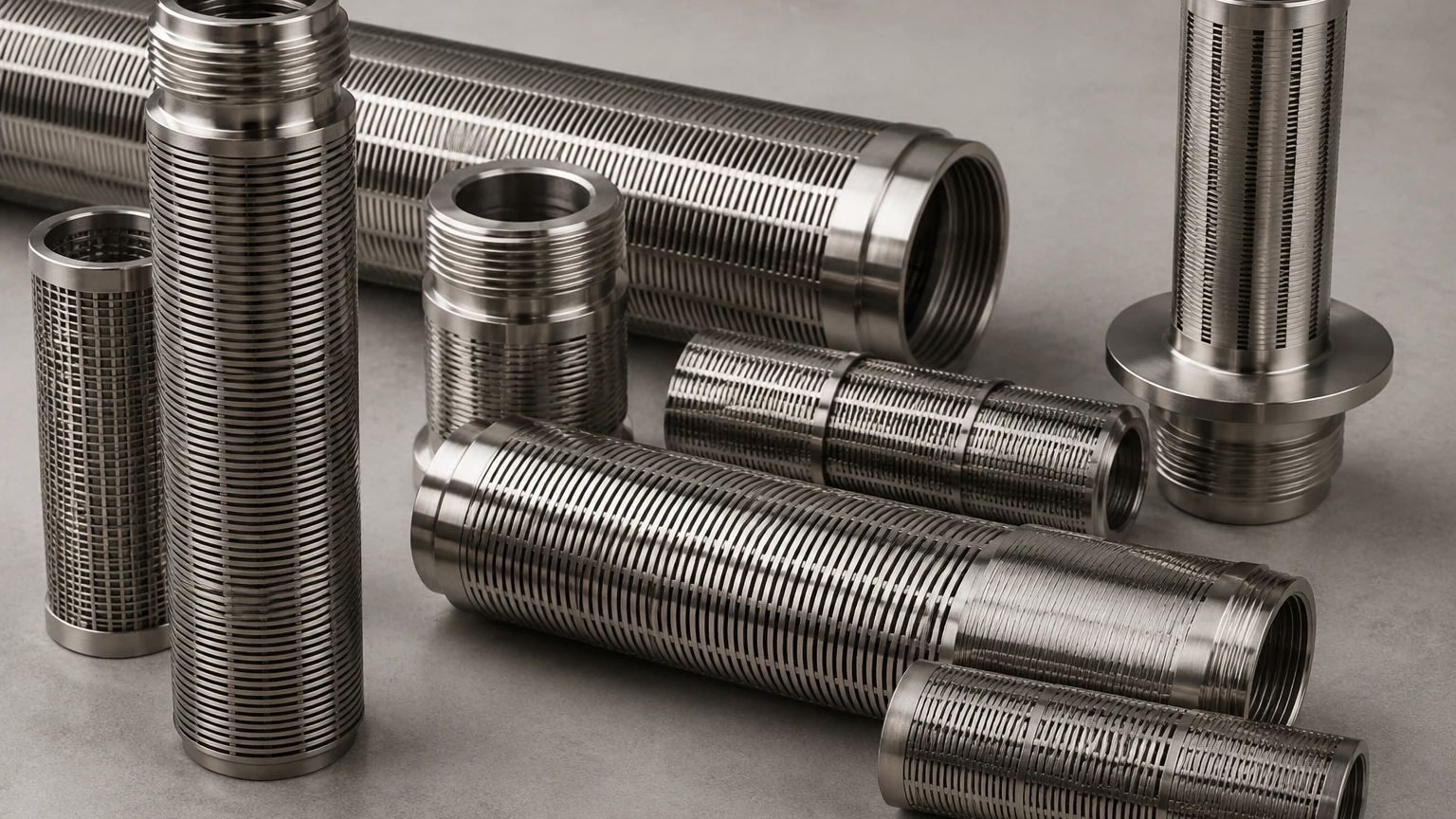
Wedge wire screens are widely considered the premium choice for industrial wells. They are constructed by wrapping a V-shaped wire around a circular array of internal longitudinal support rods.
* Non-Clogging Design: The V-shaped profile creates an opening that widens inwardly. Particles that pass through the narrowest part of the slot continue through without getting wedged.
* Maximum Open Area: This design offers the highest percentage of open area of any screen type, often exceeding 30-40%.
* Customizability: The spacing between the wires can be controlled with extreme precision during the welding process.
Bridge Slot Screens
Bridge slot screens are manufactured by punching openings into a flat sheet which is then rolled into a cylinder and welded. The openings look like small bridges. While they are robust and relatively inexpensive, they offer significantly less open area than wedge wire screens and are more prone to clogging in fine-sand formations.
Pipe-Base Screens
For very deep wells where collapse pressure is a major concern, a pipe-base screen is used. This involves a perforated heavy-duty casing pipe with a wedge wire screen jacket wrapped around it. The inner pipe provides the structural strength to resist extreme depths, while the outer jacket provides the filtration precision.
Mechanical Considerations: Collapse and Tensile Strength
A well casing screen must be engineered to survive the installation process and the lifetime of the well.
1. Tensile Strength: During installation, the screen must support the weight of the entire casing string hanging below it. This is particularly important in deep wells.
2. Collapse Resistance: Once the well is pumped, the water level inside the casing drops, creating a pressure differential between the outside and the inside. The screen must be strong enough to resist this external hydrostatic pressure.
Manufacturers like Kaifil use advanced welding techniques and material selection to ensure that these components meet the necessary safety factors for deep-well environments. Engineers should always request the collapse pressure ratings based on the expected maximum drawdown of the well.
Installation and Maintenance Best Practices
The performance of a well casing screen is heavily dependent on how it is installed and developed. "Well development" is the process of removing the drilling fluid and fine sediments from the area immediately surrounding the screen.
Techniques such as surging, jetting, and over-pumping are used to pull fine particles through the screen and out of the well, leaving behind a stable, highly permeable envelope of coarser material. A well-designed wedge wire screen facilitates this process because its inward-widening slots allow for effective backwashing and surging without the risk of permanent blinding.
Over time, even the best screens may require maintenance. If the well yield drops, it may be due to biofouling or mineral incrustation. Stainless steel screens are advantageous here because they can withstand aggressive chemical cleaning agents (such as acids or chlorine treatments) and mechanical brushing that would destroy lesser materials like PVC.
Procurement: What to Confirm with Your Manufacturer
When transitioning from the design phase to procurement, technical professionals should confirm several key details with their supplier to avoid costly field errors.
* Exact Slot Width: Ensure the manufacturer can meet the tolerances required by the sieve analysis.
* End Connections: Specify whether the screen needs threaded ends (NPT or API), weld rings, or flange connections to match the rest of the casing string.
* Quality Documentation: For industrial applications, request material mill certificates and weld inspection reports.
* Customization Options: In many industrial processes, standard sizes do not fit the specific flow requirements. Working with a manufacturer capable of custom fabrication is essential for optimizing the filtration system.
By visiting the Main Page of an experienced filtration specialist, purchasing teams can gain insights into the manufacturing capabilities and lead times associated with custom stainless steel components. This ensures that the well casing screen is not just a commodity, but a precision-engineered component tailored to the specific demands of the project.
Conclusion
The well casing screen is a fundamental component of any subsurface fluid extraction system. Its design influences everything from the initial success of the well development to the long-term operational costs of the facility. By focusing on high-quality materials like stainless steel, prioritizing high open areas to reduce entrance velocity, and selecting the appropriate mechanical structure for the depth and formation, engineers can ensure a reliable and efficient water or resource supply. In the world of industrial filtration, the screen is the first line of defense, and its quality determines the health of the entire system.
