


Cycloon Filters
In industrial fluid and gas processing, the management of solid particulates is a fundamental requirement for protecting downstream equipment and ensuring product purity. Cycloon filters, often referred to as cyclone separators or centrifugal separators, serve as a critical primary stage in many filtration sequences. Unlike barrier filters that rely on a physical mesh or membrane to trap particles, cycloon filters utilize the principles of centrifugal force and inertia to separate solids from a fluid stream. For engineers and procurement teams, understanding the mechanical nuances, material requirements, and integration strategies of these systems is essential for optimizing plant efficiency and reducing the total cost of ownership.
At Kaifil, we recognize that industrial filtration is rarely a one-size-fits-all solution. While our core expertise lies in precision stainless steel mesh and cartridge filtration, the role of cycloon filters as a pre-treatment step is vital in high-load environments. By removing the bulk of heavy particulates before they reach secondary stages, these systems extend the service life of more sensitive components and ensure consistent operational uptime.
Understanding the Mechanics of Cycloon Filters
The operation of cycloon filters is governed by fluid dynamics, specifically the interaction between centrifugal force, drag force, and gravity. When a contaminated fluid—either liquid or gas—enters the cylindrical chamber of the filter, it is introduced tangentially. This entry method forces the fluid into a high-velocity spiral or vortex.
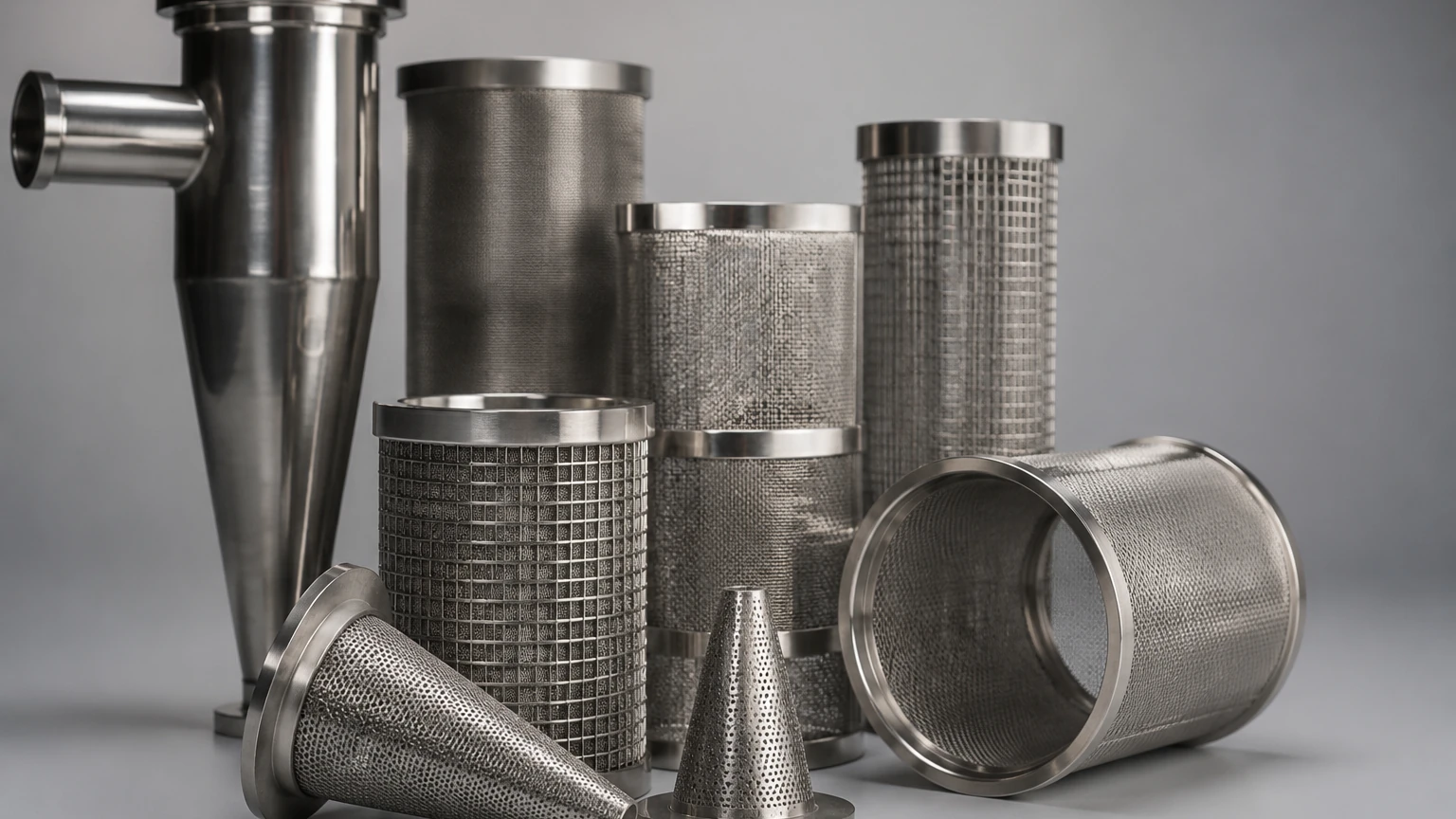
As the fluid spins, the particles suspended within it are subjected to centrifugal force, which pushes them outward toward the inner wall of the filter housing. Because the solid particles typically have a higher density than the carrying fluid, their inertia prevents them from following the tight curvature of the fluid's inner vortex. Once the particles strike the wall, they lose kinetic energy and slide down the conical section of the filter into a collection hopper or underflow outlet.
Meanwhile, the cleaned fluid, now stripped of the heavier particulate matter, reverses direction at the base of the cone and forms an inner vortex that travels upward through the center of the chamber. This clean fluid exits through a central discharge pipe, often called a vortex finder. The efficiency of this separation is highly dependent on the velocity of the fluid, the density difference between the solid and the fluid, and the geometric proportions of the filter housing itself.
Key Engineering Parameters for Filter Selection
When specifying cycloon filters for industrial applications, engineers must look beyond simple flow rates. Several technical parameters dictate whether a cyclone will meet the required separation efficiency for a specific process.
The Cut Point (d50)
The most critical performance metric for a cycloon filter is the "cut point," or d50. This represents the particle size at which the filter is 50% efficient. Particles larger than the d50 are likely to be separated and collected, while particles significantly smaller than this value will likely remain entrained in the fluid stream and exit through the top. Lowering the d50 requires increasing the centrifugal force, which is usually achieved by reducing the diameter of the cyclone or increasing the inlet velocity.
Pressure Drop (Delta P)
Efficiency in a cycloon filter comes at the cost of pressure drop. As the fluid is forced into a high-velocity vortex, energy is consumed. A higher pressure drop generally correlates with higher separation efficiency, but it also increases the energy requirements for pumps or blowers. Engineers must balance the need for fine particle removal with the operational costs associated with maintaining high system pressure. Over-specifying a filter can lead to unnecessary energy expenditure, while under-specifying can lead to premature clogging of downstream Main Page components.
Solid Loading and Particle Distribution
Cycloon filters excel in applications with high solid loading. Unlike a mesh filter that can blind or clog when faced with a sudden surge of solids, a cyclone can handle variable concentrations effectively. However, the particle size distribution (PSD) must be known. If the majority of the contaminants are below 10 microns, a standard cycloon filter may only serve as a scalping tool, requiring a secondary stainless steel cartridge filter to achieve final clarity.
Material Selection and Industrial Durability
The environment in which cycloon filters operate is often abrasive, corrosive, or subjected to extreme temperatures. Material selection is therefore a primary engineering consideration. While plastic or carbon steel cyclones may suffice for light-duty applications, industrial sectors such as chemical processing, pharmaceuticals, and food production require the durability of stainless steel.
Stainless Steel 304 vs. 316L
For most general-purpose industrial applications, Grade 304 stainless steel provides excellent structural integrity and basic corrosion resistance. However, in environments involving chlorides, acids, or high-purity requirements (such as pharmaceutical or food processing), Grade 316L is the preferred choice. The addition of molybdenum in 316L enhances its resistance to pitting and crevice corrosion, while the "L" (low carbon) designation ensures the material remains stable during welding processes, preventing intergranular corrosion.
Abrasion Resistance
Because cycloon filters rely on particles striking the outer wall at high velocities, erosion is a common concern. In highly abrasive applications, such as mining or heavy industrial slurry processing, the internal surfaces of the stainless steel housing may be treated or reinforced. For the technical buyer, confirming the wall thickness and the quality of the internal finish is essential for predicting the equipment's lifespan.
Integrating Cycloon Filters into Multi-Stage Systems
In the hierarchy of filtration, cycloon filters are rarely the final step. Their primary role is to protect more expensive, high-precision filtration media located further down the line. By removing 90% or more of the heavy solids, the cyclone ensures that the secondary filters—such as sintered wire mesh or pleated stainless steel cartridges—only have to deal with the fine, sub-micron particulates.
This multi-stage approach is particularly effective in hydraulic systems and water treatment plants. In a hydraulic circuit, a cycloon filter can remove metal shavings and large scale, preventing these particles from reaching the precision-engineered valves or the fine-mesh suction filters. In water treatment, cyclones are used to remove sand and grit before the water enters membrane filtration units or UV sterilization chambers.
When designing these systems, it is important to ensure that the flow rate remains within the optimal range for the cyclone. If the flow drops too low, the centrifugal force will be insufficient for separation; if it is too high, the turbulence may cause re-entrainment of the particles, where they are swept back into the clean fluid stream.
Maintenance, Wear Analysis, and Operational Longevity
One of the greatest advantages of cycloon filters is their lack of moving parts. This simplicity translates to high reliability and low maintenance requirements compared to mechanical centrifuges or backwashing filters. However, they are not maintenance-free. Regular inspection protocols should focus on three key areas:
1. The Apex (Underflow) Outlet: This is the most common point of failure. If the solids collection chamber is not emptied regularly, or if the discharge valve becomes clogged, the solids will back up into the cone and be carried out with the clean fluid. Automated discharge valves are often recommended to ensure consistent performance.
2. Internal Erosion Patterns: Over time, the high-velocity impact of particles can thin the walls of the cyclone, particularly in the lower conical section. Ultrasonic thickness testing can be used during scheduled shutdowns to monitor wear without dismantling the entire system.
3. Vortex Finder Integrity: The central exit pipe must remain perfectly aligned and free of obstructions. Any damage to the vortex finder can disrupt the flow patterns, significantly reducing separation efficiency.
For engineers, the total cost of ownership (TCO) of a cycloon filter is usually very favorable. The initial capital expenditure is moderate, and because there are no filter elements to replace regularly, the ongoing operational costs are primarily tied to energy consumption and periodic inspections.
Customization and OEM Considerations for Industrial Applications
Standard off-the-shelf cycloon filters may not meet the specific spatial or performance requirements of a complex industrial facility. This is where customization becomes a critical factor. At Kaifil, we work closely with engineering teams to develop filtration components that fit seamlessly into existing infrastructure.
Customization options often include:
* Inlet/Outlet Configurations: Adjusting the orientation (tangential vs. involute) to fit tight piping layouts.
* Surface Finishes: Providing electropolished internals for sanitary applications in the food and beverage or pharmaceutical sectors to prevent bacterial growth and facilitate Clean-in-Place (CIP) procedures.
* Manifolding: For applications with extremely high flow rates, multiple small-diameter cyclones (multicyclones) can be arranged in a manifold. This maintains high separation efficiency (which smaller diameters provide) while handling large volumes of fluid.
When evaluating a supplier for cycloon filters or integrated filtration systems, it is important to confirm their manufacturing capabilities. Precision welding, material traceability, and the ability to provide detailed engineering drawings are hallmarks of a professional OEM partner. For more information on how our custom stainless steel solutions can enhance your process, you can explore the Main Page of our technical resource center.
Conclusion: Making Informed Purchasing Decisions
Selecting the right cycloon filter requires a thorough analysis of the fluid properties, the nature of the contaminants, and the desired outcome of the filtration process. It is not merely about buying a piece of hardware; it is about engineering a solution that balances efficiency, pressure drop, and durability.
Before finalizing a purchase, engineers should confirm the particle size distribution of their process fluid and determine the necessary d50 cut point. They should also evaluate the compatibility of the housing material with the process chemistry and temperature. By integrating a well-designed cycloon filter as a primary separation stage, industrial facilities can significantly improve the performance of their entire filtration train, protect downstream assets, and achieve a more stable and cost-effective operation.
