


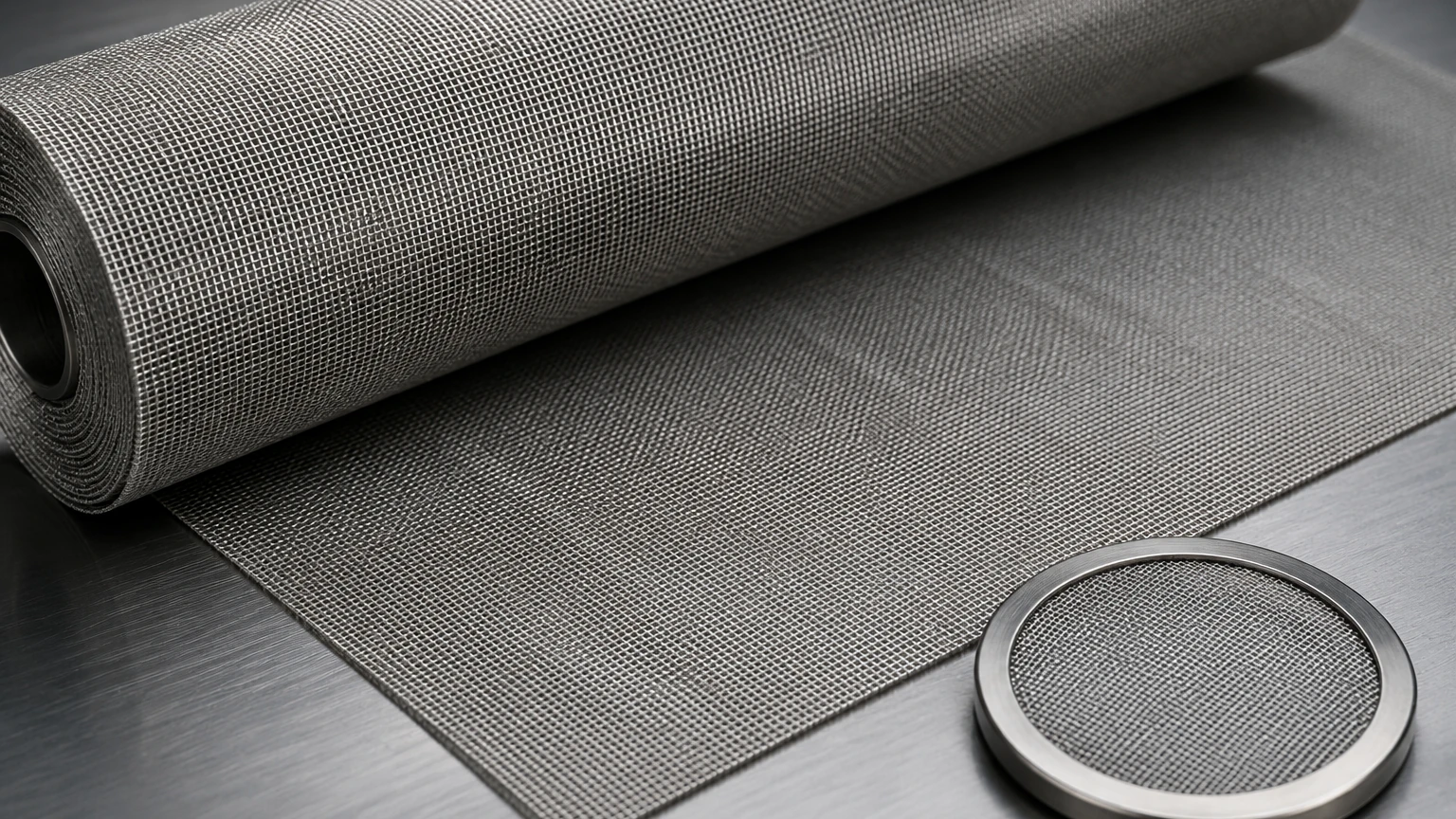
100 Micron Mesh Screen
In industrial filtration, the 100 micron mesh screen represents a critical threshold for medium-fine particulate separation. Measuring exactly 0.1 millimeters, the 100-micron aperture is widely utilized as a primary filtration stage in water treatment, a protective barrier in hydraulic systems, and a standard for particle sizing in chemical processing. Selecting the right mesh requires an understanding of how wire diameter, weave type, and material properties intersect to influence flow rates and structural integrity.
For engineers and procurement specialists, the challenge lies not just in selecting the micron rating, but in ensuring the mesh can withstand the specific mechanical and chemical stresses of the application. This guide examines the technical parameters of 100 micron mesh screens and the engineering considerations necessary for optimizing filtration performance.
Technical Specifications and Mesh Count Correlation
The term "100 micron" refers to the clear opening between the wires of the mesh. However, in the wire cloth industry, mesh is often categorized by "mesh count," which is the number of openings per linear inch. For a 100 micron mesh screen, the mesh count typically falls between 140 and 150, depending on the wire diameter used during manufacturing.
The Relationship Between Wire Diameter and Open Area
Wire diameter is a fundamental variable. A thicker wire increases the mechanical strength and longevity of the screen but reduces the percentage of open area, thereby increasing the pressure drop across the filter. Conversely, a thinner wire provides a higher flow rate but may be susceptible to deformation under high-pressure differentials.
When specifying a 100 micron screen, engineers must calculate the Open Area Percentage using the formula:
Open Area % = (Opening Width² / (Opening Width + Wire Diameter)²) x 100
For most industrial applications, an open area of 30% to 45% is standard for 100-micron ratings. If your process requires high throughput with minimal resistance, selecting a mesh with a higher open area—achieved through precision-drawn thin wires—is essential.
Material Selection for Industrial Durability
Stainless steel is the industry standard for 100 micron mesh screens due to its balance of corrosion resistance, thermal stability, and mechanical strength. The choice of grade is determined by the fluid chemistry and the operating environment.
Stainless Steel 304 vs. 316L
* Grade 304: The most common choice for general industrial use. It offers excellent strength and basic corrosion resistance suitable for water filtration and food processing where chloride exposure is low.
* Grade 316L: Contains molybdenum, which provides superior resistance to pitting and crevice corrosion in chloride-rich environments. This is the preferred material for marine applications, chemical processing, and pharmaceutical manufacturing.
In high-temperature environments, such as steam filtration or hot oil processing, stainless steel maintains its structural aperture better than polymer-based meshes, which may soften or elongate, leading to "pore migration" where the 100-micron rating is no longer guaranteed under pressure.
Engineering Performance: Flow Rate and Pressure Drop
One of the most common mistakes in filter selection is underestimating the initial clean pressure drop (ΔP). A 100 micron mesh screen introduces a specific resistance to the fluid flow. As particles begin to accumulate on the surface—a process known as "cake formation"—the pressure drop increases exponentially.
Factors Influencing Throughput
1. Fluid Viscosity: Higher viscosity fluids require larger surface areas or lower mesh densities to maintain the same flow rate as water.
2. Particulate Loading: If the fluid has a high concentration of solids near the 100-micron size, the screen will reach its terminal pressure drop quickly.
3. Velocity: High approach velocities can cause particles to become wedged in the mesh (blinding), making the screen difficult to clean.
To mitigate these issues, engineers often utilize pleated designs. By pleating the 100 micron mesh, the effective filtration area is significantly increased within the same footprint, allowing for lower flux rates per square inch and longer service life between cleaning cycles.
Common Applications for 100 Micron Mesh
The versatility of the 100 micron aperture makes it a staple across various sectors. Its primary role is often as a "security filter" to protect downstream equipment from damage or to ensure the final product meets specific clarity standards.
Water Treatment and Irrigation
In municipal and industrial water systems, 100 micron screens are used to remove sand, silt, and organic debris. This protects sensitive components like UV sterilizers, high-pressure pumps, and fine spray nozzles from abrasion and clogging.
Hydraulic and Lube Oil Systems
Hydraulic fluids must remain free of metallic shavings and environmental dust to prevent valve sticking and pump wear. A 100 micron mesh screen serves as an effective suction strainer or return-line filter, capturing large contaminants that could cause catastrophic mechanical failure.
Food and Beverage Processing
In the production of juices, syrups, and oils, 100 micron filtration ensures the removal of pulp, seeds, or unwanted precipitates. Because stainless steel is non-leaching and easy to sanitize, it meets the stringent hygienic requirements of the industry.
Evaluating Weave Types: Plain vs. Dutch Weave
The method by which the wires are interlaced significantly impacts the performance of a 100 micron mesh screen. While many assume all mesh is a simple grid, different weaves offer distinct advantages.
* Plain Weave: The most straightforward construction where each warp wire crosses over and under each shute wire. It provides the most precise aperture and is ideal for two-dimensional surface filtration where easy cleaning is required.
* Twill Weave: Used when heavier wires are required for a specific micron rating. The wires cross over two and under two, allowing for a more robust mesh that can withstand higher mechanical loads.
* Dutch Weave: This weave uses different wire diameters for the warp and shute. It creates a three-dimensional pore structure. While a "100 micron" Dutch weave might not have a visible straight-through opening, it provides superior strength and is often used in high-pressure applications like polymer filtration or hydraulic systems.
Maintenance, Cleaning, and Blinding Prevention
The longevity of a 100 micron mesh screen is largely dependent on the maintenance protocol. Unlike disposable depth filters, stainless steel mesh is designed to be cleaned and reused, which significantly reduces the total cost of ownership.
Overcoming Mesh Blinding
Blinding occurs when particles that are slightly larger than or equal to 100 microns become trapped in the openings. To prevent this, systems can be designed with backwashing capabilities, where a portion of the filtered fluid is sent in reverse through the mesh to dislodge trapped solids.
Cleaning Methods
1. Ultrasonic Cleaning: The most effective method for fine mesh. High-frequency sound waves create cavitation bubbles that lift contaminants out of the mesh without damaging the delicate wire structure.
2. Chemical Cleaning: Used when the contaminants are organic or scale-based. It is vital to ensure the cleaning agent is compatible with the stainless steel grade (e.g., avoiding strong acids that may cause corrosion in Grade 304).
3. Manual Pressure Washing: Effective for coarse debris, but care must be taken not to deform the mesh with excessive localized pressure.
Critical Factors to Confirm Before Purchasing
Before finalizing a specification for a 100 micron mesh screen, technical teams should verify several key parameters with their manufacturer to ensure the component performs as expected in the field.
* Absolute vs. Nominal Rating: Confirm if the 100-micron rating is "absolute" (meaning 100% of particles 100 microns and larger are retained) or "nominal" (meaning a high percentage, typically 60-90%, are retained). For critical protection, an absolute rating is usually required.
* Effective Filtration Area (EFA): Ensure the housing and element design provide enough surface area to keep the initial pressure drop within the system's tolerances.
* Structural Support: For high-pressure applications, the 100 micron mesh may need to be laminated or sintered to a coarser support mesh to prevent bursting or collapsing.
* Customization Requirements: If the screen is being integrated into an OEM machine, confirm the tolerances for outer diameters, flange fittings, and seam welding methods (such as plasma or TIG welding) to ensure a leak-free fit.
For a comprehensive look at available configurations and to consult with engineering experts on custom filtration designs, you can visit the Main Page of our technical resource center. Understanding these variables ensures that your 100 micron mesh screen provides reliable, repeatable performance in even the most demanding industrial environments.
