


How to Filter Ocean Water
Filtering ocean water for industrial use is a complex engineering challenge that extends far beyond simple desalination. In sectors ranging from offshore oil and gas to coastal power generation and large-scale desalination plants, the primary objective is to transform raw seawater into a manageable process fluid. This requires a robust, multi-stage filtration strategy designed to handle high salinity, organic biofouling, and abrasive suspended solids. Understanding how to filter ocean water effectively involves analyzing the mechanical, chemical, and economic variables that dictate the performance and longevity of filtration hardware.
Industrial filtration systems must protect sensitive downstream equipment, such as high-pressure pumps and Reverse Osmosis (RO) membranes, from damage and clogging. This guide examines the technical requirements, material considerations, and engineering methodologies essential for professional-grade seawater filtration.
Understanding the Composition of Ocean Water for Industrial Processing
Before implementing a filtration system, engineers must account for the specific characteristics of the source water. Ocean water is not a uniform substance; its composition varies based on depth, distance from the shore, and local environmental factors.
Total Suspended Solids (TSS) and Turbidity
Raw seawater contains a significant volume of suspended solids, including sand, silt, clay, and microscopic debris. These particles are often abrasive and can cause rapid wear on mechanical seals and valves. High TSS levels require robust mechanical pre-filtration to prevent the premature loading of fine filters.
Biological Loads and Biofouling
One of the most significant challenges in ocean water filtration is the presence of living organisms. Algae, plankton, larvae, and bacteria can colonize filter surfaces, creating a biological film known as biofouling. This film increases differential pressure and can lead to localized corrosion, even on high-grade alloys. Effective filtration must incorporate strategies to mitigate biological growth, often through a combination of mechanical exclusion and chemical treatment.
Salinity and Chemical Corrosivity
Seawater typically has a salinity of approximately 35,000 parts per million (ppm), primarily consisting of sodium chloride. The high concentration of chloride ions makes ocean water extremely corrosive to many standard industrial materials. When determining how to filter ocean water, the selection of metallurgy for filter housings and elements is the most critical factor in ensuring system reliability.
The Multi-Stage Approach to Seawater Filtration
Industrial systems rarely rely on a single filter. Instead, they utilize a graduated approach that removes larger contaminants first to protect the finer, more expensive filtration stages.
1. Intake Screens and Coarse Filtration
The process begins at the intake point. Large-scale debris, such as seaweed, fish, and plastic waste, must be excluded using coarse screens or trash racks. These are often followed by traveling band screens or static wedge wire screens with openings ranging from 1mm to 10mm. This stage is crucial for protecting the primary intake pumps.
2. Media Filtration and Pre-Treatment
Once the water enters the facility, it often undergoes media filtration (such as sand or anthracite) or disc filtration. This stage targets particles in the 20 to 100-micron range. In many modern plants, this is being replaced or supplemented by ultrafiltration (UF) membranes, which provide a more consistent Silt Density Index (SDI) for downstream processes.
3. Fine Mechanical Filtration
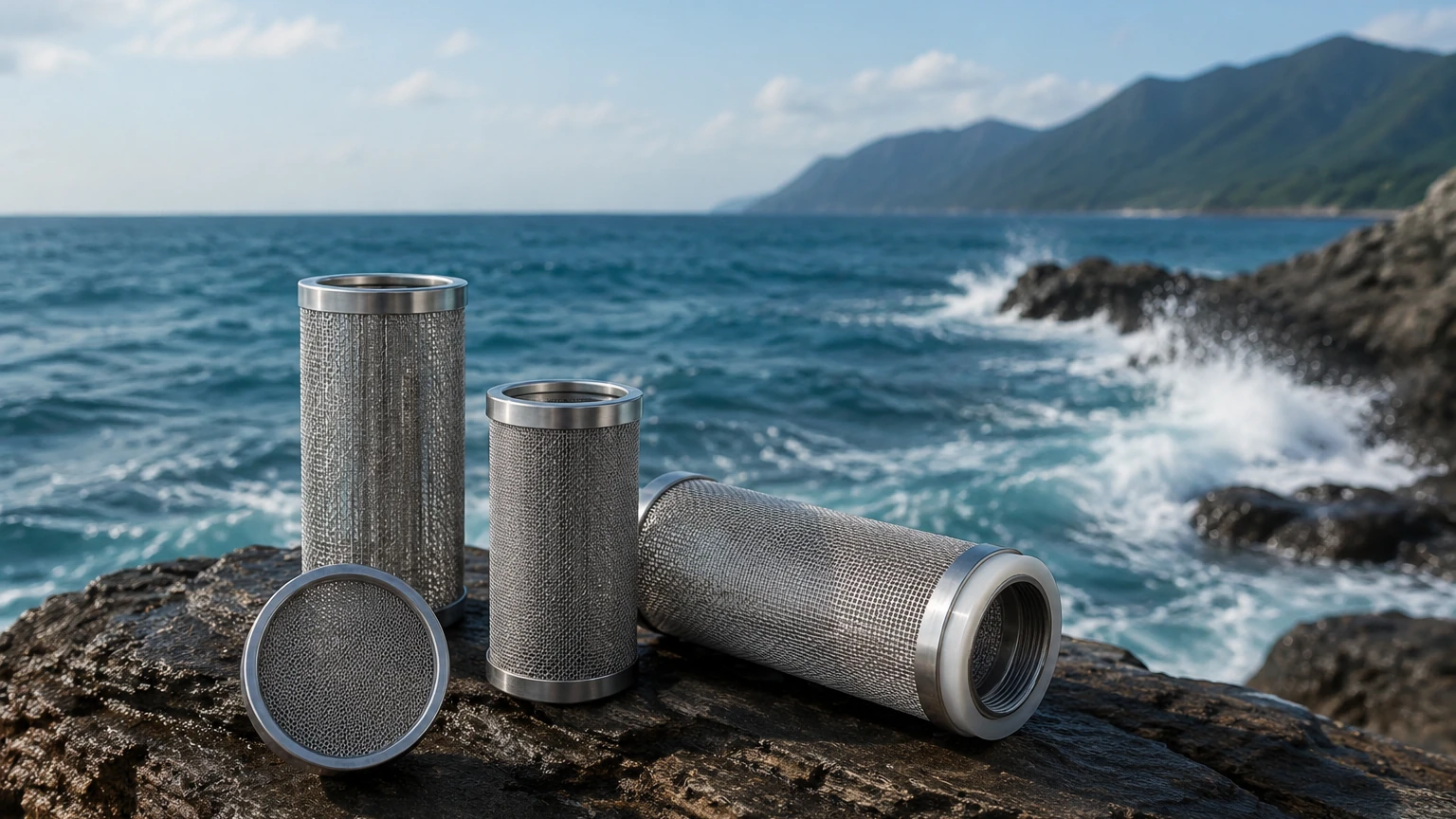
Between the pre-treatment and the final process (like RO), fine mechanical filtration is employed. This is where stainless steel wire mesh filters and high-performance cartridges are utilized. These filters typically target particles between 1 and 20 microns. Their role is to act as a "police filter," ensuring that no stray particles or media fragments reach the high-pressure membranes. For more information on specialized components for these stages, you can visit the Main Page to review product options and application support.
Material Selection: Overcoming Chloride-Induced Corrosion
When engineering systems for ocean water, material science is at the forefront. Standard 304 or even 316 stainless steel often proves insufficient for long-term immersion in seawater due to the risk of pitting and crevice corrosion.
The Role of 316L Stainless Steel
316L stainless steel, with its low carbon content and addition of molybdenum, offers better resistance to chlorides than the 300-series counterparts. It is frequently used for internal filter components where the environment is controlled or where regular maintenance and cleaning are performed. However, in stagnant seawater conditions, even 316L can succumb to localized attack.
Duplex and Super Duplex Alloys
For critical industrial applications, Duplex (e.g., 2205) and Super Duplex (e.g., 2507) stainless steels are the industry standard. These materials provide a high Pitting Resistance Equivalent Number (PREN), making them suitable for the high-pressure, high-salinity environments found in seawater RO (SWRO) plants. They offer superior mechanical strength, allowing for thinner-walled components that can withstand higher operating pressures.
Titanium and Specialized Coatings
In extreme cases, or where weight is a primary concern (such as on offshore platforms), titanium may be used. Alternatively, high-performance coatings or linings can be applied to carbon steel housings to provide a barrier against the corrosive effects of the ocean water.
Technical Specifications for Industrial Filter Cartridges
Selecting the right filter cartridge involves more than just choosing a micron rating. Engineers must evaluate several performance metrics to ensure the filter can handle the rigors of ocean water service.
Micron Rating: Absolute vs. Nominal
In industrial seawater filtration, absolute-rated filters are preferred. A nominal rating suggests that the filter will catch most particles of a certain size, but an absolute rating guarantees a specific efficiency (usually 99.9%) at that size. This precision is vital for protecting high-pressure pumps that have tight internal clearances.
Flow Rate and Differential Pressure
The design must balance the required flow rate with the initial differential pressure (ΔP). A higher surface area, achieved through pleated wire mesh designs, allows for higher flow rates with lower pressure drops. This not only reduces the energy consumption of the pumps but also extends the time between cleaning cycles.
Structural Integrity and Collapse Pressure
Seawater systems often operate at high pressures. Filter elements must be engineered to resist collapse if they become heavily loaded with contaminants. This requires robust internal cores and high-quality longitudinal welding of the filter mesh to ensure the element remains intact under stress.
Operational Challenges: Biofouling and Pressure Management
Even the best-designed filtration system will fail without proper operational management. When considering how to filter ocean water, engineers must plan for the inevitable buildup of solids and biological matter.
Backwashing and Cleaning Cycles
Automatic backwashing filters are a common solution for the pre-filtration stages. These systems detect an increase in differential pressure and automatically reverse the flow or use a scanning nozzle to clean the filter screen without interrupting the main process. For fine mesh filters, ultrasonic cleaning or chemical CIP (Clean-In-Place) procedures may be necessary to restore the original flow characteristics.
Monitoring Silt Density Index (SDI)
In desalination applications, the SDI is a critical measurement. It indicates the fouling potential of the water after it has passed through the pre-filtration stages. If the SDI is too high, it suggests that the mechanical filtration is failing to remove enough fine particulates, which will lead to rapid fouling of the RO membranes.
Selecting Custom Filtration Solutions for Marine Applications
Standard off-the-shelf filters rarely meet the specific needs of complex marine and industrial environments. Customization is often required to fit existing piping footprints, meet specific flow requirements, or satisfy stringent maritime certifications.
Engineering for Compact Spaces
On ships and offshore rigs, space is at a premium. Custom-engineered filter housings can be designed to maximize filtration surface area within a compact footprint. This often involves innovative pleated designs or multi-cartridge configurations that provide the necessary performance without requiring excessive deck space.
OEM and Tailored Designs
Working with a manufacturer that understands the nuances of metal filtration allows for the development of OEM components tailored to specific equipment. Whether it is a custom micron rating for a specialized hydraulic system or a reinforced mesh for high-vibration environments, tailored solutions ensure that the filtration system is an asset rather than a bottleneck. Technical teams can find more detailed engineering resources on the Main Page to assist in the specification process.
Total Cost of Ownership (TCO) in Seawater Filtration
The initial purchase price of a filtration system is only a fraction of its total cost. When evaluating how to filter ocean water, engineers must consider the long-term expenses associated with maintenance, energy, and replacement parts.
* Durability: High-quality stainless steel or duplex filters have a much longer service life than plastic or low-grade metal alternatives, reducing the frequency of capital expenditure.
* Energy Efficiency: Low-pressure-drop filters reduce the load on pumps, leading to significant energy savings over the life of the plant.
* Waste Reduction: Cleanable metal filters eliminate the waste stream associated with disposable polymer cartridges, aligning with corporate sustainability goals and reducing disposal costs.
Conclusion
Successfully filtering ocean water requires a deep understanding of both the environment and the mechanical tools available to manage it. By employing a multi-stage approach, selecting the correct corrosion-resistant materials, and focusing on high-precision mechanical filtration, industrial operators can ensure a reliable supply of processed water. Whether the goal is protecting a desalination membrane or cooling a power plant, the engineering of the filtration system is the foundation of operational success.
