


Woven Wire Fence Dispenser: Engineering Efficiency in Industrial Mesh Deployment
In industrial environments where perimeter security, safety guarding, and large-scale filtration systems are implemented, the handling of bulk wire materials requires precision and mechanical assistance. The use of a woven wire fence dispenser is not merely a matter of convenience; it is a critical component in ensuring the structural integrity and longevity of the installation. For engineers and procurement teams, understanding the interplay between the mechanical dispenser and the technical specifications of Woven Wire Mesh is essential for optimizing project timelines and material performance.
Industrial applications often demand high-tensile stainless steel alloys, such as SS304 or SS316L, which present unique challenges during unrolling and tensioning. Unlike lighter materials, industrial-grade mesh possesses significant "memory" or spring-back potential. A dedicated dispenser manages these forces, allowing for a controlled release that prevents kinking, deformation, or worker injury.
Technical Specifications of Woven Wire Mesh Materials
Before selecting a dispensing system, one must understand the physical properties of the material being deployed. Woven wire mesh is defined by several key parameters that dictate its behavior under tension and its suitability for specific environments.
Material Composition and Corrosion Resistance
The choice of alloy is the primary factor in the mesh's lifespan.
- SS304: The standard industrial grade, offering excellent durability and resistance to atmospheric corrosion. It is widely used in safety guarding and general-purpose industrial fencing.
- SS316L: Contains molybdenum, providing superior resistance to chlorides and marine environments. In chemical processing plants or coastal facilities, SS316L is the baseline requirement to prevent pitting and stress corrosion cracking.
Weave Types and Mechanical Stability
The method of weaving influences how the mesh reacts to the pulling force of a dispenser:
1. Plain Weave: The most common construction where wires cross over and under one another alternately. It offers high transparency and consistent opening sizes.
2. Twill Weave: Each shute wire passes successively over and under two warp wires. This allows for a heavier wire diameter in a given mesh count, increasing the overall strength of the barrier.
3. Dutch Weave: Utilizes different diameters for warp and shute wires, resulting in a dense, dimensionally stable mesh often used in high-pressure filtration but also applicable in specialized heavy-duty security barriers.
The Functionality of a Woven Wire Fence Dispenser in Industrial Settings
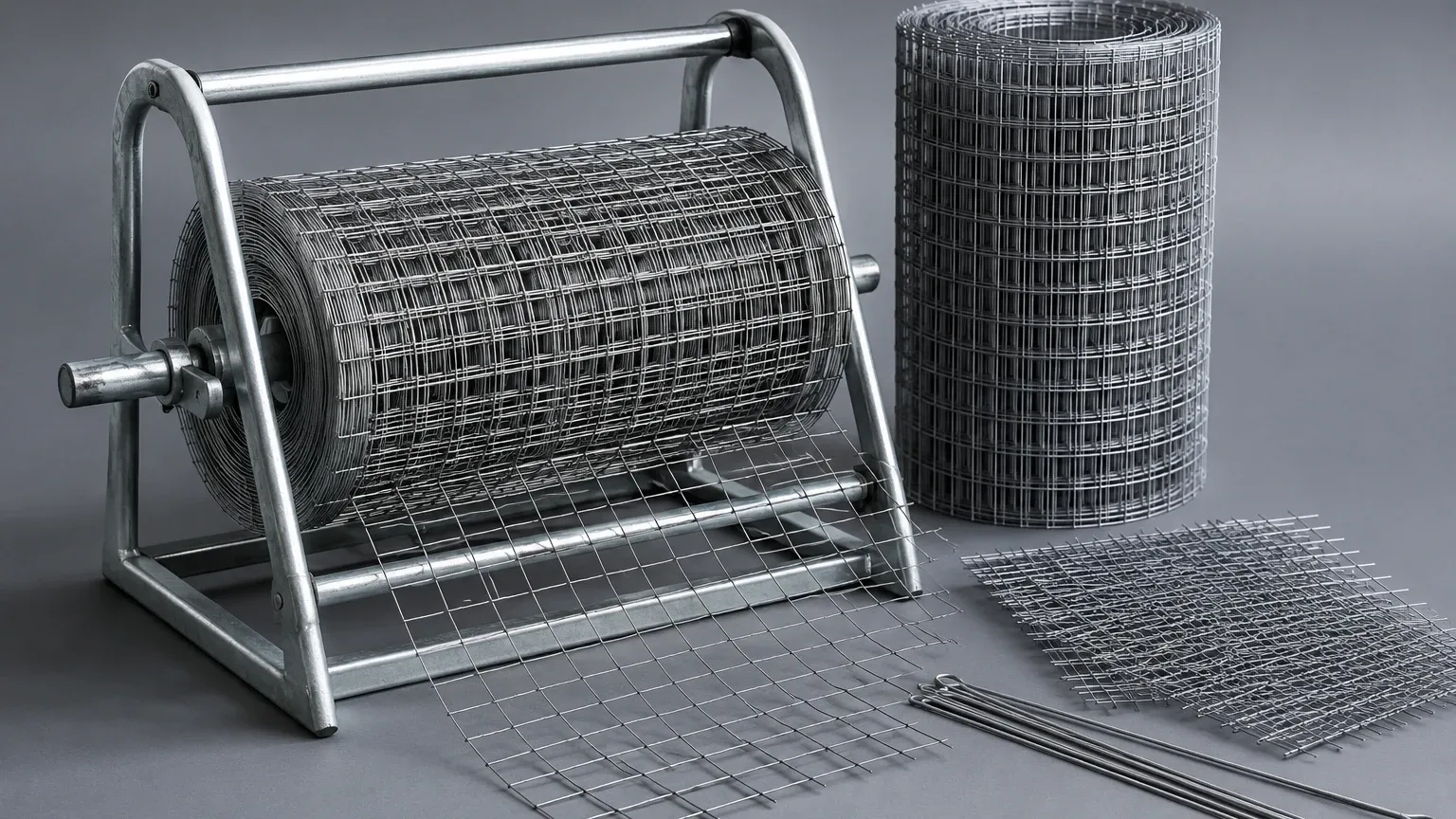
A woven wire fence dispenser serves as a mobile or stationary mandrel system designed to hold heavy rolls of mesh and facilitate their controlled deployment. In industrial fabrication or site installation, these tools solve three primary engineering problems: material memory, uniform tensioning, and labor efficiency.
Managing Material Memory
High-gauge stainless steel wire is cold-drawn, which imparts significant internal stress. When stored in a roll, the mesh "remembers" this curved shape. Attempting to unroll this manually often results in "scalloping" or uneven edges. A dispenser provides a counter-rotational force and a guide path that flattens the mesh as it is pulled, ensuring it arrives at the mounting posts or frame in a neutral state.
Achieving Uniform Tension
For a fence or guard to meet safety standards, it must be tensioned to a specific Newton-meter (Nm) rating. If the mesh is too loose, it will sag and vibrate, leading to work-hardening and eventual fatigue failure at the attachment points. If it is too tight, the wires may exceed their yield strength. Modern dispensers often include integrated braking systems or tensioning bars that allow installers to apply consistent force across the entire height of the roll.
Engineering Challenges: Tensioning and Structural Integrity
When deploying Plain, twill and dutch woven wire mesh in SS304/316L — rolls, cut mesh and framed panels. Send mesh count or micron target for a technical quote., engineers must calculate the load-bearing capacity of the support structure relative to the mesh's weight and the tension applied during dispensing.
Yield Strength and Deformation
Every wire alloy has a defined yield point. During the dispensing process, it is critical that the pulling force does not exceed approximately 40-50% of the material's yield strength. Exceeding this can cause permanent elongation, which thins the wire diameter and alters the mesh opening size (aperture). In filtration applications, this change in aperture can compromise the micron rating; in fencing, it weakens the structural barrier.
Thermal Expansion Considerations
Industrial facilities often experience significant temperature fluctuations. Stainless steel has a predictable coefficient of thermal expansion. A dispenser-installed fence must account for this by ensuring the mesh is not "over-tensioned" during cold installation, which could lead to snapping or post-deformation when temperatures drop further, or excessive sagging when temperatures rise.
Comparative Analysis: Plain vs. Dutch Weave for Heavy-Duty Use
While both weaves can be deployed via a dispenser, their mechanical requirements differ significantly.
Plain Weave is relatively flexible. It requires a dispenser with a smooth feed roller to prevent the wires from shifting out of their perpendicular alignment. It is the preferred choice for areas requiring high visibility and airflow, such as machine guards.
Dutch Weave, due to its compacted structure, is much stiffer. It requires a heavy-duty dispenser with a high-torque mandrel. This mesh type is rarely used for standard perimeter fencing but is essential in industrial "curtains" used for debris containment or specialized acoustic dampening. The dispenser must be able to handle the significantly higher weight-per-square-foot associated with Dutch weaves.
Selection Criteria for Industrial Mesh Procurement
When purchasing woven wire mesh for use with a dispenser, procurement officers should confirm the following technical details with the manufacturer:
1. Roll Length and Weight: Ensure the dispenser’s load capacity matches the roll weight. Industrial rolls of 316L mesh can exceed several hundred kilograms.
2. Edge Finish: For dispenser deployment, a "selvaged" edge (woven finished edge) is often superior to a "raw" or "knuckled" edge. Selvaged edges reduce the risk of the mesh catching on the dispenser’s guide rollers.
3. Mesh Count vs. Wire Diameter: A higher mesh count with a thinner wire may be easier to dispense but offers less impact resistance. Conversely, a low mesh count with a large wire diameter (e.g., 2mm or greater) requires specialized mechanical unrolling equipment.
4. Surface Treatment: If the mesh has been passivated or coated, the dispenser rollers must be made of non-marring materials (such as polyurethane) to avoid damaging the protective surface layer.
Maintenance and Longevity of Stainless Steel Components
The longevity of an industrial mesh installation is determined by the quality of the initial deployment. Mesh that has been kinked or improperly tensioned by manual unrolling will develop localized stress points. These points are the first to succumb to "crevice corrosion," even in high-grade stainless steels.
Using a dispenser ensures that the protective chromium oxide layer of the stainless steel remains intact. Furthermore, properly tensioned mesh is less likely to suffer from "fretting corrosion," which occurs when two metal surfaces rub together due to wind-induced vibration or mechanical movement. By maintaining a taut, stable surface, the dispenser indirectly extends the service life of the filtration or fencing system by years.
Conclusion: Strategic Integration of Tools and Materials
For B2B stakeholders in the industrial sector, the procurement of Woven Wire Mesh should be viewed as a system-level decision. The material choice (SS304 vs. SS316L), the weave pattern (Plain, Twill, or Dutch), and the deployment method (manual vs. dispenser) all contribute to the Total Cost of Ownership (TCO).
A woven wire fence dispenser is an investment in quality control. It ensures that the technical specifications of the mesh—carefully selected for its filtration accuracy or structural strength—are preserved from the moment it leaves the roll until it is secured in its final position. When planning large-scale installations, engineers should mandate the use of mechanical dispensing to guarantee that the resulting barrier or filter bed meets the rigorous safety and performance standards required in modern industrial environments.
