


Cutting Oil Filtration Systems
In modern precision machining, the performance of cutting oil is directly linked to the quality of the final product and the longevity of the machine tools. Cutting oil filtration systems are essential for removing metallic fines, abrasive particles, and other contaminants that accumulate during the machining process. Without effective filtration, these contaminants circulate back into the cutting zone, leading to premature tool wear, poor surface finishes, and increased operational costs.
For engineers and facility managers, selecting the right filtration components involves understanding the fluid dynamics of the coolant loop, the specific particle sizes generated by the machining process, and the chemical properties of the cutting oil itself. As a specialist in stainless steel filtration solutions, Kaifil provides the technical components necessary to maintain high-purity oil environments in demanding industrial settings.
Understanding Contamination in Machining Fluids
Cutting oils serve multiple roles: they lubricate the interface between the tool and the workpiece, evacuate chips from the cutting zone, and provide cooling to prevent thermal deformation. However, as the oil circulates, it becomes a carrier for various types of debris. These contaminants are generally categorized into three groups:
1. Macro-Particles (Chips and Swarf): These are the visible remnants of the machining process. While primary chip conveyors remove the bulk of this material, smaller fragments often bypass initial separation and enter the fluid reservoir.
2. Micro-Fines: These are particles often smaller than 50 microns. They are particularly dangerous because they can act as an abrasive paste, wearing down internal pump components and clogging high-pressure coolant nozzles.
3. Tramp Oils and Biological Contaminants: While less common in pure oil systems than in water-based coolants, tramp oils (leaked hydraulic or way oils) can alter the viscosity and chemical stability of the cutting fluid.
Effective cutting oil filtration systems must address these contaminants through a multi-stage approach, often utilizing stainless steel wire mesh or pleated cartridges to ensure that only clean oil reaches the high-precision components of the CNC machine. For more information on specialized filtration components, you can visit the Main Page to review product options and application support.
Engineering Considerations for Filter Selection
When designing or upgrading cutting oil filtration systems, several engineering parameters must be evaluated to ensure the system performs reliably under industrial loads. A common mistake is selecting a filter based solely on its micron rating without considering the impact on the overall hydraulic system.
Filtration Accuracy (Micron Rating)
Filtration accuracy refers to the size of the smallest particle the filter can reliably capture. In cutting oil applications, this typically ranges from 5 microns for finishing operations to 100 microns for heavy roughing. It is important to distinguish between "nominal" and "absolute" ratings. An absolute-rated stainless steel filter ensures that 99.9% of particles at the specified size are captured, providing the consistency required for high-precision aerospace or medical component manufacturing.
Flow Rate and Pressure Drop
Every filter element introduces a resistance to flow, known as pressure drop ($ΔP$). As the filter captures contaminants, the $ΔP$ increases. If the initial pressure drop is too high due to an undersized filter, the system will reach its terminal pressure quickly, leading to frequent maintenance or bypass events. Engineers must calculate the required flow rate (GPM or L/min) and select a filter housing and element that minimize initial resistance while providing sufficient surface area for dirt-holding capacity.
Material Compatibility
Cutting oils can be chemically aggressive, especially those containing sulfurized or chlorinated additives for extreme pressure (EP) performance. Stainless steel (Grade 304 or 316L) is the preferred material for filter elements in these environments. Unlike polymer-based filters, stainless steel does not degrade or leach chemicals into the oil, and it maintains its structural integrity under high temperatures and pressures.
Types of Filtration Components in Cutting Oil Systems
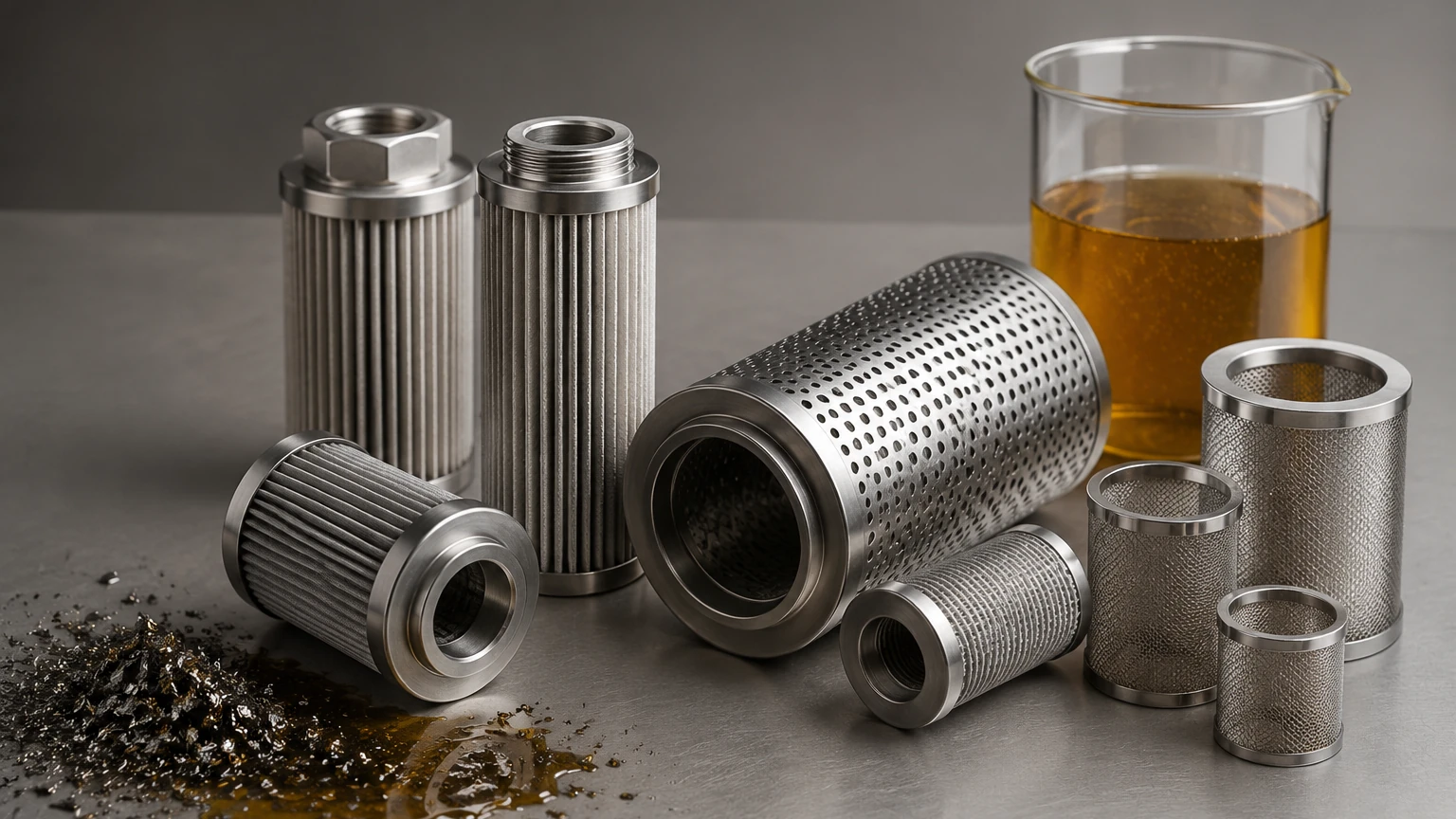
Industrial filtration systems utilize different structural designs depending on the required level of purity and the volume of oil being processed. Kaifil specializes in manufacturing several types of precision metal filter components that are central to these systems.
Stainless Steel Wire Mesh Filters
Wire mesh filters are often used as primary or secondary filters. They are constructed from woven stainless steel wire, providing a precise and uniform pore size. One of the primary advantages of wire mesh is its cleanability. Unlike disposable paper or felt filters, wire mesh elements can be cleaned via backwashing or ultrasonic baths, significantly reducing the long-term waste and replacement costs of the filtration system.
Pleated Filter Cartridges
For applications requiring high surface area in a compact footprint, pleated stainless steel cartridges are the standard. By pleating the mesh, the effective filtration area is increased by several times compared to a cylindrical filter of the same size. This results in a lower flux rate (flow per unit area), which improves filtration efficiency and extends the time between cleaning cycles.
Wedge Wire Screens
Wedge wire is used in heavy-duty cutting oil filtration systems where high structural strength is required. These screens are made from V-shaped wires that are resistance-welded to support rods. This design is virtually non-clogging and is ideal for removing large volumes of metallic swarf before the oil reaches the finer secondary filters.
Performance Expectations and Maintenance Cycles
The reliability of cutting oil filtration systems depends on a proactive maintenance strategy. Monitoring the differential pressure across the filter is the most effective way to determine when a filter element requires cleaning or replacement. Most industrial systems are equipped with pressure transducers or mechanical gauges that trigger an alarm when the $ΔP$ exceeds a pre-set limit (typically 15-25 PSI, depending on the pump capacity).
Cleaning vs. Replacement
One of the significant benefits of stainless steel filtration components is their durability. While synthetic media is discarded after a single use, stainless steel elements can be reused. In cutting oil applications, metal fines can often be removed by reversing the flow (backflushing) or by using specialized cleaning solvents. However, it is critical to inspect the mesh for signs of "blinding" (permanent clogging of the pores) or mechanical damage during each cleaning cycle. If the mesh is compromised, the filtration accuracy will drop, allowing harmful particles to reach the machine tool.
Impact on Tool Life
Empirical data from machining environments shows that maintaining cutting oil at a high level of cleanliness can extend tool life by 20% to 50%. By removing the micro-abrasives that cause edge rounding and flank wear, the tools remain sharp for longer periods. This not only reduces the cost of consumables but also decreases the downtime associated with tool changes and machine recalibration.
Customization and OEM Integration
Every machining center has unique requirements based on its footprint, pump capacity, and the materials being processed (e.g., aluminum, titanium, or hardened steel). Off-the-shelf filtration solutions often fail to meet these specific needs, leading to suboptimal performance.
Customized filtration solutions allow for the optimization of:
* End Cap Configurations: Ensuring a leak-proof seal within existing filter housings.
* Reinforcement Layers: Adding perforated metal cores or outer shrouds to withstand high-pressure surges in hydraulic-driven cutting oil loops.
* Variable Micron Ratings: Layering different mesh sizes to create a graduated density filter that captures both large and small particles in a single element.
Kaifil works closely with OEM manufacturers to develop bespoke filtration components that integrate seamlessly into larger cutting oil filtration systems. This collaborative engineering approach ensures that the filtration system is a balanced part of the machine's overall design rather than an afterthought.
Evaluating Total Cost of Ownership (TCO)
When purchasing filtration components, it is essential to look beyond the initial purchase price. The Total Cost of Ownership (TCO) for cutting oil filtration systems includes the cost of the filter elements, the labor required for maintenance, the cost of fluid loss during filter changes, and the environmental fees for disposing of contaminated waste.
Stainless steel filters typically have a higher upfront cost than disposable alternatives. However, because they are cleanable and have a service life measured in years rather than weeks, the TCO is significantly lower. Furthermore, by improving the cleanliness of the oil, these systems reduce the frequency of full oil changes, which is a major cost driver in large-scale manufacturing facilities.
Reducing the environmental footprint is another critical factor. Disposable filters contribute to hazardous waste streams when saturated with cutting oil. By switching to permanent, cleanable stainless steel media, facilities can move toward more sustainable "closed-loop" manufacturing processes.
Conclusion
Cutting oil filtration systems are a critical component of industrial productivity. By selecting high-quality stainless steel filtration elements, engineers can protect their equipment, improve part quality, and reduce operational overhead. Whether the goal is to achieve finer surface finishes or to extend the life of expensive cutting fluids, understanding the technical nuances of filter media, flow dynamics, and material compatibility is the first step toward optimization.
For those seeking to implement or upgrade their industrial filtration capabilities, focusing on precision-engineered components ensures long-term reliability in even the most demanding machining environments. To explore the full range of custom stainless steel filtration solutions, visit the Main Page and consult with a technical specialist regarding your specific application requirements.
