


3-a Sanitary Standards
In the realm of industrial processing, particularly within the food, beverage, dairy, and pharmaceutical sectors, the integrity of the production environment is paramount. Contamination, whether bacterial or chemical, can lead to catastrophic product recalls, regulatory fines, and significant risks to consumer health. To mitigate these risks, engineers and facility managers rely on established benchmarks for equipment design. Among the most critical of these benchmarks are the 3-a sanitary standards. Developed by 3-A Sanitary Standards, Inc. (3-A SSI), these criteria ensure that equipment is designed, fabricated, and installed in a manner that facilitates easy cleaning and prevents the harborage of pathogens.
For manufacturers like Kaifil, adhering to these principles is not merely a matter of compliance but a fundamental aspect of engineering high-performance stainless steel filtration solutions. This guide explores the technical nuances of 3-a sanitary standards, providing engineering professionals with the necessary information to evaluate filtration components for sanitary applications.
The Role of 3-A Sanitary Standards in Industrial Filtration
3-A Sanitary Standards are voluntary but widely recognized sets of criteria for the design and fabrication of equipment used in the production and handling of food and dairy products. The primary objective is to protect public health by ensuring that equipment can be effectively cleaned. In filtration systems, where the media and housing are in direct contact with the process fluid, the application of these standards is critical.
Filtration components that meet these standards are designed to be "Cleanable-in-Place" (CIP) or easily disassembled for manual cleaning (COP). The standards address everything from the chemical composition of the metals used to the geometric configuration of the filter housing. By following these guidelines, engineers can ensure that their filtration systems do not become a source of cross-contamination or a breeding ground for biofilms.
When sourcing components from a Main Page of a manufacturer, it is essential to distinguish between equipment that is "3-A Certified" and equipment that is "designed to 3-A standards." The former has undergone a Third-Party Verification (TPV) inspection, while the latter indicates that the engineering principles align with the standards but may not have the official symbol. For many industrial applications, ensuring that the manufacturer understands and implements these core design principles is the first step toward system validation.
Core Engineering Principles of Sanitary Design
Sanitary design is governed by the principle that all surfaces must be accessible for cleaning and inspection. In the context of stainless steel filter cartridges and housings, several engineering considerations are mandatory:
1. Accessibility: All product contact surfaces must be reachable by cleaning solutions during a CIP cycle. This requires the elimination of "dead legs"—areas where fluid can stagnate and bacteria can proliferate.
2. Internal Radii: Sharp corners are prohibited. 3-a sanitary standards typically require a minimum internal radius of 1/8 inch (3.2 mm) for all permanent joints. This ensures that cleaning agents can reach every part of the surface and that no solids are trapped in 90-degree angles.
3. Self-Draining Surfaces: Equipment must be designed to be self-draining. This means that horizontal surfaces should be avoided in favor of sloped designs that allow gravity to pull fluids toward a discharge point. In filter housings, the base and internal support structures must be configured to prevent the pooling of liquids after a cycle is complete.
4. No Exposed Threads: Threads are notorious for trapping material and are nearly impossible to clean effectively in a CIP process. Under 3-a sanitary standards, threads are generally not permitted in the product zone. If they must be used, they must be of a specific sanitary design (such as Acme threads) and must be enclosed or sealed.
Material Requirements: Stainless Steel and Elastomers
Material selection is a cornerstone of sanitary compliance. The standards specify which materials are permissible for product contact surfaces to ensure they do not leach harmful substances or corrode under the influence of process fluids and cleaning chemicals.
Stainless Steel Grades
Most 3-A standards require the use of AISI 300 Series stainless steel. For filtration applications, Type 316L (Low Carbon) is the industry standard. The low carbon content in 316L minimizes carbide precipitation during welding, which preserves the material's corrosion resistance in the heat-affected zone. This is particularly important when dealing with acidic food products or aggressive CIP chemicals like sodium hydroxide or nitric acid.
Elastomers and Gaskets
Non-metal components, such as O-rings and gaskets used to seal filter cartridges into housings, must also comply with specific 3-A standards (such as 3-A Standard 18-). These materials must be non-toxic, non-absorbent, and resistant to the temperature and chemical fluctuations of the process. Common materials include EPDM, Silicone, and FKM (Viton). Engineers must verify that these elastomers are compatible with both the product and the intended cleaning regimen to prevent swelling, cracking, or degradation.
Surface Finish and the Ra Measurement
One of the most visible aspects of 3-a sanitary standards is the requirement for surface smoothness. A smooth surface is easier to sanitize because there are fewer microscopic crevices where bacteria can hide. The standard measurement for surface roughness is Ra (Roughness Average), typically expressed in microinches or micrometers.
For most sanitary filtration applications, the requirement is a maximum Ra of 32 microinches (0.8 μm). Achieving this finish often requires a combination of mechanical polishing and electropolishing.
* Mechanical Polishing: Involves using abrasives to physically smooth the metal surface. While effective, it can leave microscopic directional scratches.
* Electropolishing: An electrochemical process that removes a thin layer of metal, smoothing out the peaks and valleys of the surface at a molecular level. Electropolishing not only improves the Ra value but also enhances the chromium-to-iron ratio on the surface, significantly increasing corrosion resistance.
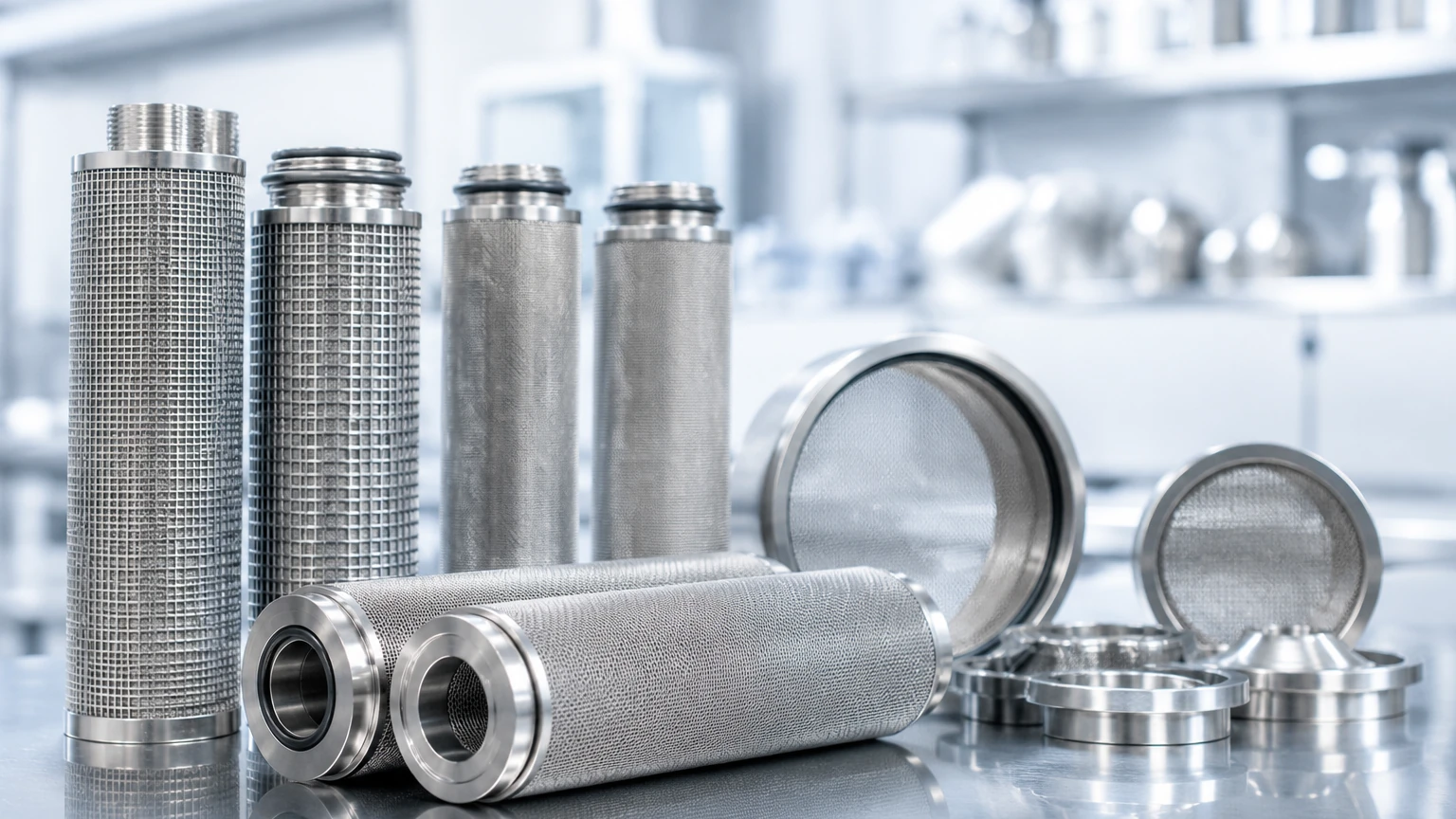
For high-precision wire mesh filters, ensuring that the individual wires and the weave itself do not create inaccessible voids is a major engineering challenge that requires specialized manufacturing techniques.
Fabrication Standards: Welding and Assembly
The way a filter is assembled is just as important as the materials used. In sanitary fabrication, welding is the preferred method of joining components, but it must be performed to exacting standards.
All welds in the product contact zone must be continuous, non-porous, and ground flush with the surrounding metal. The goal is to create a seamless transition between the weld and the base material. Pits, cracks, or "cold laps" in a weld are unacceptable, as they provide a sanctuary for microbial growth that CIP systems cannot reach.
In the production of stainless steel filter cartridges, TIG (Tungsten Inert Gas) welding is commonly used because it provides a high degree of control and a clean, slag-free weld. Advanced manufacturers may also use orbital welding for cylindrical components to ensure consistency and full penetration, which is vital for maintaining the structural integrity of the filter under pressure while meeting 3-A criteria.
Clean-in-Place (CIP) and Sterilize-in-Place (SIP) Compatibility
Engineers selecting filtration solutions must consider the total cleaning cycle. A filter that meets 3-a sanitary standards is designed to withstand the rigors of CIP and SIP without losing its structural or filtration integrity.
* CIP Cycles: These involve circulating hot water and chemical detergents through the system at high velocities. The filter must be able to handle the resulting pressure differentials and chemical exposure.
* SIP Cycles: These use saturated steam to sterilize the equipment, often at temperatures exceeding 121°C (250°F). The filtration media, whether it is a fine wire mesh or a sintered metal fiber, must be thermally stable to prevent warping or pore size deformation during these cycles.
Because stainless steel filters are inherently more robust than polymer-based alternatives, they are often the preferred choice for systems requiring frequent SIP cycles. Their durability ensures a longer service life and a lower total cost of ownership in demanding sanitary environments.
Documentation and Compliance Verification
For engineers working in regulated industries, documentation is as important as the hardware itself. When procuring filtration components, the following documentation should be requested to verify compliance with sanitary expectations:
1. Material Test Reports (MTRs): These documents confirm the chemical composition of the stainless steel used, ensuring it meets the 300-series requirements.
2. Certificates of Conformance: A statement from the manufacturer that the product was designed and manufactured according to specific 3-A standards or internal sanitary protocols.
3. Surface Finish Reports: Documentation of the Ra measurements taken on the product contact surfaces.
4. Weld Validation: In some cases, radiographic or dye penetrant testing reports may be required to ensure weld integrity.
Having this documentation on hand is essential for facility audits and for meeting the requirements of the FDA or other local health authorities.
Selecting the Right Sanitary Filter for Your Application
When evaluating options for a new project or a replacement cycle, engineers should ask several key questions to ensure the selected filter aligns with 3-a sanitary standards:
* What is the required filtration rating? Ensure the micron rating is achieved through a stable media that won't shed fibers into the product stream.
* Is the housing design truly sanitary? Check for the absence of dead legs and ensure all internal corners meet the minimum radius requirements.
* Are the seals compatible? Confirm that the O-ring materials are 3-A compliant and compatible with your specific process chemistry.
* What is the cleaning protocol? Verify that the filter can withstand the temperatures and pressures of your CIP/SIP cycles.
By focusing on these technical details, purchasing teams can avoid the common pitfall of selecting a filter based on price alone, only to find that it fails to meet hygiene requirements or requires frequent, costly manual cleaning.
Conclusion
Adhering to 3-a sanitary standards is a critical component of modern industrial engineering in the food, beverage, and pharmaceutical sectors. These standards provide a roadmap for creating equipment that is not only functional but also inherently safe and easy to maintain. From the selection of 316L stainless steel to the precision of electropolished surfaces and seamless welds, every detail matters in the pursuit of a sterile processing environment.
As a specialist in custom filtration, Kaifil understands the rigorous demands of sanitary applications. By integrating these engineering principles into the design and manufacture of stainless steel filter cartridges and components, we help our global partners achieve reliable, long-term filtration performance. For more information on our technical capabilities and product range, please visit our Main Page. Selecting the right filtration partner ensures that your system remains compliant, efficient, and, most importantly, safe for the end consumer.
