


Cartridge Filter Beer
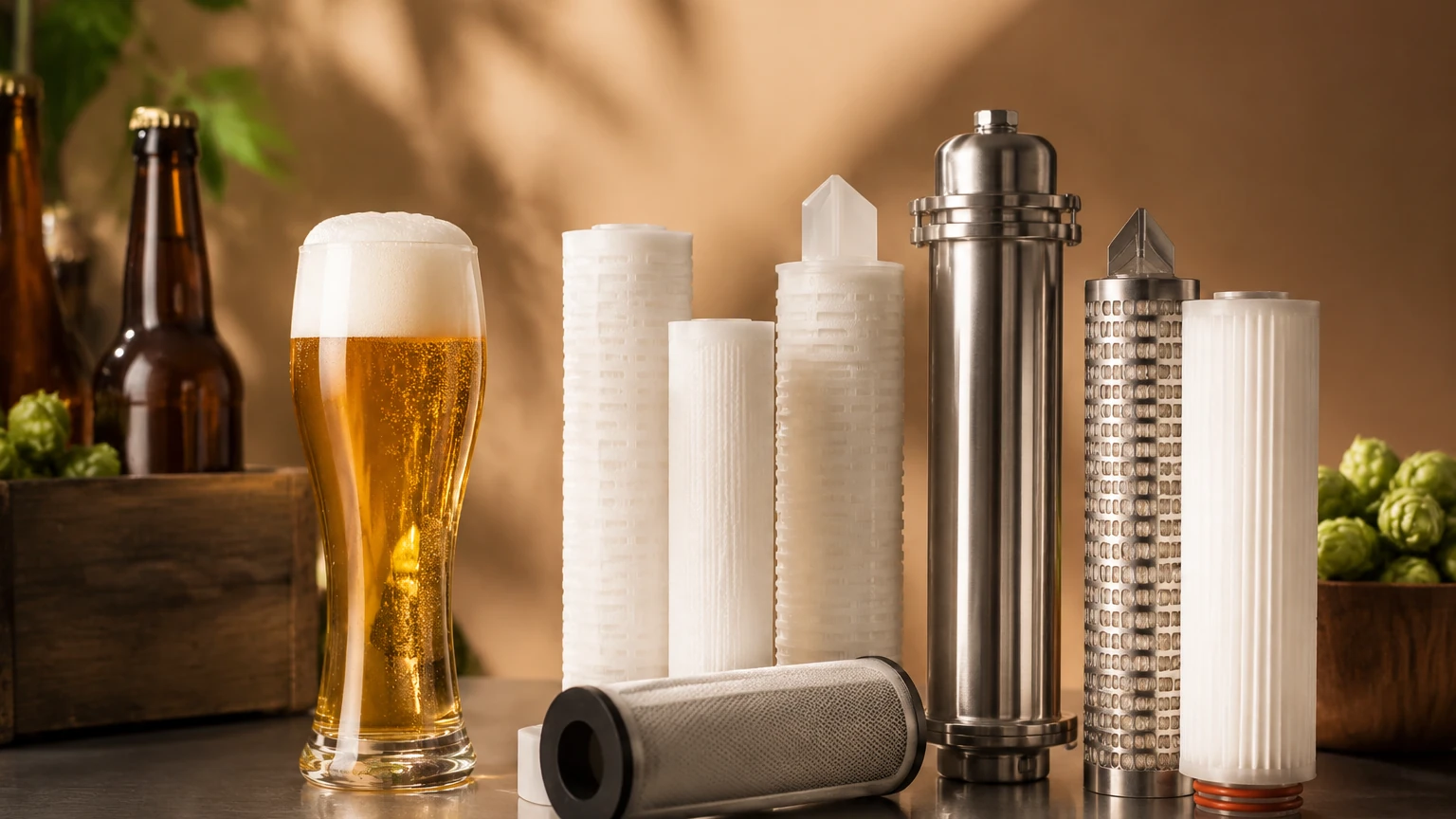
In the industrial production of beer, filtration is a critical process that dictates the final product's clarity, biological stability, and shelf life. While traditional methods like diatomaceous earth (DE) filtration or centrifugation are often used for primary clarification, the final stages of beer processing increasingly rely on high-precision cartridge filtration. Selecting the right cartridge filter beer solution requires a deep understanding of fluid dynamics, material science, and the specific microbial challenges inherent in brewing.
For engineers and production managers, the goal of filtration is to achieve a "brilliant" beer—one free of yeast, spoilage bacteria, and haze-forming proteins—without stripping away the essential flavors, aromas, and mouthfeel that define the brand. This guide explores the technical considerations, material requirements, and operational strategies for implementing effective cartridge filtration in a professional brewery environment.
The Role of Cartridge Filtration in Modern Brewing
Cartridge filtration typically serves as the "final polish" or the "sterile barrier" before the beer reaches the bright tank or the packaging line. Unlike bulk filtration methods, cartridge filters are designed for precision. They are housed in stainless steel pressure vessels and are engineered to capture specific particle sizes with high efficiency.
In most industrial setups, filtration is divided into three distinct phases:
1. Pre-filtration (Trap Filtration): This stage uses coarse cartridges to protect more expensive downstream filters. It captures residual DE particles (if DE was used), large yeast clumps, and larger protein complexes. Typically, these filters have a rating of 1 to 5 microns.
2. Fine Filtration (Clarification): This stage targets the majority of the remaining yeast and smaller haze-forming particles. It ensures the beer achieves the desired visual clarity.
3. Final/Sterile Filtration: Used primarily for beers that will not be pasteurized, this stage utilizes membrane or high-precision metal cartridges (often 0.45 to 0.65 microns) to remove spoilage organisms like *Lactobacillus* and *Pediococcus*.
By utilizing a dedicated cartridge filter beer system, breweries can achieve consistent results that are easily repeatable across different batches, a necessity for scaling operations.
Engineering Considerations for Filter Selection
When specifying a cartridge filter for beer applications, several engineering parameters must be evaluated to ensure the system meets production demands without frequent downtime.
Micron Ratings: Absolute vs. Nominal
In the context of industrial filtration, the distinction between absolute and nominal ratings is vital. A nominal rating refers to a filter's ability to retain a majority percentage of particles at a certain size, but it does not guarantee 100% retention. In contrast, an absolute rating (often defined by a Beta Ratio) indicates that the filter will capture virtually all particles of that size. For final beer stabilization, absolute-rated cartridges are the industry standard to ensure microbial safety.
Material Compatibility and Food Safety
Since beer is a consumable product with a specific pH (typically 3.8 to 4.5) and contains alcohol, the filter materials must be chemically inert and FDA-compliant. Stainless steel, particularly 304 and 316L grades, is the preferred material for filter housings and many high-durability filter elements. Stainless steel wire mesh cartridges offer superior resistance to the caustic cleaning agents and high temperatures used in Clean-in-Place (CIP) cycles.
Flow Rate and Flux
Flux refers to the flow rate per unit of filter surface area. Operating at a flux that is too high can lead to premature clogging (fouling) and may force particles through the filter media. Engineers must balance the desire for high throughput with the physical limitations of the filter media to optimize the total volume filtered before a replacement or cleaning cycle is required.
Material Selection: Why Stainless Steel Dominates Industrial Brewing
While polymer-based cartridges (such as polyethersulfone or polypropylene) are common for single-use or sterile applications, stainless steel filtration components are indispensable in the industrial brewing process. Manufacturers like Kaifil specialize in these durable, high-performance metal solutions.
Durability and Pressure Resistance
Beer filtration involves significant pressure differentials. Stainless steel cartridges can withstand higher pressure drops ($ΔP$) compared to synthetic alternatives without the risk of media migration or structural collapse. This is particularly important during trap filtration where solids loading can be high.
Thermal Stability
Brewery environments often involve extreme temperature shifts—from cold-side filtration at 0°C to Steam-in-Place (SIP) sterilization at 121°C. Stainless steel maintains its structural integrity across this entire spectrum, allowing for repeated sterilization cycles that would degrade plastic filters. This longevity significantly reduces the Total Cost of Ownership (TCO) by extending the interval between filter replacements.
Cleanability and Hygiene
Smooth, precision-engineered metal surfaces are less prone to biofilm accumulation. Stainless steel wire mesh filters can be backwashed and chemically cleaned multiple times, making them an eco-friendly and cost-effective choice for pre-filtration stages in high-volume breweries.
Optimizing the Filtration Process: Managing Differential Pressure
Monitoring differential pressure is the most effective way to manage a cartridge filter beer system. $ΔP$ is the difference in pressure between the inlet and the outlet of the filter housing.
* Initial $ΔP$: A clean filter should have a very low initial pressure drop. If the initial $ΔP$ is high, it suggests the filter is undersized for the flow rate.
* Terminal $ΔP$: Every filter has a manufacturer-recommended terminal pressure (often around 1.5 to 2.5 bar). Once this limit is reached, the filter is considered "blinded" and must be cleaned or replaced.
Operating beyond the terminal pressure drop is risky. It can lead to "breakthrough," where the pressure forces contaminants through the media, or it can cause the filter element to deform. Advanced systems often incorporate automated sensors to alert operators or trigger a bypass when terminal pressure is approached.
Sanitation and Maintenance Protocols
In brewing, a filter that is not properly sanitized is a source of contamination rather than a tool for purification. Cartridge filters must be integrated into the brewery's broader CIP and SIP protocols.
Clean-in-Place (CIP)
CIP usually involves circulating a caustic solution (like sodium hydroxide) to dissolve organic proteins and yeast, followed by an acid wash (like phosphoric acid) to remove inorganic scales (beerstone). When using stainless steel cartridges, these chemicals can be used at higher concentrations and temperatures to ensure a completely sterile environment.
Steam-in-Place (SIP)
For final stabilization filters, steam sterilization is the gold standard. The filter and housing are heated with saturated steam to kill any remaining microorganisms. It is essential to ensure that the cartridge is rated for the specific steam temperature and that the cooling process is gradual to prevent vacuum-induced damage to the filter media.
Integrity Testing
For sterile-grade cartridges, regular integrity testing (such as the Bubble Point test or Pressure Hold test) is recommended. This ensures that the filter has not been damaged during the previous production run or cleaning cycle and is still capable of providing the required microbial barrier.
Customization and OEM Solutions for Breweries
Every brewery has a unique footprint and specific production goals. Off-the-shelf filtration solutions may not always meet the spatial or technical requirements of a specialized craft brewery or a large-scale industrial plant. This is where customized OEM (Original Equipment Manufacturer) solutions become valuable.
Customization options often include:
* Bespoke Housing Designs: Fitting filtration systems into tight mechanical rooms or integrating them with existing skid-mounted equipment.
* Specific End-Cap Configurations: Ensuring compatibility with various housing brands (e.g., Code 7, 222, or 226 O-ring styles).
* Tailored Micron Ratings: Developing specific mesh weaves to target unique haze profiles caused by specific hop varieties or grain bills.
By working with a specialized manufacturer, engineers can ensure that their filtration hardware is perfectly aligned with their specific beer styles and throughput requirements. For more information on customized filtration components, you can Main Page to review product options and application support.
Conclusion: Achieving Filtration Excellence
Cartridge filtration is more than just a finishing step; it is a fundamental component of quality assurance in the brewing industry. By selecting high-quality materials, understanding the technical requirements of micron ratings and flow rates, and maintaining rigorous sanitation standards, breweries can protect their product's integrity and ensure consumer satisfaction.
Whether you are managing a high-volume industrial facility or a precision-focused craft brewery, the transition to high-performance stainless steel cartridge filters can provide the durability and reliability needed to master the art and science of beer filtration. Investing in the right filtration infrastructure today ensures a clearer, more stable, and more successful product tomorrow.
