


Automatic Backwash Filter
In industrial fluid management, the requirement for continuous, uninterrupted filtration is a critical operational standard. An automatic backwash filter serves as a self-cleaning solution designed to remove suspended solids from liquids without halting the process flow. Unlike manual basket strainers or bag filters that require downtime for cleaning or replacement, these systems utilize a pressure-differential or timer-based mechanism to initiate a cleaning cycle. For engineers and procurement teams looking to optimize system uptime and reduce labor costs, understanding the technical nuances of these filters is essential.
As a professional manufacturer of stainless steel filtration solutions, Kaifil provides high-performance components that integrate into these automated systems. Detailed product specifications and engineering support can be found on our Main Page.
Understanding the Mechanism of Automatic Backwash Filtration
The core functionality of an automatic backwash filter relies on the ability to detect when the filter element has become saturated with contaminants. As fluid passes through the internal filter mesh or wedge wire element, particles are trapped on the inner surface. This accumulation creates a flow restriction, leading to an increase in pressure on the inlet side and a decrease on the outlet side.
The Pressure Differential Trigger
When the difference between the inlet and outlet pressure (known as the differential pressure or ΔP) reaches a pre-set threshold—typically between 0.05 MPa and 0.1 MPa—the system’s control unit (PLC) triggers the backwash cycle. This automated response ensures that the filter is cleaned exactly when needed, preventing excessive energy consumption from high-pressure pumps or potential damage to the filter element from extreme pressure loads.
The Cleaning Cycle
During the backwash phase, a cleaning arm or suction scanner moves across the surface of the filter element. Simultaneously, a backwash valve opens to the atmosphere or a low-pressure drain. This creates a localized high-velocity reverse flow. Because the pressure inside the filter is higher than the atmospheric pressure at the drain, fluid is forced backward through the filter media, dislodging the "filter cake" and flushing it out of the system. In most industrial designs, the main flow continues to the outlet even during the cleaning cycle, ensuring zero downtime.
Engineering Considerations for Material and Mesh Selection
The efficiency of an automatic backwash filter is heavily dependent on the materials used in its construction. Since these filters are often deployed in corrosive or high-temperature environments, stainless steel is the industry standard.
Stainless Steel Grades
* SS 304: Suitable for general water treatment and mildly corrosive industrial fluids.
* SS 316L: Preferred for chemical processing, pharmaceutical applications, and environments with high chloride content due to its superior pitting resistance.
* Duplex Stainless Steel: Utilized in seawater applications or highly aggressive chemical environments where standard austenitic steels may fail.
Filter Element Structure
The type of filter element chosen impacts both the cleaning efficiency and the durability of the system.
1. Wedge Wire (V-Slot): These elements are constructed from V-shaped wires. They offer a smooth surface that is highly resistant to clogging and easy to clean during the backwash cycle. They are ideal for heavy-duty applications with high solid loads.
2. Sintered Multi-layer Mesh: For applications requiring high precision (down to 10-20 microns), sintered mesh provides excellent mechanical strength and precise pore size distribution. The sintering process bonds multiple layers of wire mesh together, preventing wire migration and ensuring long-term structural integrity.
3. Woven Wire Mesh: A cost-effective solution for coarser filtration requirements. When used in an automatic backwash filter, the mesh must be properly supported to withstand the reverse pressure of the cleaning cycle.
Performance Evaluation and Efficiency Metrics
When selecting an automatic backwash filter, engineers must evaluate several key performance indicators to ensure the system meets the application's demands.
Filtration Accuracy (Micron Rating)
The micron rating determines the smallest particle size the filter can reliably remove. It is important to distinguish between nominal and absolute ratings. In automated systems, selecting a micron rating that is too fine for the application can lead to frequent backwashing and excessive water loss, while a rating that is too coarse may allow harmful particles to pass through to downstream equipment.
Flow Rate and Velocity
The filter must be sized to handle the maximum expected flow rate without exceeding the recommended face velocity. High velocities can force soft particles through the mesh or cause premature wear on the filter media. Conversely, undersizing a filter leads to a high initial pressure drop, reducing the available "headroom" before a backwash cycle is triggered.
Backwash Fluid Loss
One often-overlooked metric is the volume of fluid lost during the cleaning cycle. High-efficiency automatic backwash filters are designed to minimize this loss, often keeping it below 1% of the total processed volume. The duration of the backwash (typically 10 to 60 seconds) and the frequency of the cycles are the primary variables here.
Common Operational Risks and Maintenance Strategies
While the "automatic" nature of these filters suggests a "set and forget" operation, several risks must be managed to ensure long-term reliability.
Particle Morphology and Clogging
Not all particles are created equal. Fibrous materials or sticky, gelatinous contaminants can be difficult to remove using standard backwash methods. In these cases, the filter may require specialized cleaning nozzles or a mechanical scraping mechanism in addition to the hydraulic backwash. Engineers should confirm the nature of the solids—whether they are hard, abrasive, or deformable—before finalizing the filter design.
Mechanical Wear and Seal Integrity
The moving parts within an automatic backwash filter, such as the rotating cleaning arm and the backwash valve, are subject to wear. Abrasive particles in the fluid can erode seals and bearings over time. Regular inspection of the drive motor, the PLC sensors, and the internal seals is necessary to prevent bypass—where unfiltered fluid leaks into the clean stream.
Sensor Calibration
The differential pressure transmitter is the "brain" of the system. If the sensor drifts or becomes clogged, the filter may fail to trigger a backwash, leading to a collapsed filter element, or it may trigger too frequently, wasting fluid and energy. Periodic calibration of the ΔP sensors is a critical maintenance task.
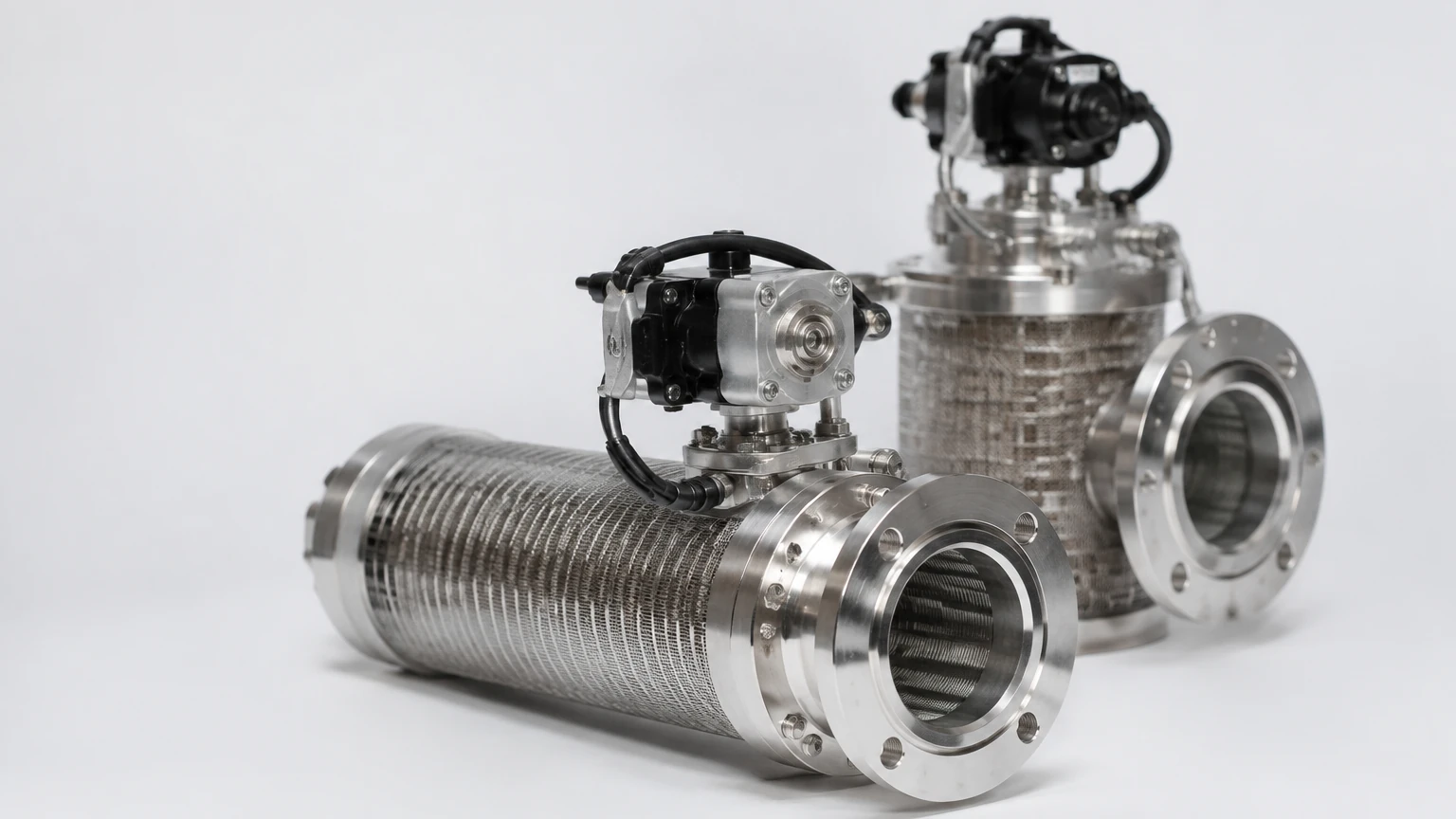
Customization and OEM Integration for Industrial Systems
Industrial applications rarely follow a one-size-fits-all model. Customization is often required to fit existing piping layouts or to meet specific industry regulations, such as FDA compliance for food and beverage or ASME standards for pressure vessels.
Kaifil specializes in providing customized stainless steel filtration components that serve as the heart of these systems. Whether a project requires a specific flange type, a non-standard housing material, or a custom-engineered filter element to handle unique particle loads, our manufacturing capabilities support complex OEM requirements. By focusing on precision engineering and high-quality material selection, we help ensure that the automatic backwash filter performs reliably under the most demanding conditions. For more information on our custom capabilities, please refer to our Main Page.
Pre-Purchase Checklist for Technical Teams
Before investing in an automatic backwash filter, purchasing teams and engineers should confirm the following technical details with their supplier:
1. Fluid Characteristics: What is the viscosity, temperature, and chemical composition of the fluid? (High viscosity may require a larger filter area or higher backwash pressure).
2. Contaminant Profile: What is the concentration of solids (ppm or mg/L)? What is the particle size distribution?
3. Pressure Requirements: What are the minimum and maximum operating pressures? Note that most backwash filters require a minimum line pressure (often 0.2 MPa) to drive the cleaning cycle effectively.
4. Control System Compatibility: Does the PLC support the existing plant communication protocols (e.g., Modbus, Profibus)?
5. Total Cost of Ownership (TCO): Beyond the initial purchase price, what are the costs for replacement seals, energy consumption, and potential fluid loss during backwashing?
6. Redundancy Needs: Does the application require a duplex arrangement where one filter remains in operation while the other is serviced, or is a single automatic unit sufficient?
Conclusion
The automatic backwash filter is a cornerstone of modern industrial efficiency, providing a robust solution for continuous filtration needs. By automating the cleaning process, facilities can significantly reduce manual labor, protect downstream equipment from damage, and maintain consistent production rates. However, the success of such a system depends on the careful selection of materials, accurate sizing, and an understanding of the specific challenges posed by the process fluid.
By prioritizing high-quality stainless steel components and precise engineering, operators can achieve a filtration system that offers both durability and high performance. For technical guidance and a wide range of filtration products, visit the Kaifil Main Page.
