


Hydraulic Oil Filtration
Hydraulic systems are the backbone of modern industrial machinery, providing the force necessary for heavy-duty operations in construction, manufacturing, and aerospace. However, the reliability of these systems is inextricably linked to the purity of the hydraulic fluid. Contamination is widely recognized by fluid power engineers as the primary cause of up to 80% of hydraulic system failures. Effective hydraulic oil filtration is not merely a maintenance task; it is a critical engineering requirement to prevent component wear, system downtime, and catastrophic mechanical failure.
For technical professionals and procurement teams, understanding the nuances of filtration media, system placement, and performance metrics is essential. This guide examines the technical foundations of hydraulic oil filtration and the engineering considerations necessary for selecting high-performance filtration components.
The Impact of Contamination on Hydraulic Systems
Hydraulic fluid serves multiple roles: it transmits power, lubricates moving parts, transfers heat, and seals clearances between components. When contaminants enter the fluid stream, they interfere with these functions, leading to several types of degradation.
Particulate Contamination
Particulates are the most common and damaging contaminants. These include metallic shavings from component wear, silica from the environment, and elastomeric bits from seal degradation. These particles act as abrasives, causing "silt-o-ring" effects where fine particles wedge into tight clearances, leading to surface erosion and valve sticking.
Water Contamination
Water enters systems through condensation or seal leaks. It reduces the fluid’s lubricity, leads to the oxidation of metal surfaces (rust), and can cause the depletion of chemical additives within the oil. In high-pressure systems, water can also lead to vapor cavitation, which physically erodes metal components.
Chemical Degradation
Over time, heat and pressure cause the hydraulic oil to oxidize. This process creates sludge and varnish—sticky substances that coat internal surfaces, restrict flow, and cause solenoids to seize. High-quality hydraulic oil filtration must account for the removal of these soft contaminants alongside hard particulates.
Technical Metrics for Filtration Performance
When evaluating filters for hydraulic oil filtration, engineers rely on standardized metrics to ensure the selected component meets the system's cleanliness requirements. The two most critical benchmarks are the Beta Ratio and the ISO Cleanliness Code.
The Beta Ratio (β)
The Beta Ratio is a measure of a filter's capture efficiency for a specific particle size. It is determined through multi-pass testing (ISO 16889). The ratio is calculated by dividing the number of particles of a certain size upstream of the filter by the number of particles of the same size downstream.
For example, a filter with a $\beta_{10} = 200$ means that for every 200 particles of 10 microns entering the filter, only one passes through. This equates to 99.5% efficiency. In critical hydraulic applications, high Beta ratios (typically $\beta_x \geq 1000$) are preferred for precision components like servo valves.
ISO 4406 Cleanliness Codes
The ISO 4406:2017 standard is the industry language for reporting fluid cleanliness. It uses a three-number code (e.g., 18/16/13) representing the quantity of particles larger than 4µm, 6µm, and 14µm per milliliter of fluid. Each decrease in a code number represents a halving of the contaminant level. Selecting the right hydraulic oil filtration solution requires matching the filter's performance to the target ISO code required by the most sensitive component in the system.
Strategic Placement of Filters in Hydraulic Circuits
A comprehensive filtration strategy involves placing filters at different points in the hydraulic circuit to address specific risks. No single filter can protect the entire system efficiently.
Suction Strainers and Filters
Located in the suction line before the pump, these are designed to protect the pump from large debris. However, they must be engineered with low pressure-drop characteristics to prevent pump cavitation. Stainless steel wire mesh is often the preferred material here due to its high flow capacity and durability.
Pressure Line Filters
Positioned downstream of the pump, pressure filters protect sensitive components like valves and actuators. These filters must withstand the full system pressure and are often rated for high-pressure fatigue. They are the primary defense against pump-generated wear debris reaching the rest of the system.
Return Line Filters
As the fluid returns to the reservoir, return line filters capture contaminants generated by the actuators and cylinders. This ensures that the fluid in the reservoir remains clean for the next cycle. These are often the most cost-effective filters in the system because they do not need to withstand high pressure.
Offline (Kidney Loop) Filtration
Offline filtration operates independently of the main hydraulic circuit. A dedicated pump circulates oil from the reservoir through a high-efficiency filter and back. This allows for continuous cleaning even when the main system is idle and is an excellent method for achieving very low ISO cleanliness codes without affecting system pressure or flow.
Material Engineering: The Case for Stainless Steel
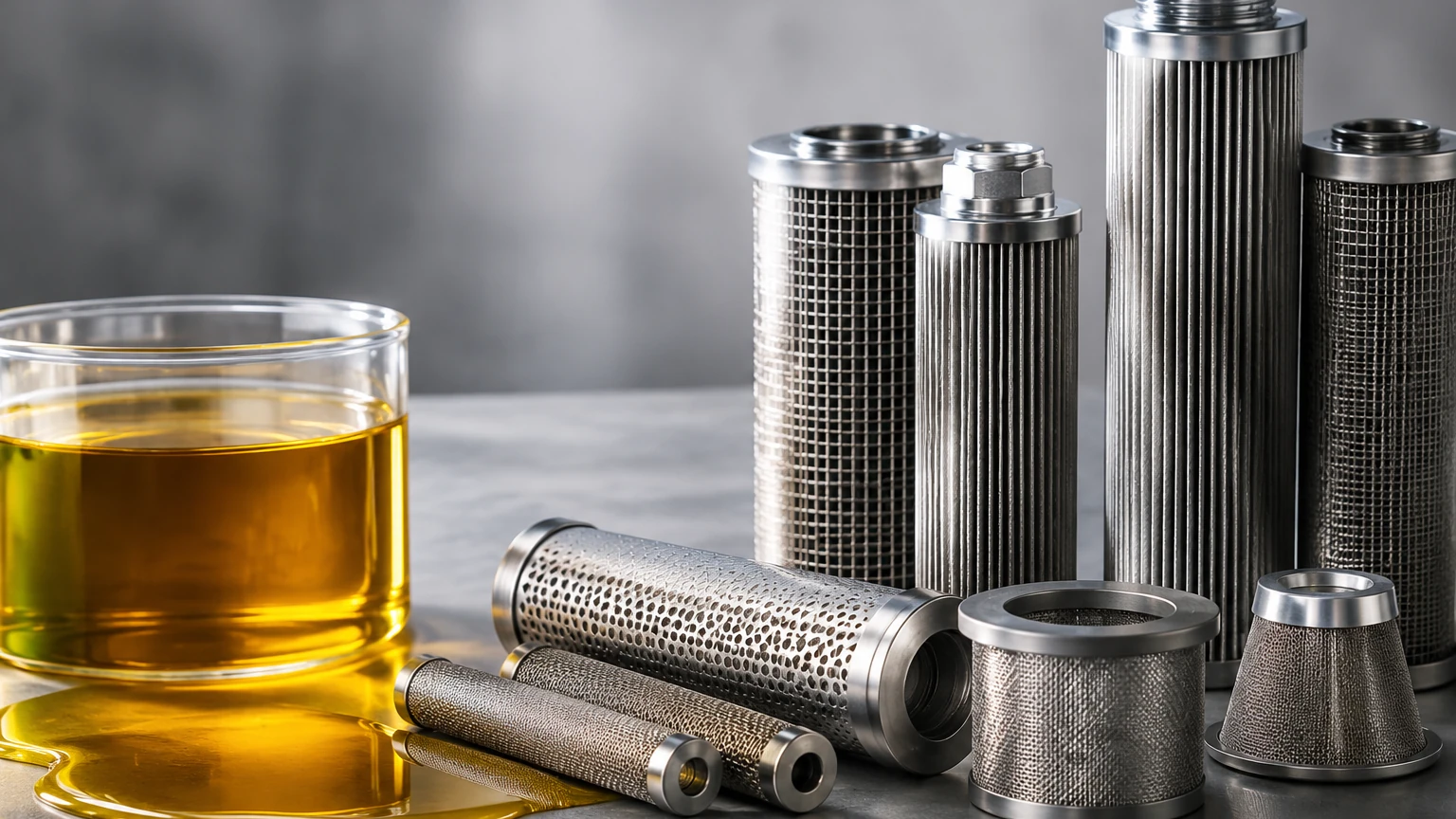
In demanding industrial environments, the choice of filter media is critical. While cellulose and glass fiber are common, stainless steel filtration components offer distinct advantages for specialized hydraulic oil filtration applications.
1. Chemical and Thermal Compatibility: Stainless steel (typically 304 or 316L) is inert to almost all hydraulic fluids, including synthetic esters and water-glycols that might degrade standard glues or media in disposable filters. They also maintain structural integrity at much higher temperatures.
2. Structural Integrity: Under high-pressure surges or cold-start conditions (where oil viscosity is high), stainless steel mesh filters resist pleat bunching and media migration, which can occur in less robust materials.
3. Cleanability and Reusability: Unlike disposable cartridges, stainless steel wire mesh filters can often be cleaned and returned to service. This is particularly valuable in systems where the cost of downtime and replacement parts is high.
4. Precision Pore Size: Advanced weaving techniques allow for precise control over pore size, ensuring consistent filtration performance across the entire surface of the filter element.
For more information on custom metal filtration components, visit the Main Page.
Engineering Selection: Flow Rate and Pressure Drop
A common mistake in hydraulic oil filtration selection is oversizing or undersizing based solely on micron rating. Engineers must balance filtration fineness with the "Clean Pressure Drop" ($\Delta P$).
As fluid passes through the filter media, it encounters resistance. This resistance increases as the filter captures contaminants. If the initial pressure drop is too high, the system may trigger the bypass valve prematurely, allowing unfiltered oil to circulate. Factors affecting $\Delta P$ include:
* Fluid Viscosity: Higher viscosity (common in cold starts or specific oil grades) increases pressure drop.
* Flow Velocity: Higher flow rates through a fixed surface area increase resistance.
* Media Surface Area: Increasing the pleat count or the size of the cartridge reduces the flux rate (flow per unit area), thereby reducing pressure drop and extending service life.
When specifying a filter, it is vital to calculate the maximum expected flow (including cylinder intensification) and the maximum viscosity at the lowest operating temperature to ensure the filter housing and element can handle the load without bypassing.
Customization and OEM Requirements
Standard catalog filters do not always meet the spatial or performance requirements of specialized industrial machinery. Custom hydraulic oil filtration solutions allow engineers to optimize the filter for specific parameters:
* Custom Dimensions: Fitting high-performance filtration into tight envelopes in mobile equipment or compact power units.
* Bypass Valve Settings: Customizing the cracking pressure of the bypass valve to match the sensitivity of the system's pump.
* End Cap and Seal Configurations: Utilizing specific materials like Viton or EPDM to ensure leak-free performance with specialized hydraulic fluids.
* Reinforced Cores: For systems prone to high-pressure spikes, reinforced inner cores prevent the collapse of the filter element.
Working with a manufacturer that understands these engineering constraints allows for the development of filtration components that enhance the total lifecycle of the machinery.
Maintenance and Total Cost of Ownership (TCO)
The true cost of hydraulic oil filtration is not the purchase price of the filter element, but the total cost of maintaining system cleanliness over time. A low-cost, low-efficiency filter may save money initially but will result in more frequent component replacements and oil changes.
Indicator Monitoring
Modern hydraulic filters should be equipped with differential pressure indicators (visual or electrical). These devices alert maintenance teams when the element is reaching its dirt-holding capacity, allowing for scheduled replacement before the bypass valve opens.
Oil Analysis
Regular oil analysis is the only way to verify that the filtration system is performing as intended. By tracking the ISO Cleanliness Code and the additive levels, engineers can adjust filtration intervals and identify potential component failures before they occur.
The Value of Durability
In high-stakes industries like chemical processing or pharmaceutical manufacturing, the durability of the filter housing and the reliability of the element are paramount. Investing in high-quality stainless steel filtration solutions reduces the risk of media migration and ensures that the filter itself does not become a source of contamination.
Conclusion
Hydraulic oil filtration is a sophisticated discipline that requires a balance of fluid dynamics, material science, and mechanical engineering. By focusing on the Beta ratio, strategic placement, and robust material selection, organizations can significantly extend the life of their hydraulic assets. Whether implementing a standard return line filter or a custom-engineered pressure filter, the goal remains the same: maintaining the fluid purity necessary for peak system performance.
For engineers and purchasing professionals seeking reliable, high-precision filtration components, understanding these technical boundaries is the first step toward optimized system design and reduced operational costs.
